Rajasthan School Entry Restriction Order and Governance Transparency
Source:the-print ↗
Why It Matters
This issue highlights the tension between institutional transparency (public right to know about school conditions) and the right to privacy (child safety). It also sheds light on the internal functioning and procedural norms of the state executive and Cabinet in authorizing departmental policy decisions.
Summary
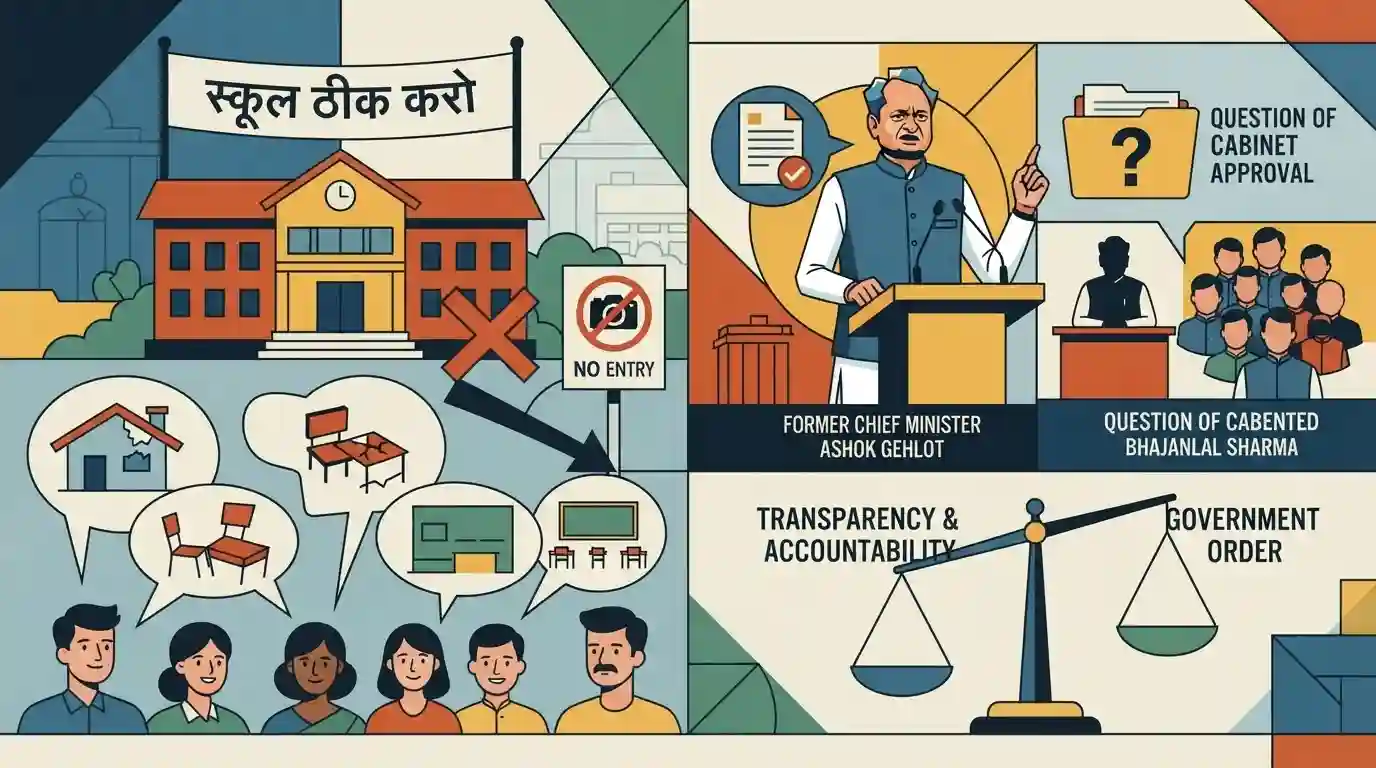
Former Rajasthan Chief Minister Ashok Gehlot has demanded the immediate withdrawal of a state government order that restricts unauthorized entry, photography, and videography inside government schools. The controversial directive from the Rajasthan Education Department comes closely on the heels of the 'School Thik Karo' campaign, which aims to expose poor conditions in state-run educational institutions. While the education department claims the measure is necessary to safeguard children's privacy and safety, critics, including Gehlot, view it as an attempt to evade accountability and transparency. Furthermore, Gehlot raised administrative concerns by questioning whether the order had received formal approval from the state Cabinet and Chief Minister Bhajanlal Sharma.
Key Points
- Former Rajasthan Chief Minister Ashok Gehlot urged the withdrawal of a recent state government order banning unauthorized entry, photography, and videography in government schools.
- Gehlot questioned if the decision underwent proper procedural scrutiny, specifically asking whether it was deliberated upon and approved by Chief Minister Bhajanlal Sharma and the state Cabinet.
- The restriction was introduced following the launch of the 'School Thik Karo' campaign, which was designed to highlight and audit poor infrastructure in government schools.
- The state education department defended the directive, citing the necessity to protect the safety, dignity, and privacy of school children from unwarranted public intrusion.
Important Terms
School Thik Karo campaign

A public accountability initiative where volunteers audit government-run schools to document poor conditions and lack of basic infrastructure.
UPSC context
Relevant for Current Affairs and Education Policy. Tests awareness of civic interventions and grassroots demands for transparency in public schooling.
Rajasthan Education Department
The state authority managing public schooling. It recently issued orders banning unauthorized entry, photography, and videography in government schools, citing child safety and privacy.
UPSC context
Important for State Administration. Tests knowledge of state directives, child rights vs. public transparency, and institutional accountability.
State Cabinet
The supreme executive body of the state government led by the Chief Minister, responsible for collectively discussing and approving major administrative policy decisions.
UPSC context
Vital for State Executive (Polity). Evaluates understanding of collective responsibility, administrative protocols, and the executive decision-making hierarchy in Rajasthan.
Prelims Trap
Every departmental directive in a state requires mandatory prior approval of the State Cabinet.
Under Article 166 (Rules of Business), routine administrative orders are issued by the respective ministry/department without needing full Cabinet approval, unless specifically mandated.
Static Concepts Connected
How is executive business formally conducted in a State Government?
- Article 166: Under Article 166, all executive actions of the state government are expressed to be taken in the name of the Governor.
- Rules of Business: The Governor makes rules for the convenient transaction of the business of the state government and for its allocation among Ministers.
- Decision Making: Routine administrative orders are handled at the departmental/ministerial level, while significant policy shifts require formal Cabinet deliberation.
How do Article 19(1)(a) and Article 21 intersect regarding public transparency?
- Right to Know: Implicit in Art 19(1)(a), enabling citizens to scrutinize public institutions and demand administrative accountability.
- Right to Privacy: Protected under Art 21, it safeguards individuals, especially minors in state care, from unwarranted public exposure and unauthorized photography.
- RTI Exemption: Section 8(1)(j) of the RTI Act balances this by exempting personal information disclosure unless justified by larger public interest.
Cross-Topic Patterns
RTE Act and School Management Committees
The RTE Act mandates School Management Committees (SMCs) for community oversight, empowering parents and citizens to legitimately audit school infrastructure without violating institutional privacy rules.
Puttaswamy Judgment vs RTI Framework
The friction over filming minors in schools highlights the constitutional tension between institutional transparency under the RTI framework and the fundamental Right to Privacy (Puttaswamy).

Expect a polity question testing the clash between Right to Information (Art 19) and Right to Privacy (Art 21) in public spaces.
Linked PYQs · 3
Linked PYQs · 3
- 2023RPSC_PRELIMSGS1
What is the minimum number of members in the Council of Ministers of Rajasthan?
- 2021RPSC_PRELIMSGS1
According to the rules of procedure and conduct of business of the Rajasthan Legislative Assembly, which of the following departments' appropriations is not under the control of the Appropriation Committee 'A'?
- 2024RPSC_PRELIMSGS1
The size of citizen's character is not –
