National Statistical Office First Advance GDP Estimates and Trends
Source:The Hindu ↗
Why It Matters
Understanding GDP estimation methodologies, such as the First Advance Estimates by MoSPI, is critical for the UPSC syllabus. Aspirants must be able to analyze macroeconomic trends, the divergence between real and nominal GDP, and the sectoral composition of growth (e.g., the performance of manufacturing versus agriculture) to evaluate India's economic health and policy requirements.
Summary
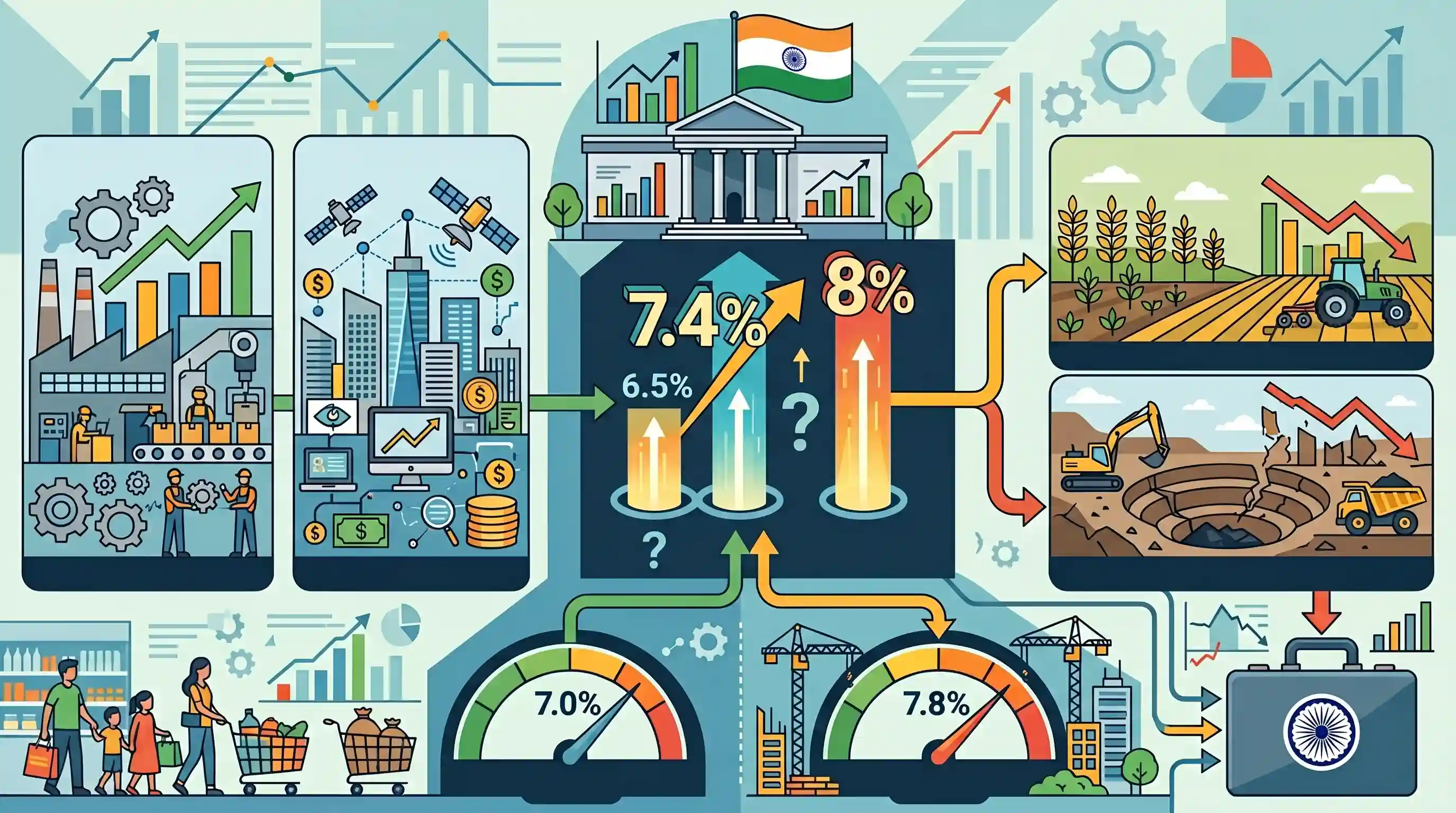
The Ministry of Statistics and Programme Implementation (MoSPI) has released the First Advance Estimates for India's GDP for the financial year 2025-26, predicting a robust real GDP growth of 7.4%. This marks a notable acceleration from the 6.5% growth seen in the previous year and slightly exceeds the Reserve Bank of India's projection of 7.3%. Nominal GDP is projected to grow at 8%. The positive outlook is primarily driven by an acceleration in the manufacturing sector and robust performance in the services sector, despite an anticipated slowdown in agriculture and a contraction in mining. Crucial macroeconomic indicators such as Private Final Consumption Expenditure (PFCE) and Gross Fixed Capital Formation (GFCF) also show healthy growth at 7% and 7.8%, respectively. These advance estimates serve as essential inputs for the upcoming Union Budget calculations.
Key Points
- The Ministry of Statistics and Programme Implementation has released the First Advance Estimates of National Income for the financial year 2025-26.
- Real GDP growth for 2025-26 is estimated at 7.4%, a significant rise from the 6.5% recorded in the previous year.
- Nominal GDP growth for 2025-26 is predicted to be 8%.
- Sectoral trends show an acceleration in manufacturing (7%) and the tertiary sector (9.1%), while agriculture is expected to slow down (3.1%).
- Private Final Consumption Expenditure (PFCE) is projected to grow by 7%, and Gross Fixed Capital Formation (GFCF) by 7.8%.
- The strong first-half growth implies an expected slowdown in the second half of the year to 6.8%.
Important Terms
First Advance Estimates (FAE)

The initial official projections for a financial year's GDP growth, typically released by the NSO in early January to provide a base for Union Budget calculations.
UPSC context
GS Paper III: Indian Economy; tests understanding of national income accounting and the budgetary process.
Ministry of Statistics and Programme Implementation (MoSPI)
The nodal ministry for the planned development of the statistical system in India; its National Statistical Office (NSO) is responsible for calculating GDP and other macroeconomic data.
UPSC context
GS Paper III: Economic Development; identifies key institutions responsible for data-driven policymaking.
Real GDP
The total value of all goods and services produced in an economy within a year, adjusted for inflation using constant base-year prices to reflect volume changes.
UPSC context
GS Paper III: Growth and Development; essential for distinguishing between purely monetary growth and actual productive expansion.
Nominal GDP
The value of all finished goods and services produced within a country's borders at current market prices, without adjusting for the effects of inflation.
UPSC context
GS Paper III: Indian Economy; relevant for budget deficit targets and debt-to-GDP ratio calculations.
Gross Fixed Capital Formation (GFCF)
A measure of the net increase in fixed capital assets, such as buildings and machinery, representing the overall investment made in the economy's productive capacity.
UPSC context
GS Paper III: Investment Models; tests knowledge of capital formation as a driver of long-term economic growth.
Private Final Consumption Expenditure (PFCE)
The total spending by resident households and non-profit institutions on goods and services, acting as a primary indicator of consumer demand and purchasing power.
UPSC context
GS Paper III: Indian Economy; crucial for analyzing demand-side constraints or drivers of the economy.
Reserve Bank of India (RBI)
India's central bank and regulatory body responsible for formulating monetary policy, managing foreign exchange, and ensuring financial stability to support economic growth.
UPSC context
GS Paper III: Monetary Policy; central to topics on inflation control, banking regulation, and growth projections.
Prelims Trap
"First Advance Estimates of GDP are prepared and released by the Ministry of Finance for the Budget."
FAE is released by the National Statistical Office (NSO) under MoSPI. The Finance Ministry merely uses these estimates as a baseline input to frame the Union Budget.
Static Concepts Connected
What are the key demand-side components of India's GDP?
- Private Final Consumption Expenditure (PFCE): Tracks spending by resident households and Non-Profit Institutions Serving Households. It is the largest component of India's GDP.
- Gross Fixed Capital Formation (GFCF): Measures the net increase in fixed assets (infrastructure, machinery). It serves as the primary proxy for overall investment in the economy.
- Government Final Consumption Expenditure (GFCE): Captures the total expenditure incurred by the government on final goods and services.
- Net Exports: The total value of a country's exports minus its imports.
How are the First Advance Estimates (FAE) calculated?
- Benchmark-Indicator Method: Extrapolates previous year's estimates using high-frequency indicators for the first 7-8 months of the current financial year.
- Key Indicators Used: Includes the Index of Industrial Production (IIP), corporate financial results, crop production targets, GST collections, and bank deposits.
Cross-Topic Patterns
FAE's role in Fiscal Deficit math
The Nominal GDP growth estimate (here 8%) provides the exact baseline denominator the Finance Ministry uses to project fiscal deficit and tax buoyancy percentages for the upcoming Union Budget.
Manufacturing growth vs Agricultural slowdown
The projected acceleration in manufacturing (7%) amidst an agricultural slowdown tests India's structural economic transformation and the capacity to absorb surplus farm labor, a recurring UPSC Mains theme.

Expect a 2026 Prelims multi-statement question contrasting Real vs Nominal GDP drivers, specifically targeting PFCE and GFCF components.
Linked PYQs · 4
Linked PYQs · 4
- 2023MainsGS3
Faster economic growth requires increased share of the manufacturing sector in GDP, particularly of MSMEs. Comment on the present policies of the Government in this regard.
- 2015PrelimsGS1
With reference to Indian economy, consider the following statements : 1. The rate of growth of Real Gross Domestic Product has steadily increased in the last decade. 2. The Gross Domestic Product at market prices (in rupees) has steadily increased in the last decade. Which of the statements given above is/are correct?
- 2018PrelimsGS1
Increase in absolute and per capita real GNP do not connote a higher level of economic development, if
- 2022MainsGS3
Economic growth in the recent past has been led by increase in labour productivity." Explain this statement. Suggest the growth pattern that will lead to creation of more jobs without compromising labour productivity.
