राष्ट्रीय आय के पहले अग्रिम अनुमान और GDP अनुमान
स्रोत:द हिंदू ↗
क्यों मायने रखता है
GDP के प्रथम अग्रिम अनुमान (First Advance Estimates) भारत के राजकोषीय नियोजन के लिए बुनियादी आधार हैं। वे नॉमिनल GDP का आंकड़ा प्रदान करते हैं जिसके आधार पर केंद्रीय बजट में राजकोषीय घाटे के लक्ष्य निर्धारित किए जाते हैं, जो इन्हें सरकार के आर्थिक अनुमानों और नीतिगत दिशा को समझने के लिए महत्वपूर्ण बनाता है।
सारांश
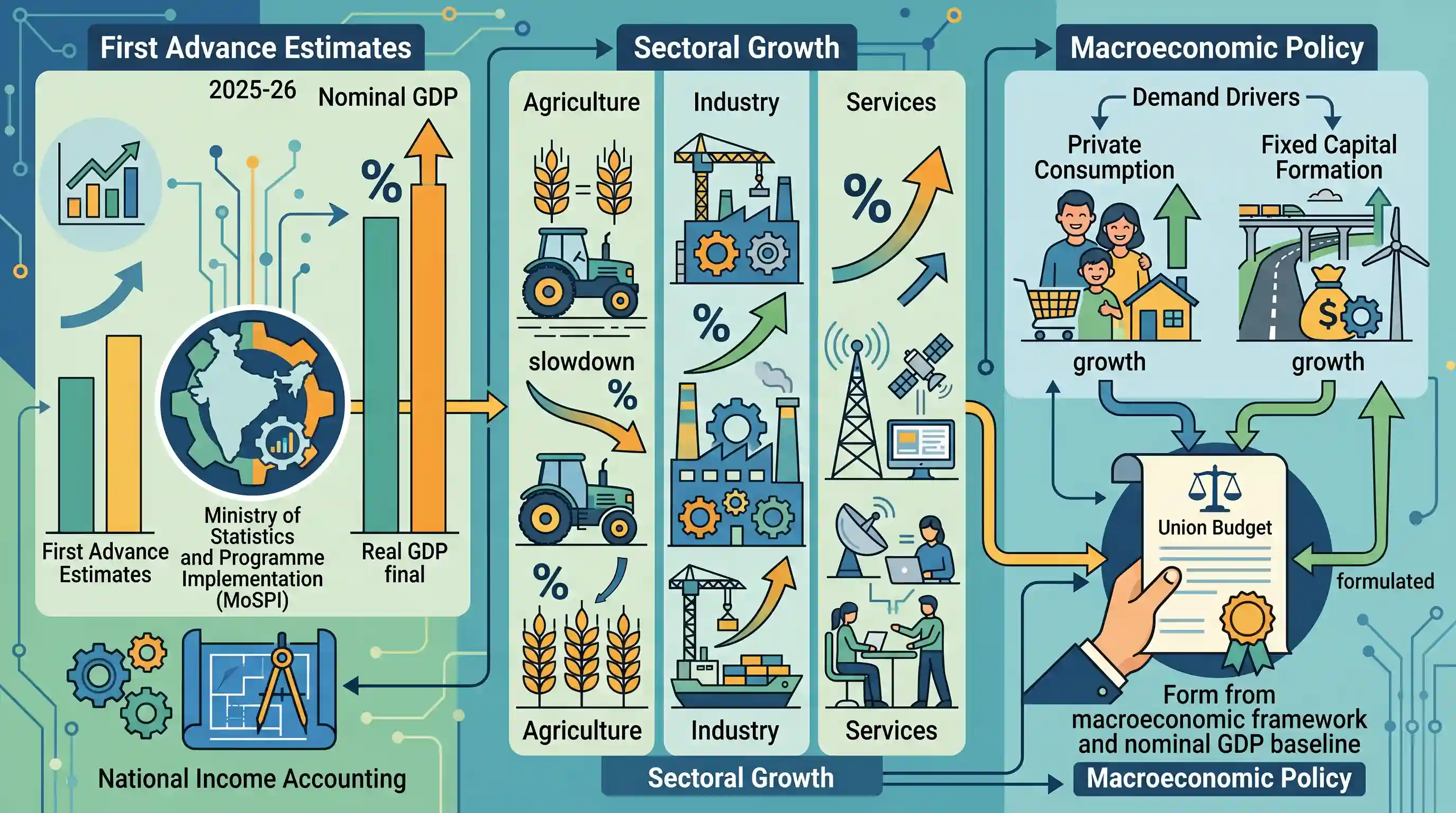
The Ministry of Statistics and Programme Implementation has released the First Advance Estimates of National Income for 2025-26, projecting a real GDP growth of 7.4% and a nominal GDP growth of 8%. The data indicates a mixed sectoral performance, with expected accelerations in manufacturing and services alongside a slowdown in agriculture. Strong growth is anticipated in both private consumption and fixed capital formation. These estimates provide the essential macroeconomic framework and nominal GDP baseline for formulating the upcoming Union Budget.
मुख्य बिंदु
- The government projects real GDP to grow at 7.4% in 2025-26, up from an estimated 6.8% in 2024-25, according to the First Advance Estimates.
- 2025-26 के लिए नॉमिनल GDP वृद्धि दर के घटकर 8% रहने का अनुमान है, जबकि चालू वित्त वर्ष के लिए यह अनुमान 9.5% है।
- क्षेत्रीय विकास अनुमान दर्शाते हैं कि विनिर्माण और सेवा क्षेत्र में तेजी (क्रमशः 7% और 9.1% तक) आएगी, जबकि कृषि के 4.3% से घटकर 3.1% तक धीमे होने की उम्मीद है।
- Key demand-side drivers, Private Final Consumption Expenditure (PFCE) and Gross Fixed Capital Formation (GFCF), are projected to grow by 7% and 7.8% respectively.
- MoSPI के ये अनुमान वित्त मंत्रालय के लिए अत्यंत महत्वपूर्ण हैं क्योंकि ये आगामी केंद्रीय बजट में उपयोग की जाने वाली नॉमिनल GDP गणनाओं के लिए आधार (baseline) तैयार करते हैं।
महत्वपूर्ण शब्द
प्रथम अग्रिम अनुमान (FAE)

Preliminary GDP projections for the current financial year, released in early January by MoSPI. They use the benchmark-indicator method to extrapolate early-year data.
UPSC context
GS Paper III (Indian Economy). Crucial for estimating nominal GDP used in Union Budget formulations.
सांख्यिकी और कार्यक्रम कार्यान्वयन मंत्रालय (MoSPI)
भारत में आधिकारिक सांख्यिकी के लिए नोडल एजेंसी, जो GDP, उपभोक्ता मूल्य सूचकांक (CPI) के संकलन और बुनियादी ढांचा परियोजनाओं की निगरानी के लिए जिम्मेदार है।
UPSC context
GS Paper III (Economy). Key institution for data-driven policymaking and national account auditing.
वास्तविक जीडीपी
The total value of goods and services produced within a country, adjusted for inflation using constant prices from a base year (currently 2011-12).
UPSC context
GS पेपर III (संवृद्धि और विकास)। मूल्य विकृतियों के बिना आर्थिक उत्पादन में वास्तविक भौतिक वृद्धि को मापता है।
Nominal GDP
मुद्रास्फीति समायोजन के बिना चालू बाजार कीमतों पर गणना की गई GDP; यह राजकोषीय घाटे के लक्ष्यों और tax buoyancy की गणना के लिए आधार के रूप में कार्य करती है।
UPSC context
GS पेपर III (बजटिंग)। राजकोषीय नीति नियोजन और ऋण-से-GDP अनुपात की तुलना करने के लिए आवश्यक।
Gross Fixed Capital Formation (GFCF)
A measure of net investment in fixed assets like machinery, buildings, and infrastructure, indicating an economy's expansion of productive capacity.
UPSC context
GS पेपर III (निवेश मॉडल)। निजी और सार्वजनिक क्षेत्र के 'पूंजीगत व्यय' (Capex) का एक प्रमुख संकेतक।
Gross Value Added (GVA)
The total value of goods and services produced in an economy, minus the cost of intermediate consumption; it provides a sector-wise breakdown of growth.
UPSC context
GS पेपर III (राष्ट्रीय आय)। कृषि और विनिर्माण जैसे विशिष्ट क्षेत्रों में उत्पादकता को ट्रैक करने के लिए उपयोग किया जाता है।
राष्ट्रीय आय लेखांकन
किसी देश की आर्थिक गतिविधि को मापने के लिए उपयोग किया जाने वाला ढांचा, जिसमें SNA 2008 जैसे अंतरराष्ट्रीय मानकों का पालन करते हुए उत्पादन, आय और व्यय शामिल हैं।
UPSC context
GS Paper III (Basic Economics). Fundamental for understanding macroeconomic aggregates like GDP, GNI, and NNP.
प्रारंभिक ट्रैप
First Advance Estimates of National Income are compiled and released by the Ministry of Finance.
इन्हें MoSPI के तहत NSO द्वारा प्रकाशित किया जाता है, वित्त मंत्रालय द्वारा नहीं। वित्त मंत्रालय केवल आगामी केंद्रीय बजट के लिए राजकोषीय घाटा अनुपात की गणना करने हेतु इन आधारभूत अनुमानों का उपयोग करता है।
संबंधित अवधारणाएँ
वास्तविक जीडीपी (Real GDP), नॉमिनल जीडीपी (Nominal GDP) और जीडीपी डिफ्लेटर (GDP Deflator) के बीच क्या अंतर है?
- वास्तविक जीडीपी: Measures the total value of economic output at constant base-year prices (2011-12), filtering out the effect of inflation to show actual volume growth.
- सांकेतिक जीडीपी: Calculates the value of output at current market prices. This figure is crucial for budget math like tax buoyancy and fiscal deficit ratios.
- GDP डिफ्लेटर: नॉमिनल (Nominal) से रियल (Real) GDP का अनुपात। यह मुद्रास्फीति के सबसे व्यापक पैमाने के रूप में कार्य करता है क्योंकि इसमें घरेलू स्तर पर उत्पादित सभी वस्तुओं और सेवाओं को शामिल किया जाता है।
व्यय विधि (Expenditure Method) के माध्यम से गणना किए गए GDP के प्राथमिक घटक क्या हैं?
- PFCE (उपभोग): Private Final Consumption Expenditure represents household spending and is the primary demand driver, constituting nearly 60% of India's GDP.
- GFCF (Investment): सकल स्थायी पूंजी निर्माण (Gross Fixed Capital Formation) भौतिक परिसंपत्तियों और अवसंरचना में नए निवेश का संकेतक है, जो भविष्य की उत्पादक क्षमता के विस्तार के लिए आवश्यक है।
- GFCE एवं शुद्ध निर्यात: Government Final Consumption Expenditure (GFCE) plus the Net Exports (total exports minus total imports) make up the remainder of the expenditure formula.
अंतर-विषय पैटर्न
Growth vs. Inflation Deflator dynamics
A narrow gap between Nominal (8%) and Real GDP (7.4%) implies a critically low GDP deflator. This connects growth metrics directly to WPI/CPI divergence and RBI's monetary policy challenges.
प्राथमिक क्षेत्र में जलवायु संबंधी सुभेद्यताएँ
Agriculture's projected slowdown to 3.1% directly links macroeconomic growth estimates to geography and environment syllabus areas, specifically changing monsoon patterns, spatial distribution of rainfall, and extreme weather impacts.

Expect a multi-statement Prelims question linking NSO's Advance Estimates methodology with GFCF as a proxy for capital investment.
संबद्ध PYQ · 3
संबद्ध PYQ · 3
- 2018PrelimsGS1
Despite being a high saving economy, capital formation may not result in significant increase in output due to
- 2021MainsGS3
Explain the difference between computing methodology of India's Gross Domestic Product (GDP) before the year 2015 and after the year 2015.
- 2023MainsGS3
Faster economic growth requires increased share of the manufacturing sector in GDP, particularly of MSMEs. Comment on the present policies of the Government in this regard.
