First Advance Estimates of national income and GDP projections
Source:The Hindu ↗
Why It Matters
The First Advance Estimates of GDP are foundational to India's fiscal planning. They provide the nominal GDP figure against which fiscal deficit targets are set in the Union Budget, making them crucial for understanding the government's economic projections and policy direction.
Summary
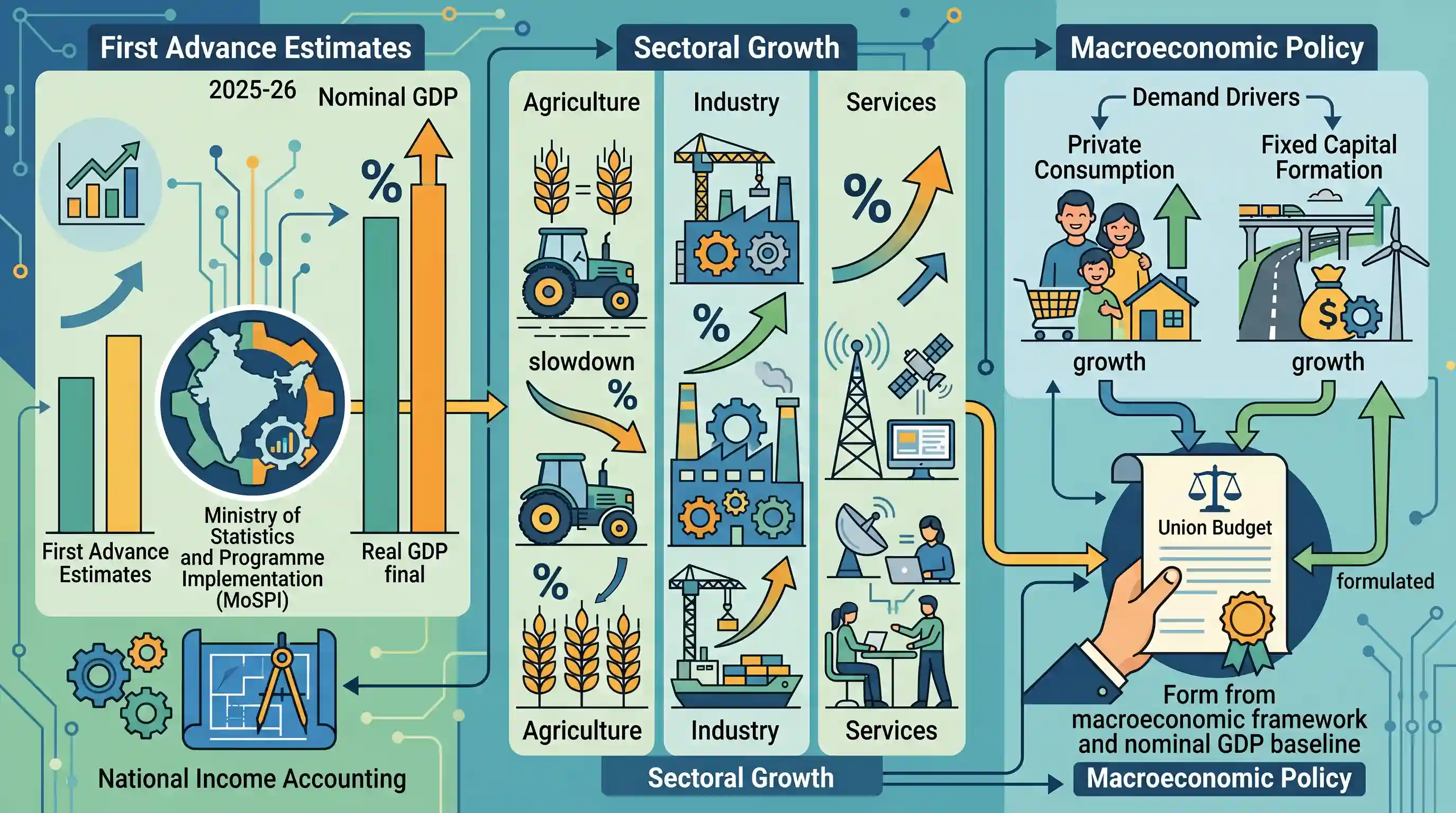
The Ministry of Statistics and Programme Implementation has released the First Advance Estimates of National Income for 2025-26, projecting a real GDP growth of 7.4% and a nominal GDP growth of 8%. The data indicates a mixed sectoral performance, with expected accelerations in manufacturing and services alongside a slowdown in agriculture. Strong growth is anticipated in both private consumption and fixed capital formation. These estimates provide the essential macroeconomic framework and nominal GDP baseline for formulating the upcoming Union Budget.
Key Points
- The government projects real GDP to grow at 7.4% in 2025-26, up from an estimated 6.8% in 2024-25, according to the First Advance Estimates.
- Nominal GDP growth for 2025-26 is projected to slow to 8%, compared to the 9.5% estimate for the current fiscal year.
- Sectoral growth projections show manufacturing and services accelerating (to 7% and 9.1% respectively), while agriculture is expected to slow from 4.3% to 3.1%.
- Key demand-side drivers, Private Final Consumption Expenditure (PFCE) and Gross Fixed Capital Formation (GFCF), are projected to grow by 7% and 7.8% respectively.
- These estimates by MoSPI are critical for the Finance Ministry as they form the baseline for nominal GDP calculations used in the upcoming Union Budget.
Important Terms
First Advance Estimates (FAE)

Preliminary GDP projections for the current financial year, released in early January by MoSPI. They use the benchmark-indicator method to extrapolate early-year data.
UPSC context
GS Paper III (Indian Economy). Crucial for estimating nominal GDP used in Union Budget formulations.
Ministry of Statistics and Programme Implementation (MoSPI)
The nodal agency for official statistics in India, responsible for compiling GDP, Consumer Price Index (CPI), and monitoring infrastructure projects.
UPSC context
GS Paper III (Economy). Key institution for data-driven policymaking and national account auditing.
Real GDP
The total value of goods and services produced within a country, adjusted for inflation using constant prices from a base year (currently 2011-12).
UPSC context
GS Paper III (Growth & Development). Measures actual physical growth in economic output without price distortions.
Nominal GDP
GDP calculated at current market prices without inflation adjustments; it serves as the base for calculating fiscal deficit targets and tax buoyancy.
UPSC context
GS Paper III (Budgeting). Essential for fiscal policy planning and comparing debt-to-GDP ratios.
Gross Fixed Capital Formation (GFCF)
A measure of net investment in fixed assets like machinery, buildings, and infrastructure, indicating an economy's expansion of productive capacity.
UPSC context
GS Paper III (Investment Models). A key indicator of private and public sector 'capital expenditure' (Capex).
Gross Value Added (GVA)
The total value of goods and services produced in an economy, minus the cost of intermediate consumption; it provides a sector-wise breakdown of growth.
UPSC context
GS Paper III (National Income). Used to track productivity in specific sectors like agriculture and manufacturing.
National Income Accounting
The framework used to measure a country's economic activity, including production, income, and expenditure, following international standards like SNA 2008.
UPSC context
GS Paper III (Basic Economics). Fundamental for understanding macroeconomic aggregates like GDP, GNI, and NNP.
Prelims Trap
First Advance Estimates of National Income are compiled and released by the Ministry of Finance.
They are published by the NSO under MoSPI, not the Finance Ministry. The Finance Ministry merely uses these baseline estimates to calculate fiscal deficit ratios for the upcoming Union Budget.
Static Concepts Connected
What is the difference between Real GDP, Nominal GDP, and the GDP Deflator?
- Real GDP: Measures the total value of economic output at constant base-year prices (2011-12), filtering out the effect of inflation to show actual volume growth.
- Nominal GDP: Calculates the value of output at current market prices. This figure is crucial for budget math like tax buoyancy and fiscal deficit ratios.
- GDP Deflator: The ratio of Nominal to Real GDP. It acts as the most comprehensive gauge of inflation since it covers all goods and services produced domestically.
What are the primary components of GDP calculated via the Expenditure Method?
- PFCE (Consumption): Private Final Consumption Expenditure represents household spending and is the primary demand driver, constituting nearly 60% of India's GDP.
- GFCF (Investment): Gross Fixed Capital Formation is the proxy for new investments in physical assets and infrastructure, essential for expanding future productive capacity.
- GFCE & Net Exports: Government Final Consumption Expenditure (GFCE) plus the Net Exports (total exports minus total imports) make up the remainder of the expenditure formula.
Cross-Topic Patterns
Growth vs. Inflation Deflator dynamics
A narrow gap between Nominal (8%) and Real GDP (7.4%) implies a critically low GDP deflator. This connects growth metrics directly to WPI/CPI divergence and RBI's monetary policy challenges.
Climate vulnerabilities in the primary sector
Agriculture's projected slowdown to 3.1% directly links macroeconomic growth estimates to geography and environment syllabus areas, specifically changing monsoon patterns, spatial distribution of rainfall, and extreme weather impacts.

Expect a multi-statement Prelims question linking NSO's Advance Estimates methodology with GFCF as a proxy for capital investment.
Linked PYQs · 3
Linked PYQs · 3
- 2018PrelimsGS1
Despite being a high saving economy, capital formation may not result in significant increase in output due to
- 2021MainsGS3
Explain the difference between computing methodology of India's Gross Domestic Product (GDP) before the year 2015 and after the year 2015.
- 2023MainsGS3
Faster economic growth requires increased share of the manufacturing sector in GDP, particularly of MSMEs. Comment on the present policies of the Government in this regard.
