Drivers of Sustained Economic Growth and Private Investment Needs
Source:Indian Express ↗
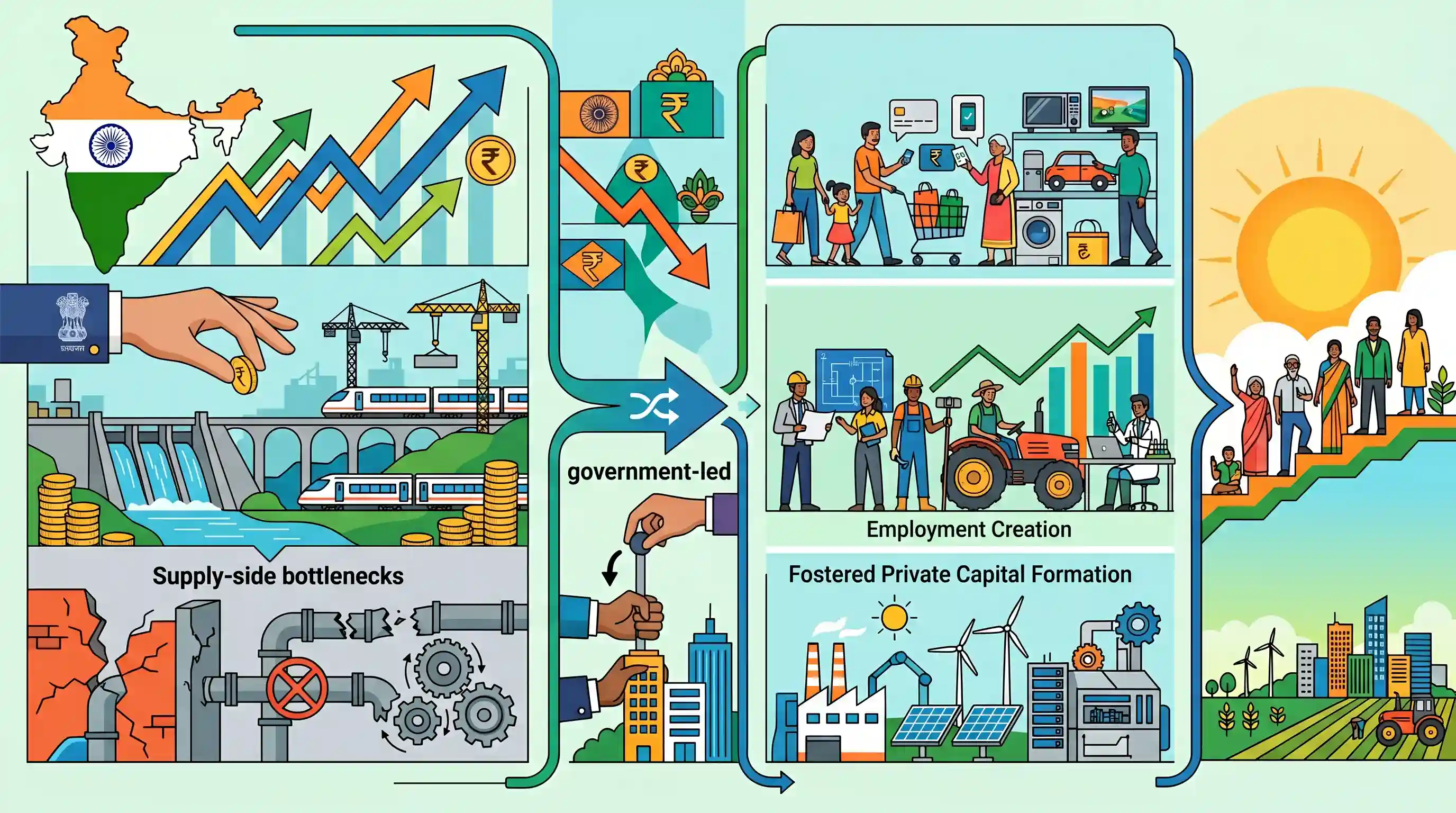
Why It Matters
Understanding the mechanics of GDP growth—specifically the shift from government capex to private investment and consumption—is crucial for analyzing India's macroeconomic trajectory, making it highly relevant for Mains GS3 answers on economic development and Prelims questions on national income accounting.
Summary
The article analyzes the recent fluctuations in India's GDP growth numbers and explores the underlying drivers of sustained economic expansion. It emphasizes the critical need for a structural transition from government-led capital expenditure to broad-based private investment. To sustain high GDP growth rates in the long run, the article underscores the importance of reviving private final consumption expenditure, creating adequate employment opportunities, and fostering an environment conducive to private capital formation. Overcoming supply-side bottlenecks and improving capital productivity are highlighted as essential steps to achieve durable and inclusive economic growth.
Key Points
- Analyzes the recent fluctuations in India's quarterly GDP estimates and the volatility of macroeconomic indicators.
- Argues that long-term sustainable economic growth cannot be driven solely by government capital expenditure.
- Emphasizes the critical need for crowding-in private sector investment (Gross Fixed Capital Formation) to build economic resilience.
- Highlights that robust Private Final Consumption Expenditure (PFCE) is essential for sustainable growth, requiring steady wage growth and broad-based job creation.
- Suggests that addressing supply-side bottlenecks and structural reforms are necessary to lower the capital-output ratio and boost overall productivity.
Important Terms
National Statistical Office (NSO)

India's nodal statistical agency under MoSPI, formed by merging the CSO and NSSO. it is responsible for compiling GDP, CPI, and conducting large-scale socio-economic surveys.
UPSC context
GS Paper 3 (Economy); crucial for understanding institutional frameworks for national income accounting and official data collection.
Reserve Bank of India (RBI)
India's central bank, established in 1935, responsible for regulating the monetary system, issuing currency, and maintaining financial stability through tools like the Repo rate.
UPSC context
GS Paper 3 (Economy); tested under monetary policy, banking sector reforms, and inflation management.
Private Final Consumption Expenditure (PFCE)
The total expenditure incurred by resident households and non-profit institutions on final consumption of goods and services. It is the largest component of India's GDP.
UPSC context
GS Paper 3 (Growth); key for analyzing demand-side drivers and the impact of household spending on economic cycles.
Capital Expenditure (Capex)
Government spending directed toward the creation or acquisition of long-term physical and productive assets like infrastructure, schools, and hospitals. It yields a high multiplier effect.
UPSC context
GS Paper 3 (Investment Models/Budgeting); essential for discussing fiscal policy effectiveness and long-term economic capacity building.
Gross Fixed Capital Formation (GFCF)
A measure of the net investment in fixed assets (machinery, buildings, infrastructure) within an economy, indicating the growth of its productive capital stock.
UPSC context
GS Paper 3 (Resource Mobilization); tests ability to analyze investment trends and private sector participation in economy.
Incremental Capital Output Ratio (ICOR)
An economic metric measuring the additional capital required to produce one unit of additional output. A lower ratio indicates higher capital efficiency and productivity.
UPSC context
GS Paper 3 (Planning/Growth); fundamental for evaluating investment efficiency and the success of various Five-Year Plans.
Supply-side bottlenecks
Structural constraints such as infrastructure gaps, logistical delays, or labor shortages that restrict production, often leading to 'bottleneck inflation' despite healthy demand.
UPSC context
GS Paper 3 (Inclusive Growth/Inflation); relevant for suggesting reforms to improve ease of doing business and productivity.
Prelims Trap
"High domestic savings and capital formation automatically guarantee a high rate of economic growth."
If an economy suffers from supply-side bottlenecks and a high Incremental Capital-Output Ratio (ICOR), capital productivity is low. Thus, high savings won't automatically boost GDP.
Static Concepts Connected
What are the core components of GDP under the expenditure method?
- PFCE: Private Final Consumption Expenditure, historically comprising around 60% of India's GDP, tracking household consumer spending.
- GFCF: Gross Fixed Capital Formation, representing net additions to physical capital assets (private and public investments).
- GFCE: Government Final Consumption Expenditure, covering routine operational state expenditures.
- Net Exports: Calculated as total exports minus total imports (often a negative drag on India's GDP calculation).
How does Incremental Capital-Output Ratio (ICOR) impact an economy?
- Definition: It measures the additional capital investment needed to produce one additional unit of economic output.
- Efficiency Indicator: An inversely proportional relationship: a lower ICOR signifies higher capital efficiency and technological productivity.
- Policy Focus: Structural reforms, skill development, and overcoming supply-side bottlenecks are required to lower a high ICOR.
Cross-Topic Patterns
Demographic Dividend & PFCE Linkage
Jobless growth directly threatens India's demographic dividend by dampening Private Final Consumption Expenditure (PFCE), linking GS-3 national income accounting to GS-1 population dynamics.
Fiscal Deficit & Crowding-out Dilemma
High government capex creates 'crowding-in' infrastructure, but breaching FRBM targets risks 'crowding-out' private credit by absorbing market funds and driving up interest rates.

A multi-statement Prelims Q linking ICOR, domestic savings rates, and GFCF trends is highly likely in 2026. Watch for crowding-in dynamics.
Linked PYQs · 4
Linked PYQs · 4
- 2018PrelimsGS1
Despite being a high saving economy, capital formation may not result in significant increase in output due to
- 2020MainsGS3
Explain the meaning of investment in an economy in terms of capital formation. Discuss the factors to be considered while designing a concession agreement between a public entity and a private entity.
- 2022MainsGS3
Economic growth in the recent past has been led by increase in labour productivity." Explain this statement. Suggest the growth pattern that will lead to creation of more jobs without compromising labour productivity.
- 2023MainsGS3
Faster economic growth requires increased share of the manufacturing sector in GDP, particularly of MSMEs. Comment on the present policies of the Government in this regard.
