National GDP Data and Sectoral Trends for Economic Growth
Source:The Hindu ↗
Why It Matters
GDP data releases by MoSPI form the bedrock of Indian macroeconomic assessment. Understanding the nuances of components like Gross Fixed Capital Formation (GFCF) and Private Final Consumption Expenditure (PFCE), as well as sectoral shifts (e.g., the slowdown in manufacturing versus the rebound in agriculture), is highly relevant for GS Paper 3 questions on economic growth patterns, industrial policy, and employment.
Summary
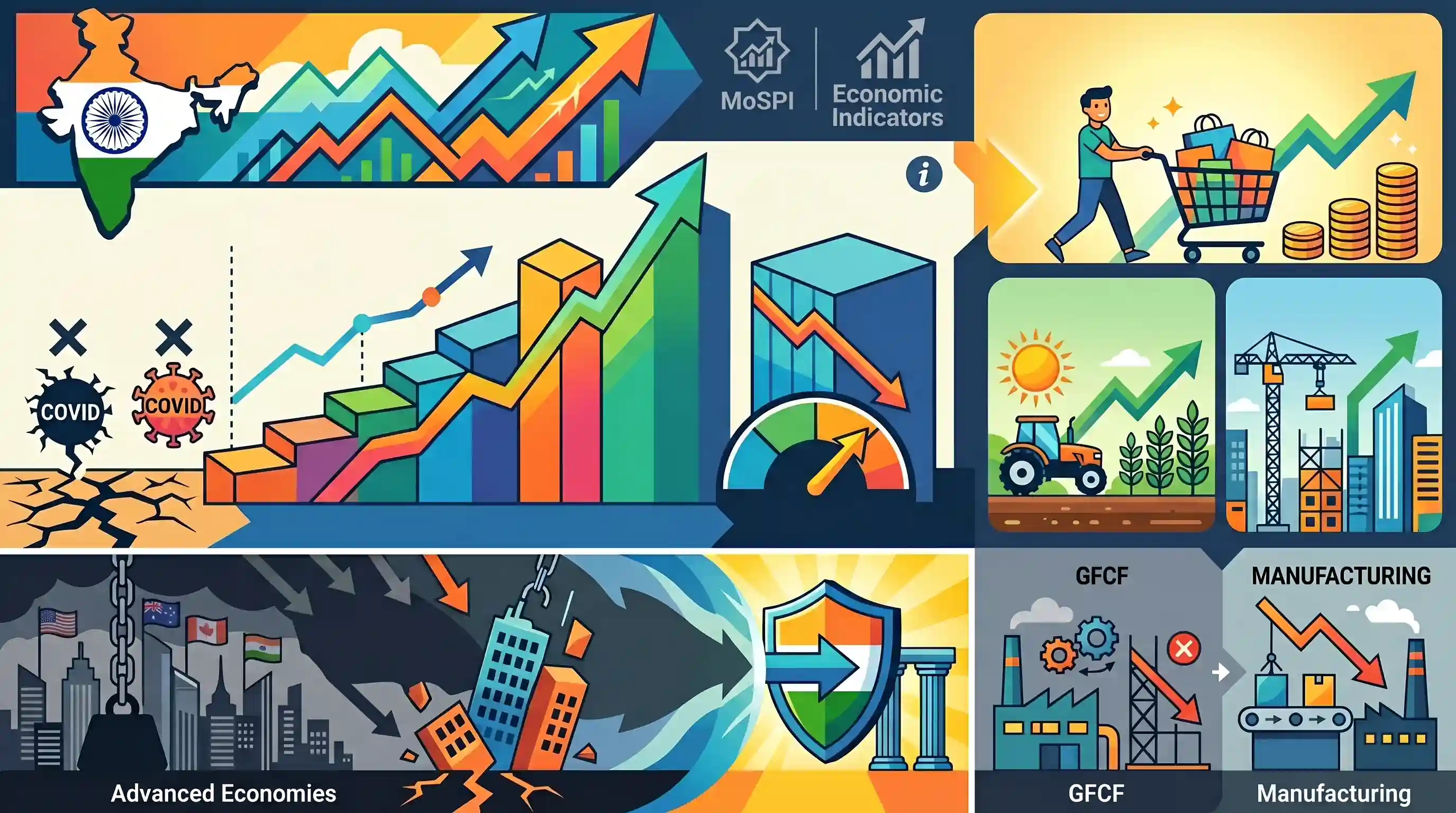
India's real GDP growth for the financial year 2024-25 moderated to 6.5%, the slowest pace of economic expansion since the COVID-19 pandemic. Data released by the Ministry of Statistics and Programme Implementation (MoSPI) showed that while the fourth quarter (Q4) saw a significant acceleration to 7.4%, the overall annual growth cooled compared to 8.2% in 2023-24. The economic composition revealed a strengthening of household consumption (Private Final Consumption Expenditure) and a strong rebound in agriculture and construction. Conversely, Gross Fixed Capital Formation (GFCF) and the manufacturing sector experienced a slowdown. The Chief Economic Advisor emphasized that despite the domestic slowdown, India remains resilient in a global landscape characterized by sluggish growth in advanced economies and high debt-to-GDP ratios.
Key Points
- India's real GDP growth for 2024-25 came in at 6.5%, the slowest full-year growth since the pandemic-hit 2020-21, down from 8.2% in 2023-24.
- The fourth quarter (Q4) of 2024-25 saw growth accelerate to 7.4%, marking the fastest quarterly pace in the fiscal year.
- Household consumption (Private Final Consumption Expenditure) showed strong recovery, quickening to 7.2% for the full year from 5.6% previously.
- Gross Fixed Capital Formation (GFCF), a proxy for investment and asset creation, slowed to 7.1% in 2024-25 from 8.8% in 2023-24.
- Sectorally, agriculture bounced back with 4.6% annual growth (5.4% in Q4), and construction hit double digits (10.8% in Q4).
- Manufacturing growth dropped significantly to 4.5% for the full year, compared to a robust 12.3% in the previous fiscal year.
- The Chief Economic Advisor highlighted India's resilient performance compared to advanced economies navigating a 'growth-scarce' global environment.
Important Terms
Real GDP

The inflation-adjusted market value of all final goods and services produced within a country. It measures actual economic volume by using constant prices from a specific base year.
UPSC context
GS-III (Economy); core metric for growth, national income accounting, and comparing economic performance over time.
Ministry of Statistics and Programme Implementation (MoSPI)
The nodal ministry responsible for collecting and disseminating national statistics (GDP, CPI, IIP). It oversees the National Statistical Office (NSO) and monitors major infrastructure project implementations.
UPSC context
GS-III (Institutional Framework); tests knowledge of the agencies behind major economic indicators and data governance.
Gross Fixed Capital Formation (GFCF)
A measure of net investment in fixed assets like machinery and infrastructure. It reflects an economy's future productive capacity and is a key component of expenditure-based GDP.
UPSC context
GS-III (Investment Models); tests understanding of investment's role in long-term capital accumulation and economic expansion.
Private Final Consumption Expenditure (PFCE)
Total spending by resident households and private non-profit institutions on final goods and services. It is the largest component of India's GDP, indicating domestic demand levels.
UPSC context
GS-III (Growth & Development); crucial for analyzing domestic consumption patterns and their impact on overall economic stability.
Debt-to-GDP Ratio
A metric comparing a country's total public debt to its annual economic output. It is a critical indicator of fiscal sustainability and a government’s debt repayment capacity.
UPSC context
GS-III (Fiscal Policy); relevant for questions on debt sustainability, the FRBM Act, and macroeconomic health.
Chief Economic Advisor (CEA)
The head of the Economic Division in the Ministry of Finance who advises the government on macroeconomic policy and is responsible for preparing the annual Economic Survey.
UPSC context
GS-III (Economic Development); tests knowledge of key institutional roles in policy formulation and national economic reporting.
Prelims Trap
India's GDP contracted to 6.5% in 2024-25, marking the lowest growth since the pandemic.
A growth rate of 6.5% means the economy is still expanding, just at a slower pace. It is a 'slowdown', not a 'contraction' (which requires negative growth).
Static Concepts Connected
What are the primary components of GDP calculated via the expenditure method?
- PFCE (Consumption): Private Final Consumption Expenditure measures household spending on goods and services, forming the largest single share of India's GDP.
- GFCF (Investment): Gross Fixed Capital Formation represents net private and public investment in long-term fixed assets, machinery, and infrastructure.
- GFCE (Govt Spending): Government Final Consumption Expenditure captures recurring government spending on goods and services.
- Net Exports: The value of total exports minus total imports, which historically remains a net negative drag on India's GDP calculation.
Who releases India's GDP data and how is Real GDP calculated?
- Publishing Agency: The National Statistical Office (NSO), functioning under the Ministry of Statistics and Programme Implementation (MoSPI).
- Real vs Nominal: Real GDP is calculated using constant prices (base year 2011-12) to remove the effect of inflation, reflecting genuine volume growth in the economy.
Cross-Topic Patterns
Consumption vs Investment divergence
While household consumption strongly recovered, investment (GFCF) slowed. UPSC often links this macro divergence to debates on private capex stagnation and the necessity of government capital expenditure to crowd-in private investment.
Agriculture as a macro shock-absorber
Agriculture showed strong resilience (4.6% growth) while manufacturing slumped. This mirrors the pandemic-era pattern where the primary sector anchored the economy amidst industrial headwinds.

Expect a 2026 Prelims question tracking 5-year trend lines of specific GDP components (PFCE vs GFCF) and manufacturing vs agriculture.
Linked PYQs · 4
Linked PYQs · 4
- 2021MainsGS3
Explain the difference between computing methodology of India's Gross Domestic Product (GDP) before the year 2015 and after the year 2015.
- 2023MainsGS3
Faster economic growth requires increased share of the manufacturing sector in GDP, particularly of MSMEs. Comment on the present policies of the Government in this regard.
- 2001PrelimsGS1
The most appropriate measure of a country’s economic growth is its
- 2018PrelimsGS1
Increase in absolute and per capita real GNP do not connote a higher level of economic development, if
