India GDP Growth Slowdown Concerns and Macroeconomic Trends
Source:Indian Express ↗
Why It Matters
Understanding macroeconomic indicators, growth projections, and potential slowdowns is vital for aspirants preparing for GS3 economy questions regarding growth drivers and policy challenges.
Summary
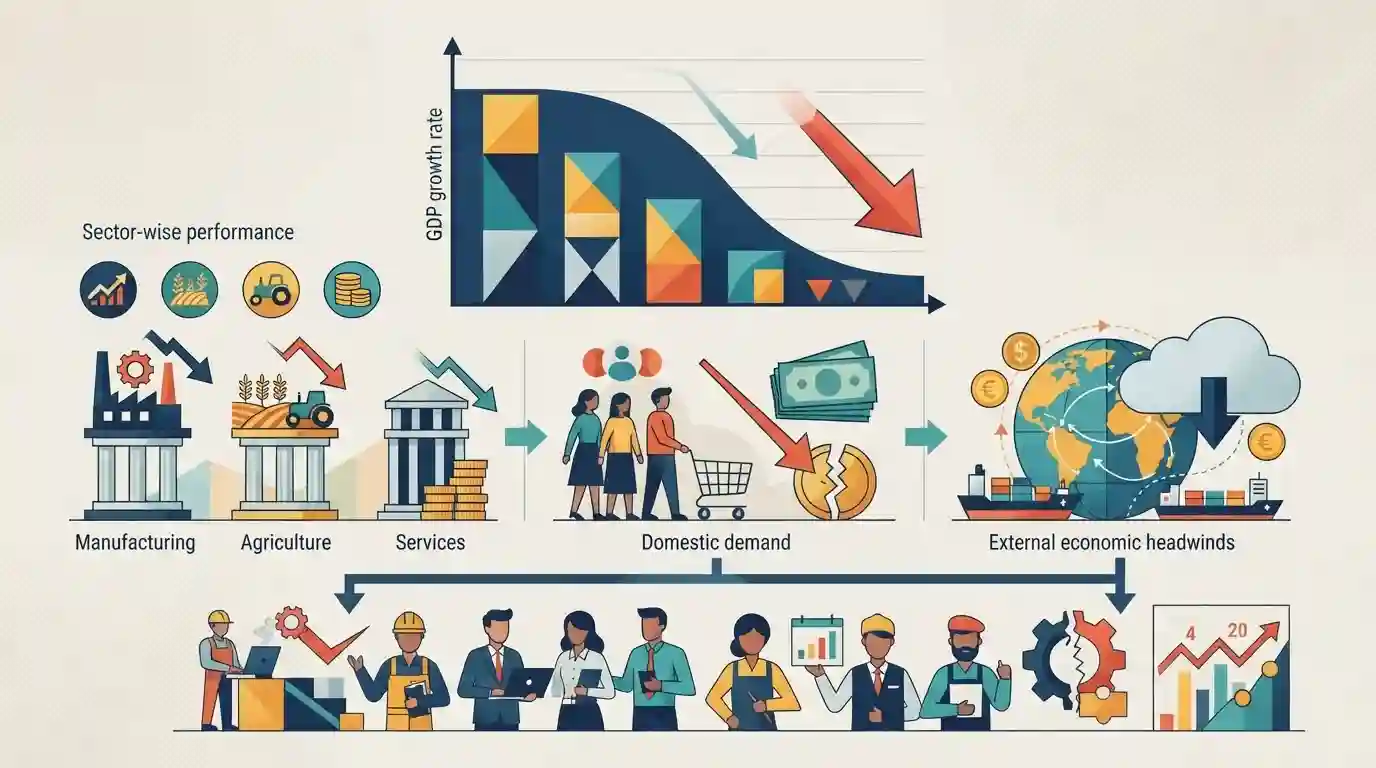
The article explores concerns regarding an expected slowdown in India's GDP growth rate, analyzing the underlying macroeconomic factors such as sector-wise performance, domestic demand, and external economic conditions affecting overall development trends.
Key Points
- India's GDP growth is anticipated to see a moderation or slowdown compared to previous high quarters, raising policy debates.
- Key sectors like manufacturing, agriculture, and services dictate the overarching economic trajectory and investment cycles.
- External headwinds, domestic demand dynamics, and fiscal consolidation measures influence future growth projections.
Important Terms
Reserve Bank of India

India's central banking institution responsible for regulating the monetary policy, issuing currency, managing foreign exchange reserves, and maintaining financial stability to balance economic growth with inflation control.
UPSC context
UPSC Prelims/Mains (GS Paper III): Core institution for monetary policy, inflation targeting, and macroeconomic management under the Indian Economy syllabus.
Ministry of Statistics and Programme Implementation
The nodal ministry under the Government of India responsible for the collection, compilation, and dissemination of official statistical data, including national income accounts, GDP growth rates, and industrial production indices.
UPSC context
UPSC Prelims/Mains (GS Paper III): Critical body for economic data governance, national statistics, and mobilization of resources and growth monitoring.
Prelims Trap
Fiscal consolidation measures uniformly restrict medium-term economic growth by dampening aggregate demand across all sectors.
Aspirants often assume fiscal consolidation inherently contracts economic growth entirely, overlooking how capital expenditure quality can sustain multiplier effects despite headline consolidation.
Static Concepts Connected
What are the key components and targets under the Fiscal Responsibility and Budget Management (FRBM) Act?
- Legislative Objective: Enacted in 2003 to institutionalize financial discipline, reduce fiscal deficit, and macroeconomic stability.
- Deficit Targets: The amended target aimed to reduce fiscal deficit to 3% of GDP by 2025-26 while ensuring debt sustainability.
- Escape Clause: Allows for an escape clause during extreme national emergencies, structural shifts, or severe economic contraction.
Cross-Topic Patterns
Fiscal Deficit vs Monetary Policy Easing
Fiscal consolidation targets under FRBM interact directly with RBI's inflation-targeting mandate, creating a policy trade-off during growth slowdowns.

Expect statements linking fiscal consolidation paths with growth moderation and RBI's liquidity management in prelims.
Linked PYQs · 3
Linked PYQs · 3
- 2019MainsGS3
Do you agree with the view that steady GDP growth and low inflation have left the Indian economy in good shape? Give reasons in support of your arguments.
- 2024MainsGS3
What are the causes of persistent high food inflation in India? Comment on the effectiveness of the monetary policy of the RBI to control this type of inflation.
- 2023MainsGS3
Faster economic growth requires increased share of the manufacturing sector in GDP, particularly of MSMEs. Comment on the present policies of the Government in this regard.
