Gaza Peace Deal: India Welcomes Step Towards Regional Stability
Source:The Hindu ↗
Why It Matters
Understanding India's balanced approach to the Israel-Palestine conflict is crucial for GS-2 (International Relations). It reflects India's evolving strategic posture in the Middle East, balancing deepening ties with Israel against historical support for a sovereign Palestine.
Summary
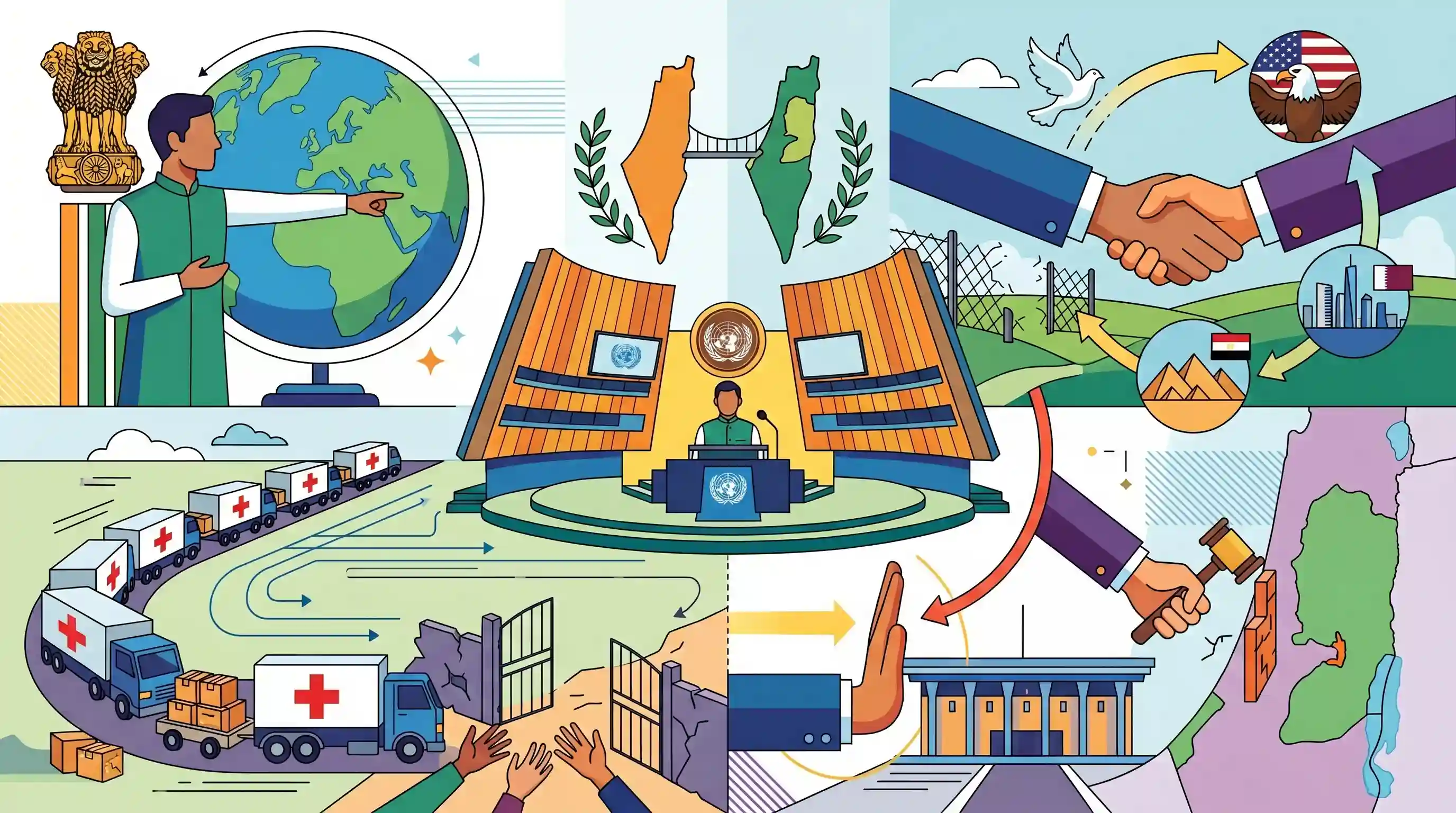
India has hailed the newly forged Gaza peace deal as a 'landmark step' towards stability in the Middle East, commending the roles played by the US, Egypt, and Qatar. At the UN, India reiterated its support for a negotiated two-state solution and called for unrestricted humanitarian aid to Gaza. Simultaneously, India expressed firm opposition to the Israeli Knesset's preliminary bill aimed at annexing the West Bank, highlighting its commitment to resolving the conflict without unilateral actions, in line with its historic policy on Palestine.
Key Points
- India welcomed the Gaza peace deal, praising the efforts of the US, Egypt, and Qatar in facilitating regional stability.
- India explicitly opposed unilateral moves, particularly the Israeli Knesset's preliminary bill aimed at annexing parts of the West Bank.
- India reiterated its long-standing commitment to a negotiated two-state solution to resolve the Israel-Palestine conflict.
- India called for unimpeded humanitarian assistance to Gaza, emphasizing the urgent need for food, medicine, and fuel.
- While condemning terrorism, India underscored its historical stance since being the first non-Arab state to recognize the PLO in 1974 and the State of Palestine in 1988.
Important Terms
Gaza peace deal

A 2025 agreement brokered by the US, Egypt, and Qatar at Sharm el-Sheikh to end hostilities in Gaza, facilitate hostage release, and ensure humanitarian aid flow.
UPSC context
Relevant for GS Paper II (International Relations) regarding West Asia stability and India's diplomatic stakes.
Two-state solution
A proposed framework to resolve the conflict by establishing an independent State of Palestine alongside Israel, based on the 1967 borders and mutual recognition.
UPSC context
Tests knowledge of India's long-standing Palestine policy and global conflict resolution frameworks.
Israeli Knesset
The unicameral national legislature of Israel which passes laws, elects the President and Prime Minister, and oversees government operations.
UPSC context
Significant for GS Paper II under 'Effect of policies of developed/developing countries'.
West Bank
A landlocked territory near the Mediterranean coast, occupied by Israel since 1967, which Palestinians envision as the heart of a future sovereign state.
UPSC context
Mapping and geopolitical significance in West Asia; central to the Middle East Peace Process.
United Nations
The primary international body for maintaining global peace. India uses its forums, like the Security Council, to articulate its 'Link West' and Palestine policies.
UPSC context
Core topic for GS II (International Institutions) and India's role in multilateral diplomacy.
Prelims Trap
India was the first country globally to recognize the Palestine Liberation Organization (PLO).
India was the first *non-Arab* state to recognize the PLO (1974) and Palestine (1988). Arab states recognized them earlier; UPSC often drops 'non-Arab' to trick aspirants.
Static Concepts Connected
What are the geographical boundaries of the West Bank and Gaza Strip?
- West Bank: Landlocked territory bordered by Israel to the north, west, and south, and by Jordan and the Dead Sea to the east.
- Gaza Strip: Coastal enclave bounded by the Mediterranean Sea (west), Israel (north and east), and Egypt (south).
- Rafah Crossing: Crucial border crossing between the Gaza Strip and Egypt, serving as the primary non-Israeli entry point for humanitarian aid.
What is India's 'De-hyphenation' policy in West Asia?
- Independent Ties: Treating bilateral relations with Israel and Palestine as independent, mutually exclusive tracks rather than viewing them through a zero-sum lens.
- Strategic Autonomy: Allows India to engage in deep defense and tech pacts with Israel while simultaneously funding Palestinian capacity-building projects.
Cross-Topic Patterns
IMEC corridor's dependence on peace
The India-Middle East-Europe Economic Corridor (IMEC) requires regional stability; prolonged conflicts and unilateral annexations directly threaten this geoeconomic counter to China's BRI.
I2U2 vs. traditional Palestinian support
India balances new geo-economic frameworks like I2U2 (India, Israel, UAE, US) with its historic political backing for an independent Palestinian state and the two-state solution.

Prelims 2026 will likely test the Levant's geography (Rafah, Dead Sea) paired with statements on India's timeline of PLO recognition.
Linked PYQs · 3
Linked PYQs · 3
- 2018MainsGS2
“India’s relations with Israel have, of late, acquired a depth and diversity, which cannot be rolled back.” Discuss.
- 2025MainsGS2
"Energy security constitutes the dominant kingpin of India's foreign policy, and is linked with India's overarching influence in Middle Eastern countries.” How would you integrate energy security with India's foreign policy trajectories in the coming years?
- 2022PrelimsGS1
The term "Levant" often heard in the news roughly corresponds to which of the following regions?
