West Asian Conflict intensifies with Civilian Infrastructure Hits
Source:Indian Express ↗
Why It Matters
The Middle East conflict is central to global geopolitical stability and directly affects India's strategic and energy interests. The evolving US-Israel-Iran dynamics, driven by key political figures, are crucial for GS2 International Relations. Furthermore, the ethical implications of civilian casualties in modern warfare provide strong material for GS4, while specific conflict zones are frequent targets for Prelims mapping questions.
Summary
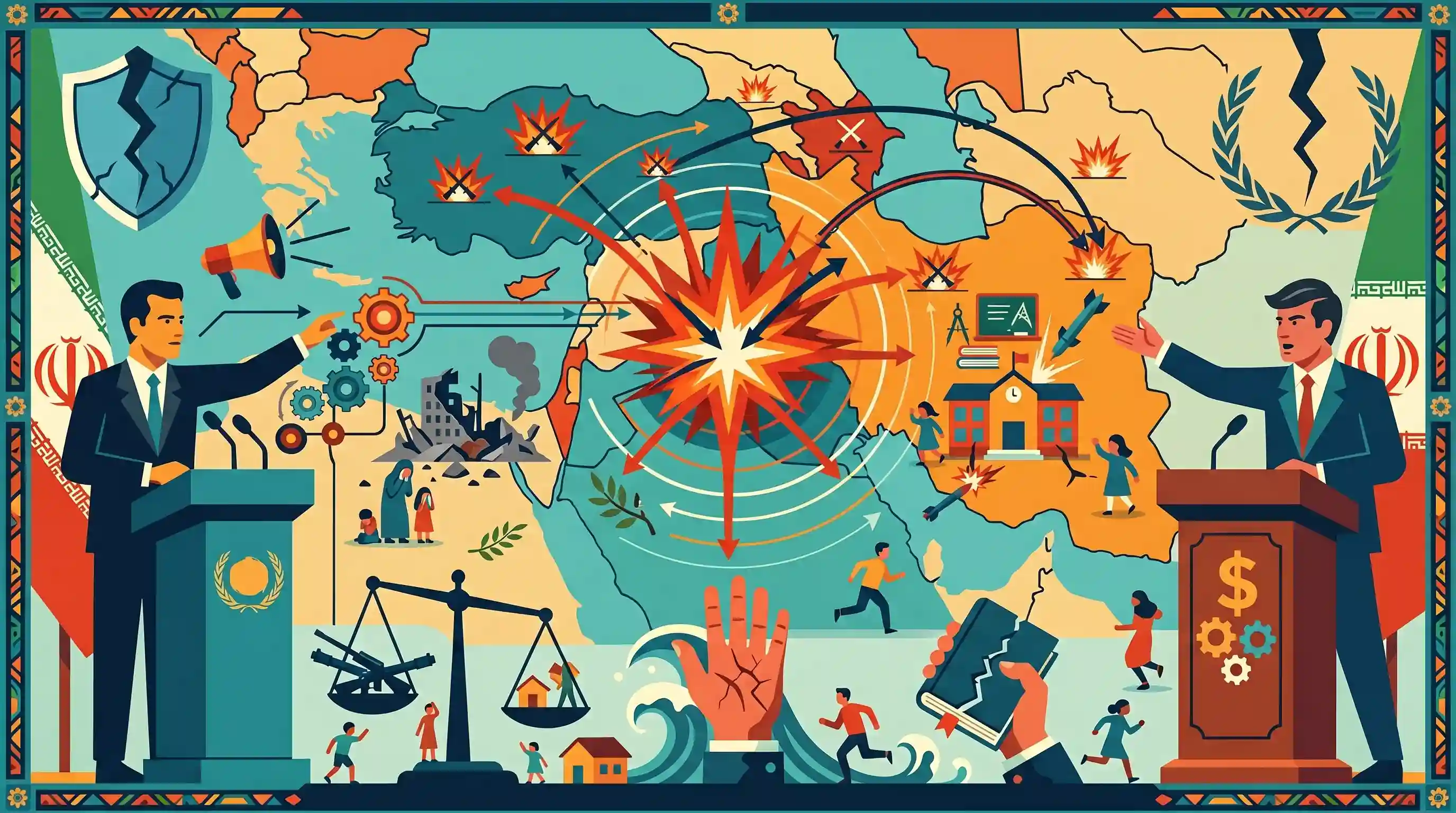
The article examines the broadening and increasingly destructive nature of the Middle East conflict, highlighting the devastating civilian toll in Gaza and related incidents like the missile strike in Minab, Iran, involving a girls' school. It underscores how the political strategies and rhetoric of leaders like Benjamin Netanyahu and Donald Trump are shaping regional hostilities. The expanding theater of war—shifting from localized conflicts to broader Israel-Iran tensions—raises profound ethical concerns regarding collateral damage, civilian suffering, and the violation of international norms in contemporary geopolitical warfare.
Key Points
- The escalating conflict in the Middle East has resulted in devastating civilian casualties, as seen in the ongoing situation in Gaza and recent incidents such as the Minab missile strike and attacks affecting a girls' school in Iran.
- Political leadership, particularly the dynamics between figures like Benjamin Netanyahu and Donald Trump, continues to heavily influence the strategic trajectory and escalation of the conflict.
- The broadening scope of hostilities, moving from Gaza to direct confrontations involving Iranian territory, signals a dangerous regional escalation with significant implications for global geopolitical stability.
- The targeting or collateral damage involving civilian infrastructure such as schools raises critical ethical questions regarding modern warfare and adherence to international humanitarian law.
Important Terms
International Humanitarian Law

International legal framework, including the Geneva Conventions, designed to limit the effects of armed conflict by protecting non-combatants and regulating methods of warfare.
UPSC context
GS II: International Relations/Agreements. Critical for analyzing legal responsibilities and war crime allegations in modern conflicts.
Principle of Distinction
A cardinal rule of IHL requiring parties in a conflict to differentiate between combatants and civilians, ensuring military operations target only military objectives.
UPSC context
GS II/IV: Ethics in IR. Tests ability to evaluate the legality of strikes on civilian-adjacent infrastructure like schools.
Proportionality
The legal requirement that incidental civilian harm must not be excessive in relation to the concrete and direct military advantage anticipated from an attack.
UPSC context
GS IV: Ethics. Essential for discussing the moral and legal thresholds of 'acceptable' damage in urban warfare.
Shadow War
A prolonged state of indirect hostility characterized by proxy warfare, cyberattacks, and assassinations, avoiding direct, full-scale military confrontation between states.
UPSC context
GS II: Regional security dynamics. Key for understanding the historical transition of Israel-Iran tensions into direct conflict.
Collateral Damage
Incidental death, injury, or damage to civilians and civilian property during a military operation aimed at a legitimate military target.
UPSC context
GS IV: Ethical dilemmas. Tests the application of the Doctrine of Double Effect in international security policies.
Axis of Resistance
A regional alliance led by Iran including Hezbollah, Hamas, and the Houthis, aimed at countering Israeli and Western influence in the Middle East.
UPSC context
GS II: International Relations. Crucial for mapping proxy dynamics and their impact on India's energy security interests.
Octopus Doctrine
An Israeli strategic shift to target Iran directly (the 'head') rather than focusing solely on its regional proxies (the 'tentacles').
UPSC context
GS II: Geopolitics. Important for analyzing changing security strategies in the West Asian theater.
Prelims Trap
"Minab, recently seen in the news due to missile strikes, is located in Yemen."
Minab is situated in Iran's Hormozgan province near the Strait of Hormuz, not Yemen. UPSC often swaps the countries of heavily bombed West Asian cities.
Static Concepts Connected
What are the core principles of International Humanitarian Law (IHL)?
- Principle of Distinction: Warring parties must strictly differentiate between active combatants and non-combatants; civilian infrastructure like schools cannot be intentionally targeted.
- Principle of Proportionality: Incidental civilian harm must not be excessive in relation to the concrete and direct military advantage anticipated from an attack.
- Principle of Precaution: All feasible precautions must be taken in the choice of means and methods of attack to minimize collateral damage.
What is the strategic geography surrounding the Strait of Hormuz?
- Vital Chokepoint: It is a critical maritime chokepoint connecting the Persian Gulf to the Gulf of Oman and the broader Arabian Sea.
- Bordering Nations: The strait is bounded by Iran (including provinces like Hormozgan) to the north, and Oman (Musandam peninsula) and the UAE to the south.
- Economic Significance: It facilitates the passage of roughly 20% of global oil consumption, making it highly sensitive to regional conflicts.
Cross-Topic Patterns
Iran strikes and India's energy security
Escalations in Iran's Hormozgan province (Minab) threaten the Strait of Hormuz chokepoint, linking West Asian conflict directly to India's macroeconomic stability and energy security.
IHL + Ethics in Warfare (GS4)
The bombing of civilian infrastructure provides immediate, real-world case studies for GS4 questions on 'Jus in Bello' (justice in war) and the ethical limits of proportionality in modern combat.

Map-based pairing of recent conflict zones (Minab, Rafah) with adjacent water bodies (Strait of Hormuz, Red Sea) is highly probable in 2026.
Linked PYQs · 4
Linked PYQs · 4
- 2025MainsGS4
Carl von Clausewitz once said, "War is a diplomacy by other means." Critically analyse the above statement in the present context of contemporary geo-political conflict.
- 2015PrelimsGS1
The area known as 'Golan Heights' sometimes appears in the news in the context of the events related to
- 2023PrelimsGS1
Consider the following pairs: Regions often mentioned in news Reason for being in news 1. North Kivu and Ituri : War between Armenia and Azerbaijan 2. Nagorno-Karabakh : Insurgency in Mozambique 3. Kherson and Zaporizhzhia : Dispute between Israel and Lebanon How many of the above pairs are correctly matched?
- 2018MainsGS2
“India’s relations with Israel have, of late, acquired a depth and diversity, which cannot be rolled back.” Discuss.
