Humanitarian Flotilla Challenges Gaza Naval Blockade Amid Risks
Source:Indian Express ↗
Why It Matters
The incident highlights the complex intersection of humanitarian aid, international law, and global civil society efforts within active conflict zones. For UPSC aspirants, understanding the geographical nuances of the Mediterranean and Middle East, alongside the geopolitical ramifications of naval blockades and international aid corridors, is crucial for both Prelims mapping and Mains IR answers.
Summary
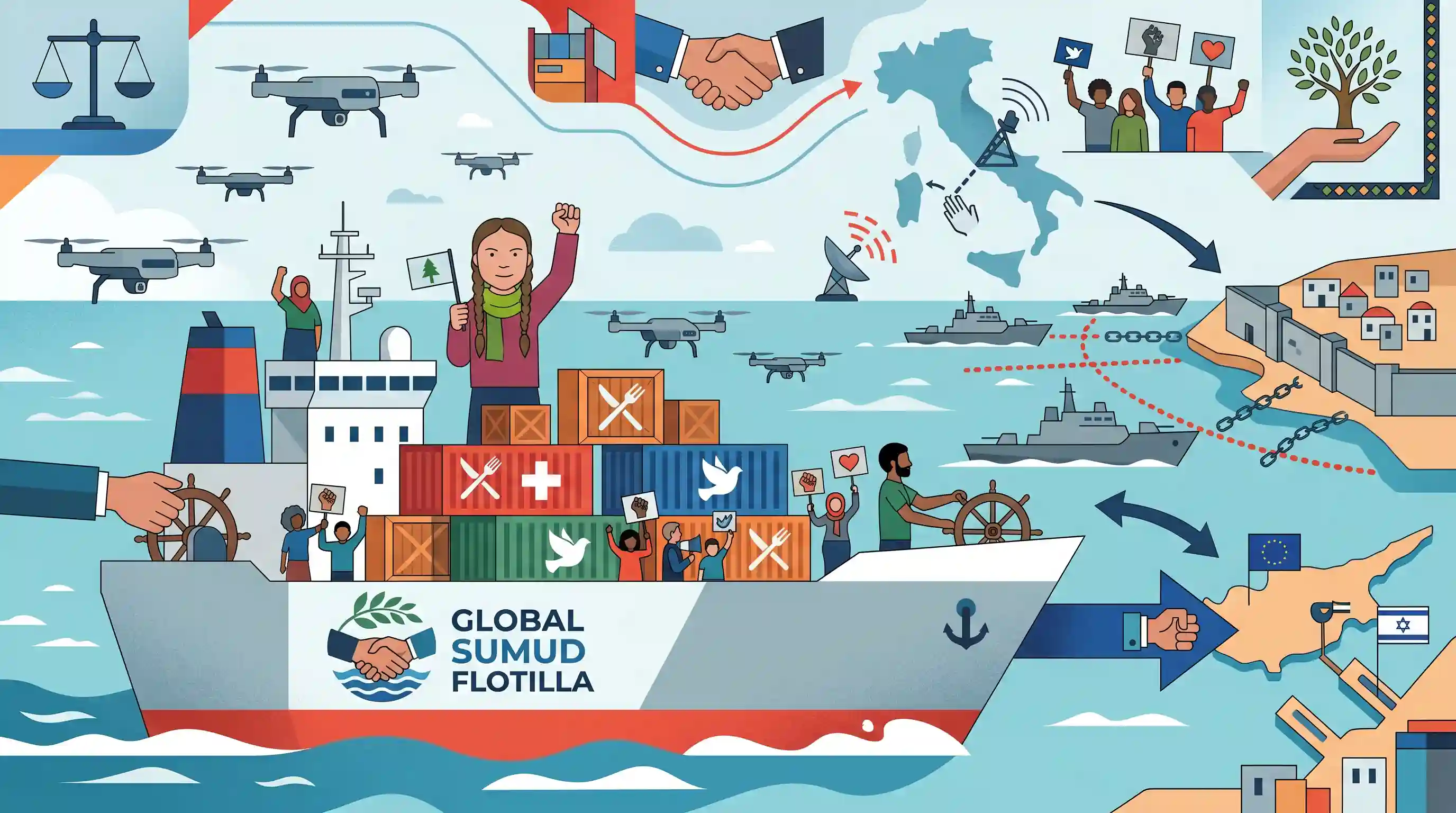
A humanitarian cargo ship named the Global Sumud Flotilla, carrying 5,500 tonnes of aid and climate activist Greta Thunberg, has entered a high-risk zone in the Mediterranean Sea as it attempts to break Israel's naval blockade on Gaza. Organised by the Freedom Flotilla Coalition, the mission aims to deliver unhindered aid directly to Palestinians. However, it faces mounting challenges as drone activity increases and Italy withdraws tracking support, instead urging the ship to dock in Cyprus. The activists rejected this diversion, emphasizing their goal of establishing a direct humanitarian corridor rather than utilizing EU- or Israel-controlled inspection routes.
Key Points
- The Global Sumud Flotilla, carrying 5,500 tonnes of humanitarian aid and activists including Greta Thunberg, has entered a 'high-risk zone' en route to Gaza.
- The flotilla aims to break the Israeli naval blockade to deliver direct, unhindered aid to Palestinians amid the ongoing Israel-Hamas conflict.
- Italy revoked its satellite tracking support for the vessel and urged the crew to dock in Cyprus to utilize the established international maritime corridor for aid.
- The activists refused the diversion to Cyprus, insisting that routing aid through EU-mandated or Israeli-controlled inspection ports contradicts their mission of establishing a direct humanitarian lifeline.
- The current mission occurs 14 years after the Mavi Marmara incident, during which Israeli forces intercepted a similar flotilla, leading to casualties.
Important Terms
Global Sumud Flotilla

A 2025–2026 civilian maritime initiative by an international coalition attempting to break Israel's naval blockade of Gaza to deliver humanitarian aid directly.
UPSC context
GS Paper 2: Role of non-state actors and activists in international geopolitics and humanitarian assistance.
Freedom Flotilla Coalition (FFC)
A global network of grassroots organizations that has organized maritime missions since 2010 to challenge the Gaza blockade and provide aid.
UPSC context
GS Paper 2: International relations and the impact of civil society on global conflict management.
International Criminal Court (ICC)
The permanent international tribunal that prosecutes individuals for war crimes, genocide, and crimes against humanity, such as the war crime of starvation.
UPSC context
GS Paper 2: Important international institutions; tests understanding of global accountability for war crimes.
Freedom of Navigation
An international law principle allowing ships of any sovereign state to travel on the high seas without interference, codified in UNCLOS.
UPSC context
GS Paper 2: International law and maritime security; critical for analyzing high-seas interceptions.
International Humanitarian Law (IHL)
Rules seeking to limit the effects of armed conflict by protecting civilians and regulating methods of warfare, including the Geneva Conventions.
UPSC context
GS Paper 2/Ethics: Framework for assessing the legality of humanitarian corridors and civilian protection.
Sumud
An Arabic term for 'steadfastness,' representing a Palestinian ideology of resilient non-violent resistance and remaining on ancestral lands.
UPSC context
GS Paper 1: Socio-political movements and ideologies in modern world history.
San Remo Manual
A 1994 restatement of international law governing naval warfare, specifically the rules for legal blockades and humanitarian exceptions.
UPSC context
GS Paper 2: Technical international law; relevant for debates on maritime security and blockade legality.
Naval Blockade
The deployment of naval ships to prevent all passage to or from a coast; its legality depends on declaration, effectiveness, and humanitarian impact.
UPSC context
GS Paper 2: Geopolitics and International Law; explores the balance between military necessity and humanitarian needs.
Prelims Trap
Naval blockades are entirely prohibited under International Humanitarian Law during armed conflicts.
Under the San Remo Manual (1994), naval blockades are legally recognized wartime instruments, provided they do not deliberately starve civilians or block essential humanitarian shipments.
Static Concepts Connected
Which countries comprise the historical 'Levant' region along the Mediterranean?
- Geographic Scope: Historically refers to the eastern shores of the Mediterranean, encompassing modern-day Syria, Lebanon, Israel, Palestine, and Jordan.
- UPSC Relevance: The definition of the Levant was a direct question in Prelims 2022. It frequently appears alongside Eastern Mediterranean geopolitical disputes.
What is the Amalthea Initiative (Cyprus Maritime Corridor)?
- Core Purpose: An international mechanism based in Cyprus to securely inspect and transport humanitarian aid directly to Gaza via the Mediterranean Sea.
- Key Backers: Supported by the EU, UAE, and the US, it attempts to bypass contested land crossings and strict land checkpoints.
Cross-Topic Patterns
Mediterranean vs Red Sea logistics
The push for the Cyprus (Amalthea) corridor highlights how Eastern Mediterranean supply routes are increasingly leveraged when traditional chokepoints face militant or state blockades.
Climate activism meets geopolitics
Thunberg's participation bridges climate activism with international human rights, reflecting a trend of global civil society actors directly challenging state-imposed wartime blockades.

Expect a 'Places/Terms in News' question in 2026 linking the Amalthea Initiative to Cyprus or testing Eastern Mediterranean mapping.
Linked PYQs · 4
Linked PYQs · 4
- 2022PrelimsGS1
The term "Levant" often heard in the news roughly corresponds to which of the following regions?
- 2003PrelimsGS1
Israel has common borders with
- 2023PrelimsGS1
Consider the following statements: Statement-I: Israel has established diplomatic relations with some Arab States. Statement-II: The 'Arab Peace Initiative' mediated by Saudi Arabia was signed by Israel and Arab League. Which one of the following is correct in respect of the above statements?
- 2018MainsGS2
“India’s relations with Israel have, of late, acquired a depth and diversity, which cannot be rolled back.” Discuss.
