Gaza Humanitarian Crisis and UK Protests Under Anti Terror Laws
Source:Indian Express ↗
Why It Matters
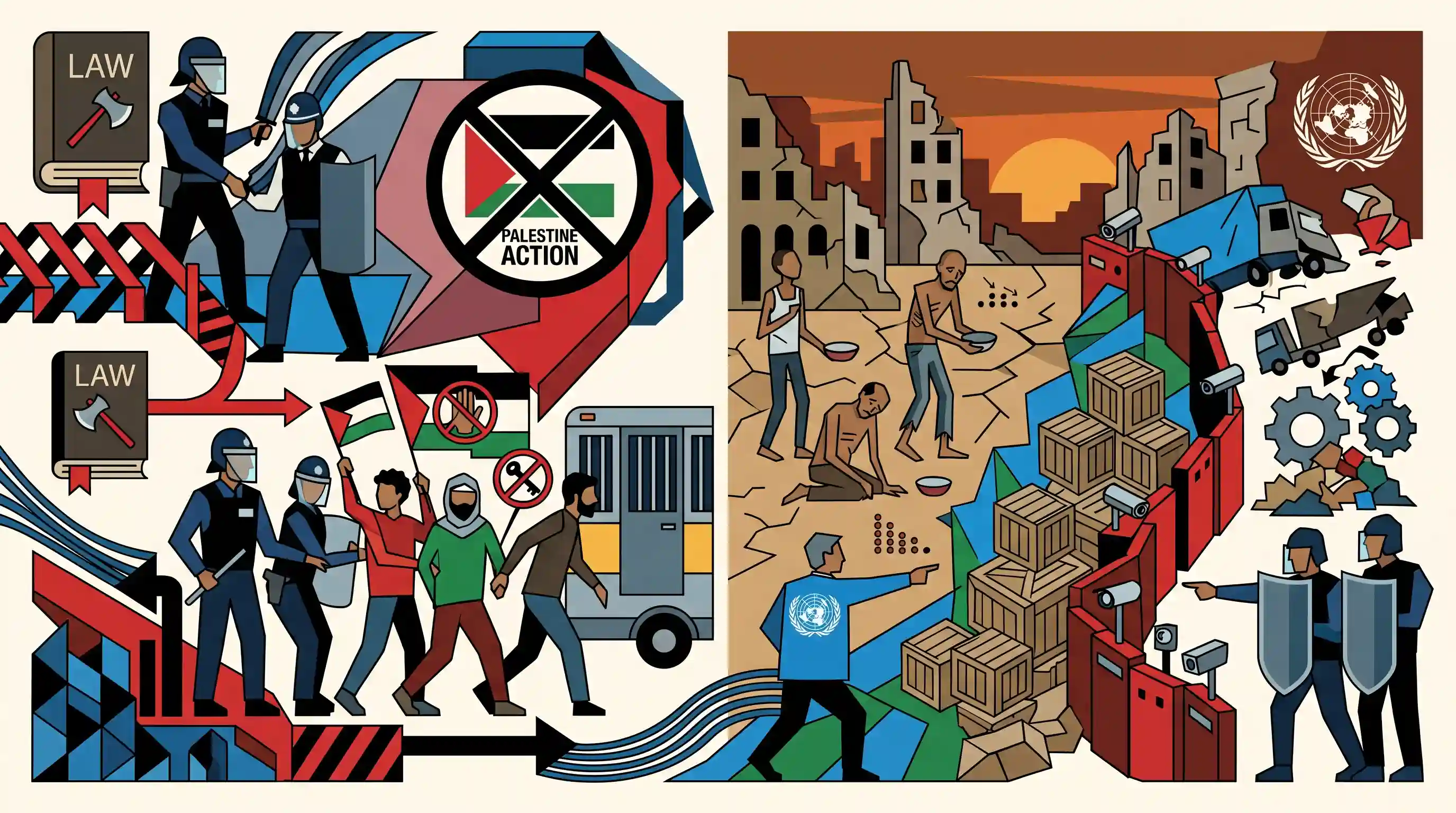
The article juxtaposes domestic civil liberties—specifically the limits of free speech and assembly when confronted with broad anti-terror laws in a democracy—against the grim reality of international conflict. It also emphasizes the limitations of global governance and UN agencies in executing humanitarian relief in active war zones, resulting in severe human development crises like mass malnutrition.
Summary
UK police arrested approximately 150 pro-Palestinian protesters in London after they defied a new law banning support for "Palestine Action," which the UK designated as a terrorist organization. The crackdown occurred against the backdrop of a worsening humanitarian crisis in Gaza, where the local health ministry reports 212 people have died from malnutrition. While the United Nations warns of imminent famine due to severely restricted aid deliveries, Israel denies employing starvation as a weapon and attributes the delays to UN logistical failures.
Key Points
- UK police arrested roughly 150 pro-Palestinian protesters in London for defying a ban on "Palestine Action," a group recently designated as a terrorist organization by the UK.
- The protests highlight the growing tension between strict anti-terror legislation and the freedom of assembly and expression in democratic states.
- Meanwhile, in Gaza, local health authorities report that 212 individuals have died from malnutrition amid the ongoing conflict.
- The UN warns of severe famine conditions in Gaza, stating that humanitarian aid deliveries are significantly below the minimum required levels.
- Israel has denied accusations of causing starvation, instead blaming the United Nations for logistical failures in distributing aid.
Important Terms
Palestine Action

A UK-based direct-action group targeting Israeli-linked defense firms. It was designated a terrorist organization in 2025 under the UK Terrorism Act, a move later challenged in court as disproportionate.
UPSC context
GS Paper II (International Relations/Fundamental Rights). Tests understanding of proscription laws and the balance between national security and freedom of expression.
Famine (IPC Phase 5)
The final stage (Phase 5) of the Integrated Food Security Phase Classification (IPC) where at least 20% of households face extreme food gaps, and acute malnutrition exceeds 30%.
UPSC context
GS Paper II (Global Humanitarian Issues). Important for understanding UN-standardized humanitarian metrics and international response triggers.
Proscription
A legal mechanism allowing a government to ban an organization deemed involved in terrorism. Under the UK's 2000 Act, it makes membership or support a criminal offense.
UPSC context
GS Paper III (Internal Security). Relevant for comparative study of anti-terror laws like India's UAPA (Unlawful Activities Prevention Act).
IPC Classification
A global scale for monitoring food security used by the UN (WFP, FAO). It classifies hunger from Phase 1 (Minimal) to Phase 5 (Famine).
UPSC context
GS Paper II (International Institutions). Tests knowledge of international standards for declaring humanitarian emergencies.
United Nations (UN)
The intergovernmental body coordinating humanitarian aid in Gaza (via UNRWA/OCHA) and investigating allegations of starvation used as a weapon of war.
UPSC context
GS Paper II (IR). Focuses on the role of international organizations in conflict zones and managing global hunger crises.
Prelims Trap
"Both Central and State Governments can notify an entity as a 'terrorist organization' under the Unlawful Activities (Prevention) Act."
Under the UAPA, 1967, only the Central Government is empowered to designate an entity as a "terrorist organization" by adding it to the First Schedule. State governments cannot do this.
Static Concepts Connected
What are the Constitutional grounds for restricting Freedom of Assembly in India?
- Constitutional Guarantee: Article 19(1)(b) guarantees citizens the right to assemble peaceably and without arms.
- Reasonable Restrictions: Under Article 19(3), the State can impose reasonable restrictions in the interests of the sovereignty and integrity of India, or public order.
- Statutory Powers: Under Section 144 of CrPC (now BNSS), magistrates can prohibit assemblies to prevent danger to human life or public tranquility.
How does International Law regulate civilian starvation during armed conflicts?
- Rome Statute (ICC): The 1998 Rome Statute explicitly classifies the intentional starvation of civilians as a method of warfare as a war crime.
- Geneva Conventions: The Conventions require conflicting parties to allow and facilitate rapid and unimpeded passage of humanitarian relief for civilians.
- Customary IHL: Customary international humanitarian law strictly prohibits attacking, destroying, or rendering useless objects indispensable to the survival of the civilian population.
Cross-Topic Patterns
Democratic rights vs. Anti-terror legislation
The UK's crackdown on Palestine Action mirrors Indian constitutional debates over UAPA, emphasizing a global pattern of democracies using anti-terror legislation to override freedom of assembly (Article 19).
ICC jurisdiction and war crimes
Accusations of starvation as a weapon tie into recent ICC arrest warrants and ICJ genocide cases, topics UPSC frequently tests regarding the jurisdiction and enforcement limitations of international courts.

Expect a multi-statement Prelims question in 2026 contrasting the Rome Statute's war crime definitions with ICJ's advisory jurisdictions.
Linked PYQs · 4
Linked PYQs · 4
- 2024MainsGS2
‘Terrorism has become a significant threat to global peace and security.’ Evaluate the effectiveness of the United Nations Security Council's Counter Terrorism Committee (CTC) and its associated bodies in addressing and mitigating this threat at the international level.
- 2014MainsGS2
What do you understand by the concept "freedom of speech and expression"? Does it cover hate speech also ? Why do the films in India stand on a slightly different plane from other forms of expression ? Discuss.
- 2018MainsGS2
“India’s relations with Israel have, of late, acquired a depth and diversity, which cannot be rolled back.” Discuss.
- 2024MainsGS2
Poverty and malnutrition create a vicious cycle, adversely affecting human capital formation. What steps can be taken to break the cycle ?
