Gaza Conflict Humanitarian Crisis and Ceasefire Negotiations
Source:The Hindu ↗
Why It Matters
The Israel-Palestine conflict is a highly significant geopolitical issue with ripple effects on global security, energy markets, and India's foreign policy maneuvering in West Asia. It highlights international humanitarian law challenges and serves as a vital area for UPSC Prelims mapping questions (places in news).
Summary
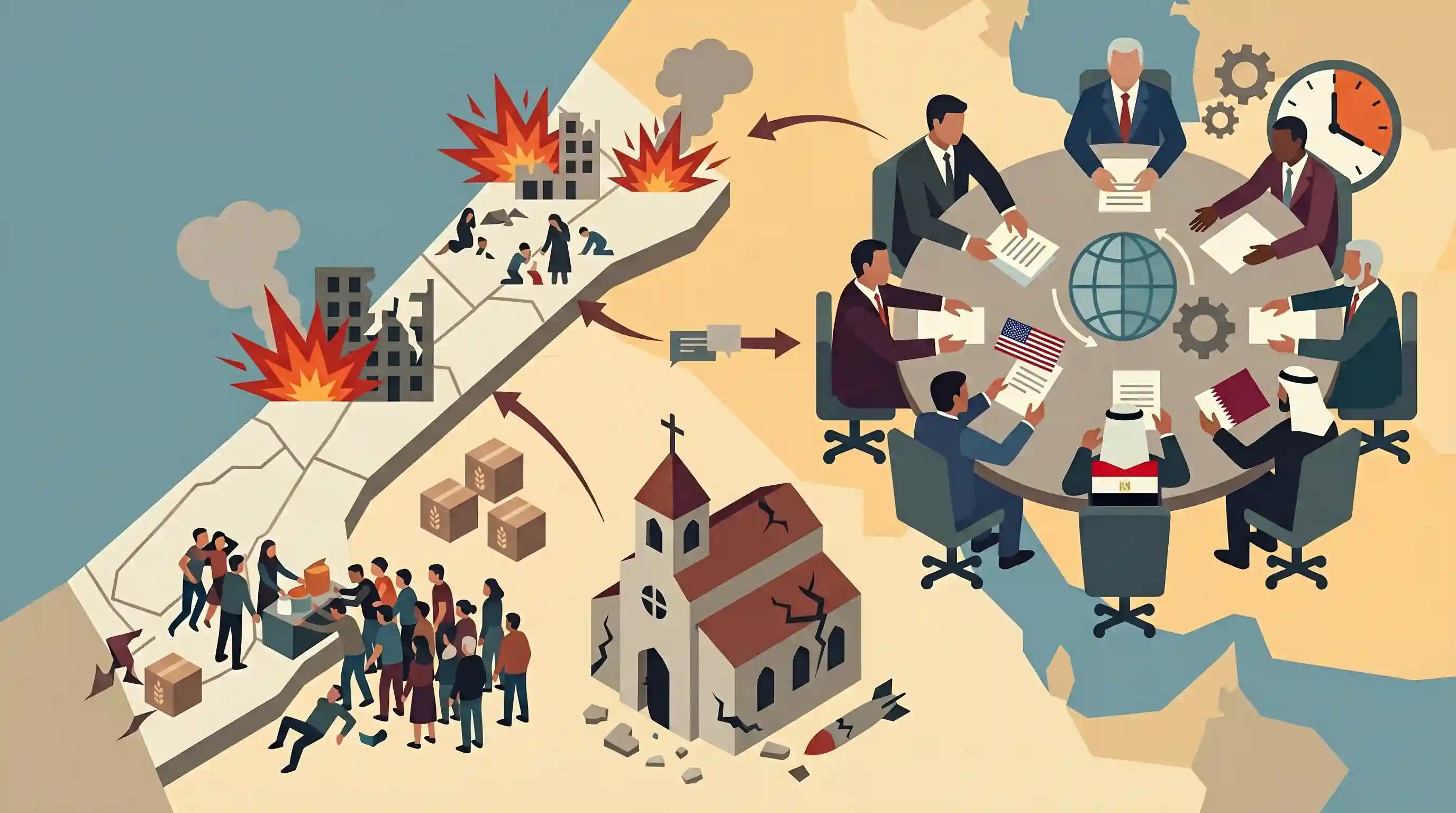
The ongoing Israel-Hamas conflict continues to inflict heavy civilian casualties in Gaza, with recent Israeli strikes killing at least 14 people across Khan Younis and Jabalia. The humanitarian crisis is deepening, illustrated by a fatal crush at a food aid center in Deir el-Balah. The Israeli military also mistakenly damaged Gaza's only Catholic church. Concurrently, indirect ceasefire negotiations mediated by the US, Egypt, and Qatar are taking place in Doha, aiming for a 60-day truce, although the humanitarian toll steadily mounts.
Key Points
- Recent Israeli strikes in Gaza killed at least 14 people, targeting areas in southern Khan Younis and northern Jabalia al-Nazla.
- The Israeli military acknowledged mistakenly damaging the Holy Family Church, Gaza's only Catholic church, while targeting nearby militant positions.
- A fatal crush at a food aid distribution center in Deir el-Balah highlighted the severe humanitarian crisis and desperation among displaced Palestinians.
- Indirect negotiations between Israel and Hamas, mediated by Qatar, Egypt, and the US, are ongoing in Doha to establish a 60-day ceasefire.
Important Terms
Hamas

An acronym for the 'Islamic Resistance Movement,' it is a Sunni Islamist militant and political organization that has governed the Gaza Strip since 2007.
UPSC context
GS Paper II: International Relations. Essential for understanding non-state actors, Middle East geopolitics, and regional security dynamics.
Latin Patriarchate of Jerusalem
The Catholic episcopal see in Jerusalem with jurisdiction over Israel, Palestine, Jordan, and Cyprus; it provides critical humanitarian aid and spiritual leadership during regional conflicts.
UPSC context
GS Paper I/II: World History and IR. Relevant for religious diplomacy and the role of international ecclesiastical bodies in humanitarian crises.
Palestinian Civil Defence
The emergency rescue and fire-fighting agency of the Palestinian Authority; it is responsible for disaster response, search-and-rescue, and civilian protection in the Palestinian territories.
UPSC context
GS Paper II: International Relations. Illustrates the challenges of humanitarian infrastructure and governance in conflict-prone regions.
Jabalia Refugee Camp
The largest of the Gaza Strip's eight refugee camps, known as the birthplace of the First Intifada (1987) and characterized by extreme urban density.
UPSC context
GS Paper I: World Geography (Mapping). Significant as a historical and strategic flashpoint in the Israel-Palestine conflict.
Khan Younis
The second-largest urban area in the Gaza Strip; it serves as a major commercial and strategic hub in the southern part of the territory.
UPSC context
GS Paper I: World Geography. Important for location-based questions regarding West Asia and strategic conflict zones.
Geneva Conventions
Four 1949 treaties and later protocols that form the core of International Humanitarian Law, establishing standards for the humane treatment of non-combatants and civilians.
UPSC context
GS Paper II: International Relations. Tests knowledge of global legal frameworks, human rights, and the 'rules of war.'
Prelims Trap
"The Gaza Strip opens into the Red Sea, making it a critical maritime chokepoint."
Gaza is located on the eastern coast of the Mediterranean Sea, NOT the Red Sea. UPSC frequently swaps Mediterranean and Red Sea borders to confuse aspirants on Middle East geography.
Static Concepts Connected
What are the core principles of International Humanitarian Law (IHL)?
- Distinction: Parties to an armed conflict must at all times distinguish between the civilian population and combatants. Attacks must only be directed at military objectives.
- Proportionality: Incidental loss of civilian life or damage to civilian objects must not be excessive in relation to the concrete and direct military advantage anticipated.
- Precaution: Constant care must be taken in military operations to spare the civilian population, civilians, and civilian objects from collateral damage.
Which countries and water bodies share a land or maritime border with Israel?
- Bordering Countries: Lebanon (North), Syria (Northeast), Jordan (East), and Egypt (Southwest).
- Bordering Water Bodies: The Mediterranean Sea (West), the Red Sea/Gulf of Aqaba (South), and the Dead Sea (East).
- Contested Territories: Israel also shares internal/contested borders with the Palestinian territories of the West Bank and the Gaza Strip.
Cross-Topic Patterns
Gaza conflict + Red Sea trade disruptions
The prolonged Gaza conflict has spilled over into Houthi attacks in the Red Sea, directly impacting global supply chains, freight insurance rates, and India's maritime trade via the Suez Canal.
Qatar's strategic diplomatic balancing
Qatar hosts major US military bases while mediating for groups like Hamas and the Taliban. UPSC increasingly tests the strategic regional roles and hedging strategies of Gulf nations.

Expect a 2026 multi-statement mapping question linking Gaza's internal cities (Khan Younis), border crossings (Rafah), and water bodies.
Linked PYQs · 4
Linked PYQs · 4
- 2003PrelimsGS1
Israel has common borders with
- 2022PrelimsGS1
The term "Levant" often heard in the news roughly corresponds to which of the following regions?
- 2017PrelimsGS1
Mediterranean Sea is a border of which of the following countries? 1. Jordan 2. Iraq 3. Lebanon 4. Syria Select the correct answer using the code given below:
- 2018MainsGS2
“India’s relations with Israel have, of late, acquired a depth and diversity, which cannot be rolled back.” Discuss.
