Israel and Hamas implement Gaza ceasefire under US-brokered plan
Source:Indian Express ↗
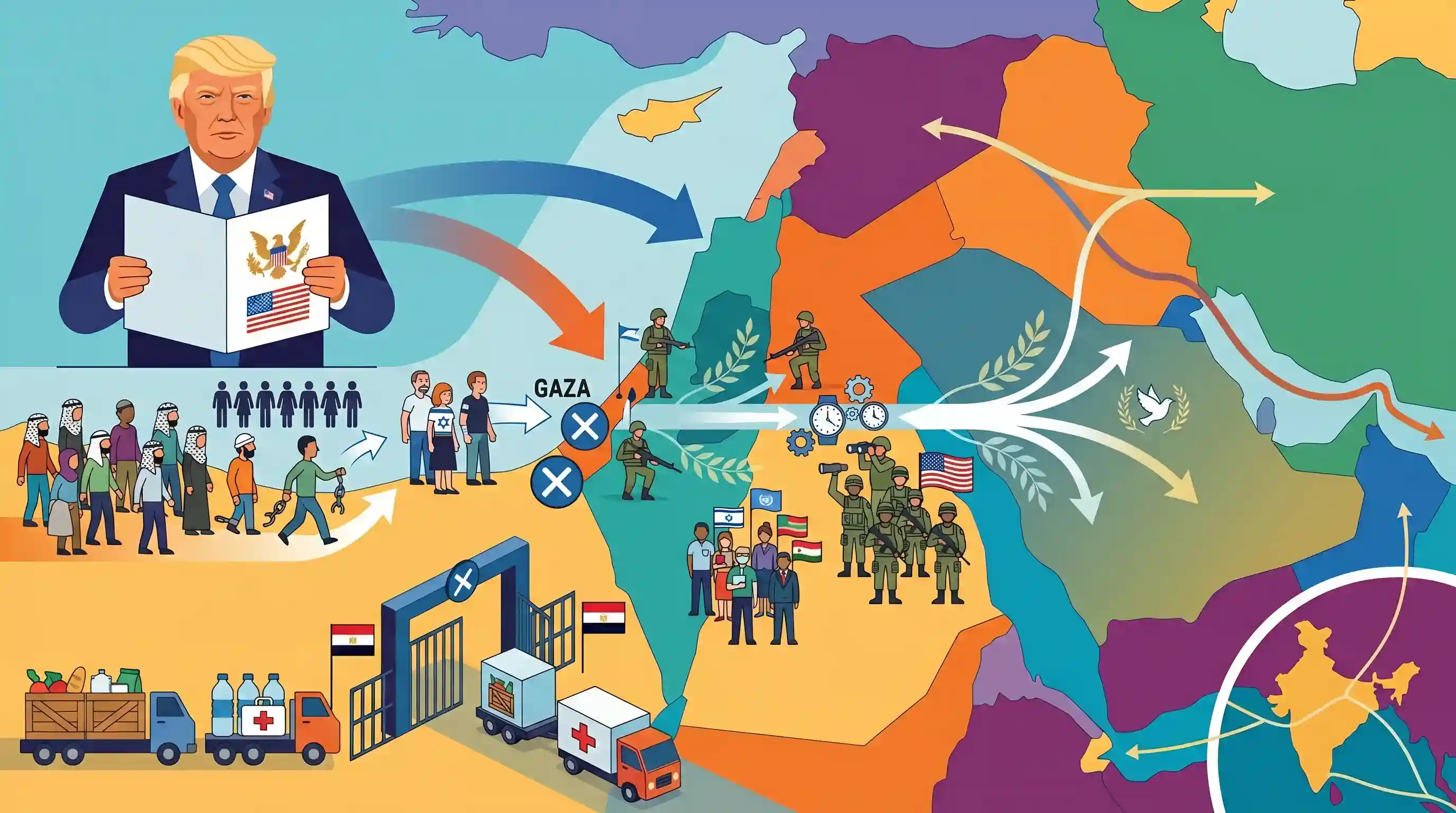
Why It Matters
The Israel-Palestine conflict is a core geopolitical issue affecting West Asia's stability, international diplomacy, and global security. Understanding the geography of the region (e.g., the Levant, Rafah crossing) and the mediatory role of major powers like the US is crucial for UPSC candidates. This context is important given India's strategic ties with Israel and its significant diaspora and energy interests in the Arab world.
Summary
The Israeli military confirmed the commencement of a Gaza ceasefire with Hamas, initiating phase one of a US-backed peace plan proposed by President Donald Trump. The agreement features a phased release of Israeli captives in exchange for approximately 2,000 Palestinian prisoners. Crucially for the enclave's humanitarian crisis, the deal includes the reopening of the Rafah border crossing with Egypt to facilitate the delivery of aid. To ensure compliance, an international monitoring team, including the deployment of around 200 US troops to Israel, is being established. This truce provides a temporary halt to hostilities that have deeply affected regional geopolitics in West Asia.
Key Points
- A ceasefire between Israel and Hamas has taken effect, implementing phase one of a US-brokered peace plan proposed by President Donald Trump.
- The agreement mandates the release of Israeli captives in exchange for the freeing of approximately 2,000 Palestinian prisoners by Israel.
- The crucial Rafah border crossing with Egypt will reopen, allowing much-needed humanitarian aid to enter the Gaza Strip.
- The United States is deploying around 200 military personnel to Israel to participate in an international mechanism monitoring the ceasefire.
- The truce follows severe bombardments and marks a significant geopolitical development for West Asia stability.
Important Terms
Gaza Ceasefire Agreement

A phased US-led multilateral deal (2025-2026) between Israel and Hamas involving hostage-prisoner swaps, humanitarian aid restoration, and a temporary cessation of hostilities under international monitoring.
UPSC context
Relevant for GS Paper 2 (International Relations); tests understanding of conflict resolution, bilateral negotiations, and West Asia's stability.
Hamas
A Palestinian Sunni-Islamic militant organization and political party that has governed the Gaza Strip since 2007; it is a central non-state actor in the West Asian conflict.
UPSC context
Important for GS Paper 2; tests knowledge of non-state actors, regional security, and their impact on global geopolitics.
Israel Defense Forces (IDF)
The national military of Israel, responsible for the country's defense. In the ceasefire context, it manages troop withdrawals and enforces security at border crossings.
UPSC context
Relevant for GS Paper 2/3; concerns state-led security operations and the implementation of international peace agreements.
Rafah Border Crossing
The southern gateway between the Gaza Strip and Egypt; it is Gaza's primary link to the outside world for humanitarian aid and pedestrian travel.
UPSC context
Crucial for World Geography and GS Paper 2; focuses on strategic choke points and humanitarian corridors in West Asia.
International Stabilisation Force (ISF)
A US-led multilateral security entity mandated to monitor ceasefire compliance, coordinate humanitarian aid, and manage the transitional security environment in post-conflict Gaza.
UPSC context
Relevant for GS Paper 2; tests knowledge of international peacekeeping, monitoring mechanisms, and US influence in the Middle East.
West Asia Geopolitics
The study of power dynamics, conflicts, and alliances in the Middle East, particularly affecting India’s energy security, trade routes (like IMEC), and diaspora.
UPSC context
Core topic for GS Paper 2; essential for analyzing India’s "Link West" policy and regional strategic interests.
Prelims Trap
The Gaza ceasefire is monitored by a United Nations Peacekeeping force deployed at the Rafah border.
The agreement bypasses the UN, deploying an ad-hoc international monitoring team including 200 US troops. The UNSC structural deadlock prevented a UN mandate.
Static Concepts Connected
What are the primary land border crossings into the Gaza Strip?
- Rafah crossing: Connects southern Gaza to Egypt's Sinai Peninsula. It is the sole crossing that bypasses Israeli territory, making it critical for humanitarian aid.
- Kerem Shalom: Located at the junction of Gaza, Israel, and Egypt. It is primarily controlled by Israel and used for commercial goods transit.
- Erez crossing: The primary northern crossing connecting Gaza strictly to Israel, historically used for pedestrian, worker, and diplomatic transit.
What is India's 'De-hyphenation' policy in West Asia?
- Independent engagements: Cultivating bilateral ties with Israel and Palestine independently, ensuring that relations with one do not dictate or constrain ties with the other.
- Strategic autonomy: Allows India to secure advanced defense and agricultural tech from Israel while continuing traditional diplomatic support for a Two-State solution for Palestine.
Cross-Topic Patterns
Geopolitical shocks and RBI inflation targeting
West Asia peace directly cools crude oil prices. This reduces imported inflation pressures, easing the burden on India's Current Account Deficit and the RBI's monetary policy stance.
Decline of UNSC in conflict resolution
The reliance on a US-brokered bilateral truce and US troops rather than UN blue helmets highlights the growing irrelevance of the UN Security Council in major regional conflicts.

Map-based matching of West Asian border crossings (Rafah, Erez) to their respective countries and 'Levant' geography is highly probable in 2026.
Linked PYQs · 3
Linked PYQs · 3
- 2022PrelimsGS1
The term "Levant" often heard in the news roughly corresponds to which of the following regions?
- 2018MainsGS2
“India’s relations with Israel have, of late, acquired a depth and diversity, which cannot be rolled back.” Discuss.
- 2025MainsGS2
"Energy security constitutes the dominant kingpin of India's foreign policy, and is linked with India's overarching influence in Middle Eastern countries.” How would you integrate energy security with India's foreign policy trajectories in the coming years?
