Gaza Humanitarian Crisis Reaches Breaking Point Says WFP Chief
Source:The Hindu ↗
Why It Matters
The article sheds light on the devastating humanitarian consequences of the Israel-Palestine conflict and the critical role (and limitations) of international bodies like the WFP in mitigating hunger in war zones. It brings into focus global discussions on the laws of war, humanitarian access, and weaponisation of food.
Summary
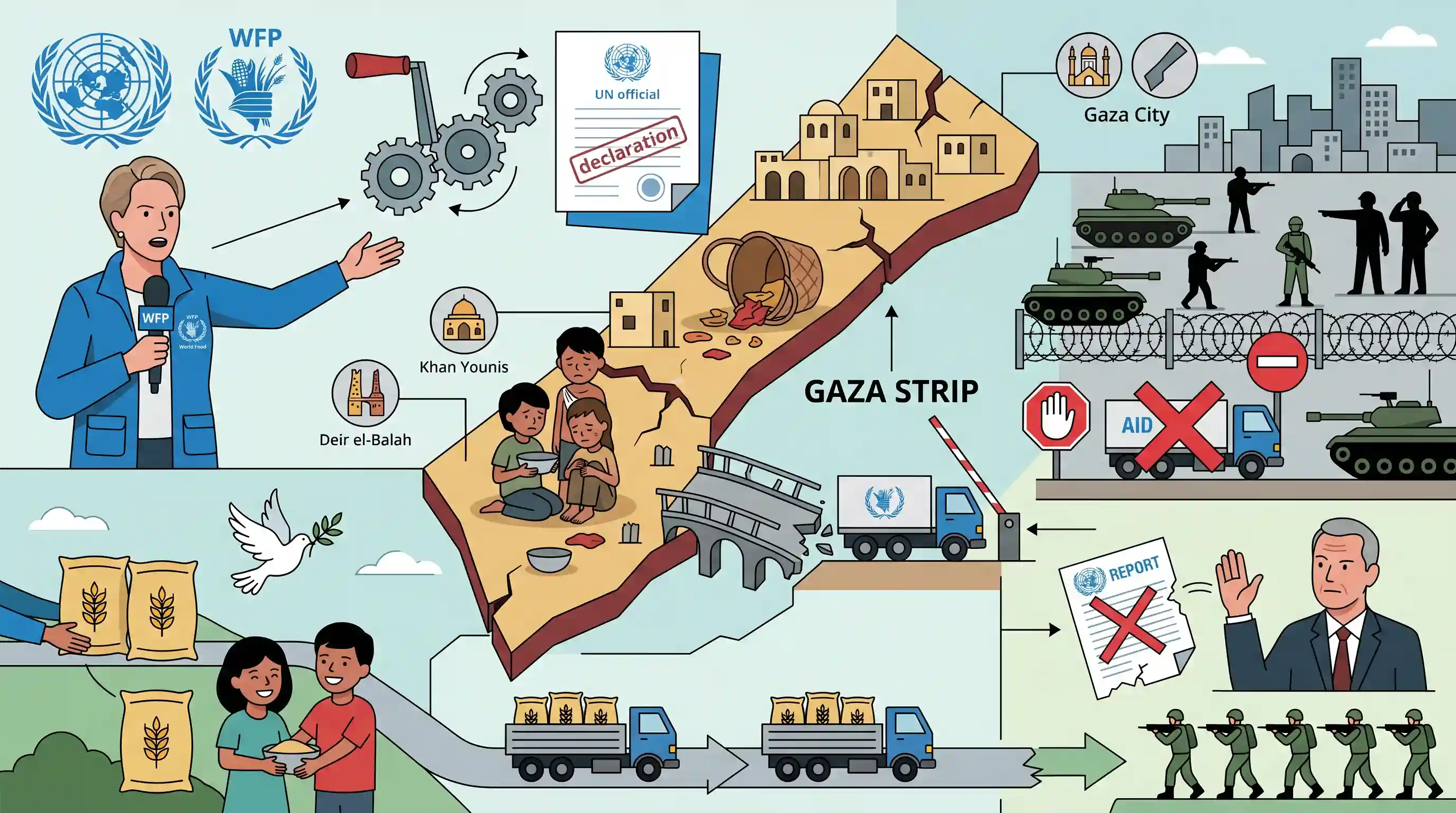
The UN World Food Programme (WFP) Executive Director Cindy McCain has warned that the Gaza Strip is at a 'breaking point' following an official UN declaration of famine in the territory. Visiting Khan Younis and Deir el-Balah, she highlighted the severe malnutrition among children and appealed for a ceasefire alongside the urgent revival of WFP’s food distribution networks. While the UN points to systemic obstruction of humanitarian aid by Israel as the cause, Israel has dismissed the famine reports as 'fabricated' amidst preparations for further operations in Gaza City.
Key Points
- The United Nations World Food Programme (WFP) chief, Cindy McCain, warned that Gaza is at a 'breaking point' due to the ongoing conflict.
- The UN has officially declared a famine in the Gaza governorate, though Israel has dismissed the report as 'fabricated'.
- The WFP highlighted severe child malnutrition and called for a ceasefire and the revival of 200 food distribution points to prevent mass starvation.
- The crisis involves severe restrictions on humanitarian access and underscores the profound humanitarian cost of the Israel-Hamas war.
Important Terms
World Food Programme (WFP)

The UN's food-assistance branch and the world's largest humanitarian organization. Headquartered in Rome, it received the 2020 Nobel Peace Prize for combating hunger in conflict zones.
UPSC context
GS II (International Agencies) & GS III (Food Security). Tests understanding of global aid architecture and SDG 2 (Zero Hunger).
Integrated Food Security Phase Classification (IPC)
A global standardized scale (Phases 1-5) used to classify food insecurity. Phase 5 (Famine/Catastrophe) requires specific thresholds: 20% household food gaps, 30% acute malnutrition, and 2 deaths/10,000 people daily.
UPSC context
GS III (Food Security). Crucial for technical questions on how global bodies measure and declare humanitarian catastrophes.
International Humanitarian Law (IHL)
A set of rules (e.g., Geneva Conventions) seeking to limit the effects of armed conflict. It explicitly prohibits the use of starvation of civilians as a method of warfare.
UPSC context
GS II (IR/Global Governance). Tests knowledge of legal frameworks governing conflict zones and human rights during war.
United Nations (UN)
An intergovernmental organization established in 1945 to maintain international peace and security. In Gaza, it acts through agencies like WFP and OCHA to coordinate emergency relief and political mediation.
UPSC context
GS II (International Institutions). Core topic regarding the efficacy and mandate of the UN in resolving contemporary global crises.
UNRWA
A UN agency established in 1949 specifically to provide relief and human development to registered Palestinian refugees. It operates independently of the WFP but collaborates on food distribution.
UPSC context
GS II (IR). Important for understanding specific regional agencies and the complexities of the Israel-Palestine conflict.
Hamas
A Palestinian political and military organization that has governed the Gaza Strip since 2007. It is a central party to the conflict and ongoing ceasefire negotiations.
UPSC context
GS II (IR). Relevant for mapping non-state actors in West Asian geopolitics and their impact on regional stability.
Prelims Trap
"The World Food Programme is funded by mandatory assessed contributions from UN member states."
The WFP is funded entirely by voluntary donations from governments, corporations, and private donors, unlike the core UN budget which relies on assessed contributions.
Static Concepts Connected
What are the technical criteria for declaring a Famine (IPC Phase 5)?
- Extreme Shortages: At least 20% of households in a given area face extreme lack of food.
- Acute Malnutrition: At least 30% of children suffer from acute malnutrition.
- Mortality Rate: Two out of every 10,000 people die daily from starvation or related diseases.
How do the mandates of the three Rome-based UN food agencies differ?
- FAO: Focuses on long-term policy, knowledge sharing, and global agricultural development.
- IFAD: Acts primarily as a financial institution financing rural development and agricultural projects.
- WFP: Focuses on frontline humanitarian food assistance, emergency logistics, and crisis response.
Cross-Topic Patterns
Geography of Levantine border crossings
Gaza's border controls (Rafah, Kerem Shalom) and adjacent territories frequently appear in map-based Prelims questions concerning the Mediterranean and Middle Eastern geopolitics.
Rome Statute and starvation war crimes
The deliberate starvation of civilians is explicitly classified as a war crime under the ICC's Rome Statute, bridging food security with International Humanitarian Law and the Geneva Conventions.

Expect a 2026 Prelims question mixing UN agency funding types (voluntary vs assessed) with IPC famine criteria and Rome bodies.
Linked PYQs · 2
Linked PYQs · 2
- 2018MainsGS2
“India’s relations with Israel have, of late, acquired a depth and diversity, which cannot be rolled back.” Discuss.
- 2016PrelimsGS1
Which of the following is/are the indicator/indicators used by IFPRI to compute the Global Hunger Index Report? 1. Undernourishment 2. Child stunting 3. Child mortality Select the correct answer using the code given below.
