Chhattisgarh High Court Upholds Gayatri Mantra Recitation in Schools
Source:Indian Express ↗
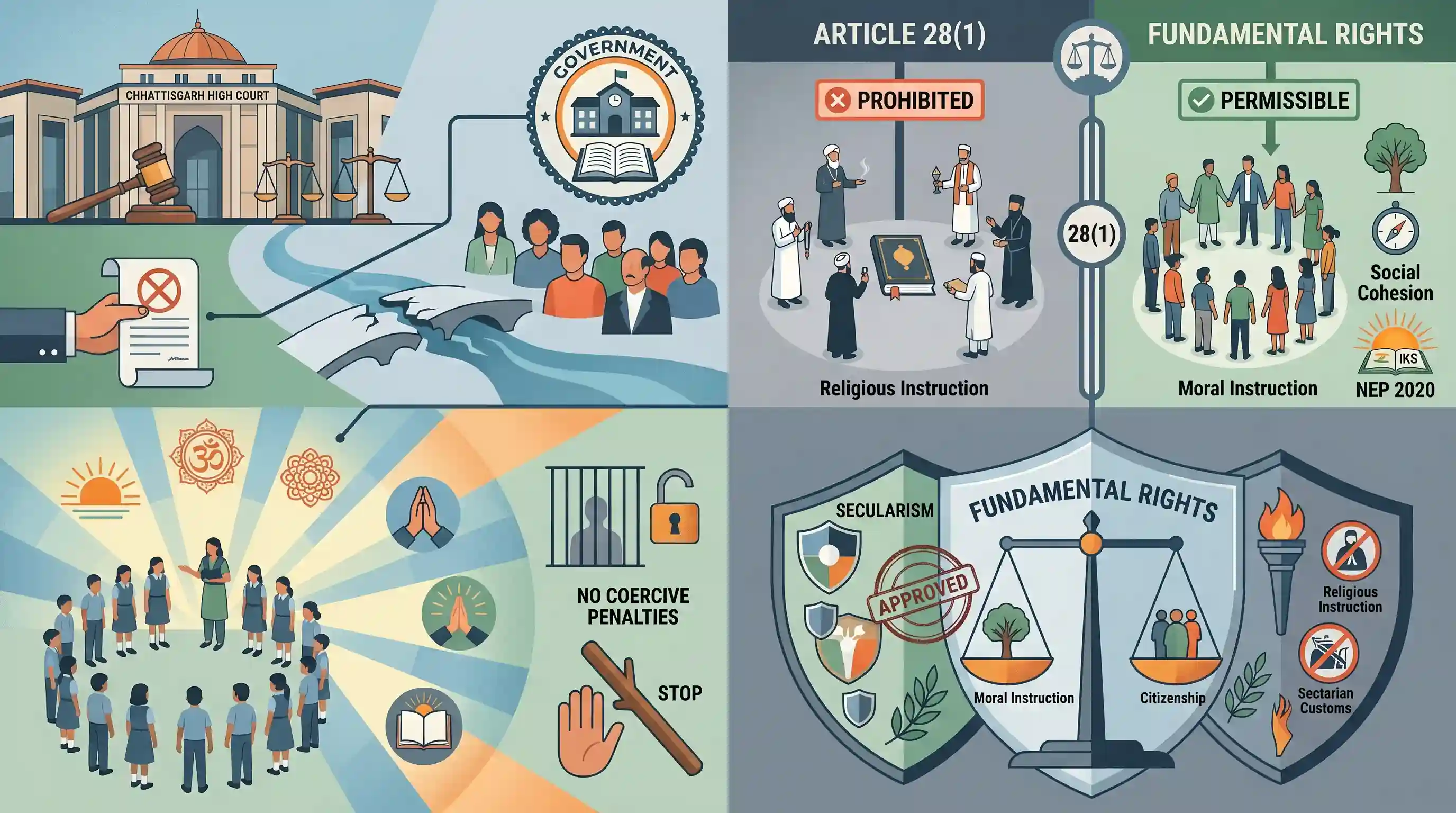
Why It Matters
This ruling serves as a vital case study for the GS2 syllabus on Indian Secularism, Fundamental Rights (Articles 25 and 28), and Education. It provides a nuanced judicial interpretation of the boundary between 'religious instruction' and 'moral instruction' in state-funded schools. It also highlights the constitutional debates surrounding the integration of Indian Knowledge Systems (IKS) under the National Education Policy 2020.
Summary
The Chhattisgarh High Court rejected a petition challenging the state's directive to recite the Gayatri Mantra and other prayers in state-funded schools. The Court ruled that the directive does not violate constitutional rights as it contains no coercive penalties. Crucially, the judgment drew a clear constitutional distinction under Article 28(1) between prohibited 'religious instruction' (sectarian customs/rituals) and permissible 'moral instruction' (non-denominational teachings that foster citizenship, focus, and social cohesion).
Key Points
- The Chhattisgarh High Court dismissed a petition challenging a state education department directive mandating the recitation of the 'Gayatri Mantra' and other prayers during school morning assemblies in state-funded schools.
- The petition argued that the directive violated Articles 14, 21, 25, 28(1), 29, and 30, claiming it forced minority students to participate in Hindu religious practices and amounted to state-led religious instruction.
- The state government defended the order, stating that it was not coercive, carried no penalties for non-compliance, and aligned with NEP 2020's mandate to integrate Indian Knowledge Systems (IKS) to foster cultural awareness and cognitive focus.
- The High Court held that the order did not contain any mandatory or coercive direction that interfered with a student's freedom of religion or conscience.
- Significantly, the Court clarified the scope of Article 28(1), ruling that 'religious instruction' has a restricted meaning (teaching of specific religious customs, rituals, or sectarian modes of worship) and does not ban 'moral instruction' that is disassociated from denominational doctrines.
- The Court emphasized that moral instruction remains essential for citizenship training, the maintenance of law and order, and the growth of social cohesion.
Important Terms
Article 28 of the Constitution of India

A fundamental right that prohibits religious instruction in educational institutions wholly maintained by state funds, while distinguishing it from permissible moral education.
UPSC context
GS Paper II (Polity/Fundamental Rights); tests understanding of freedom of religion, state-funded institutions, and secular educational frameworks.
National Education Policy 2020 (NEP 2020)
India's comprehensive framework for transforming the education system, emphasizing holistic development, flexibility, and the integration of value-based learning and traditional Indian knowledge.
UPSC context
GS Paper II (Social Justice/Education); tests policies aimed at structural and pedagogical reforms in primary to higher education.
Indian Knowledge Systems (IKS)
An initiative under NEP 2020 to promote interdisciplinary research and the integration of traditional Indian scientific, cultural, and philosophical heritage into modern educational curricula.
UPSC context
GS Paper I & II (Culture/Education); tests understanding of incorporating indigenous wisdom, heritage, and values into official state curricula.
Secularism
The constitutional principle of maintaining equal respect and distance from all religions, ensuring the state does not sponsor any specific religion in public institutions.
UPSC context
GS Paper I & II (Indian Society/Polity); tests understanding of India's unique positive secularism versus Western concepts of strict separation.
Chhattisgarh High Court
The principal civil court of original jurisdiction in the state of Chhattisgarh, located in Bilaspur, established under the Madhya Pradesh Reorganisation Act, 2000.
UPSC context
GS Paper II (Polity/Judiciary); tests understanding of the judicial structure, powers, and regional interpretations of fundamental rights in states.
Prelims Trap
Article 28(1) bans both sectarian religious instruction and non-denominational moral or value-based education in institutions wholly maintained by the State.
Article 28(1) strictly prohibits 'religious instruction' (dogmatic, sectarian rituals), but does not bar 'moral instruction' or value education, which the judiciary has repeatedly upheld as constitutional and non-coercive.
Static Concepts Connected
How does Article 28 categorize educational institutions regarding religious instruction?
- Wholly State-maintained: Religious instruction is strictly prohibited under Article 28(1).
- State-administered/Trust-established: Instruction is permitted as they are established under a specific trust or endowment.
- State-recognized or Aided: Religious instruction is permitted but must be entirely voluntary for students.
What is the judicial distinction between religious and moral instruction (Aruna Roy Case, 2002)?
- Religious Instruction: Refers strictly to teaching specific sectarian dogmas, rituals, and modes of worship. This is prohibited in wholly state-funded schools.
- Moral Education: Refers to universal ethical values, citizenship training, and spiritual heritage disassociated from specific dogmas. This is constitutionally permissible.
Cross-Topic Patterns
Composite Culture vs. Article 28
Balances the fundamental duty to preserve India's composite culture (Article 51A) against the non-establishment mandate of secularism in state-funded educational institutions.
NEP 2020 vs. Minority Autonomy
Examines how standardizing Indian Knowledge Systems (IKS) under NEP 2020 interacts with the administrative and religious autonomy of minority institutions under Article 30.

The legal distinction between prohibited 'religious instruction' and permissible 'moral education' under Article 28 is a likely 2026 Prelims target.
Linked PYQs · 2
Linked PYQs · 2
- 2024MainsGS2
Discuss India as a secular state and compare with the secular principles of the US constitution.
- 2020MainsGS2
National Education Policy 2020 is in conformity with the Sustainable Development Goal-4 (2030). It intends to restructure and reorient education system in India. Critically examine the statement.
