Gauhati High Court orders framing of IPC charges in protest case
Source:Indian Express ↗
Why It Matters
The judgment provides crucial legal clarity on the threshold for invoking the UAPA, distinguishing between ordinary law and order disruptions (like unlawful assembly during protests) and 'terrorist acts'. It also illustrates the jurisdictional boundaries of specialized investigative agencies (NIA) and their respective courts when scheduled offences are not proven.
Summary
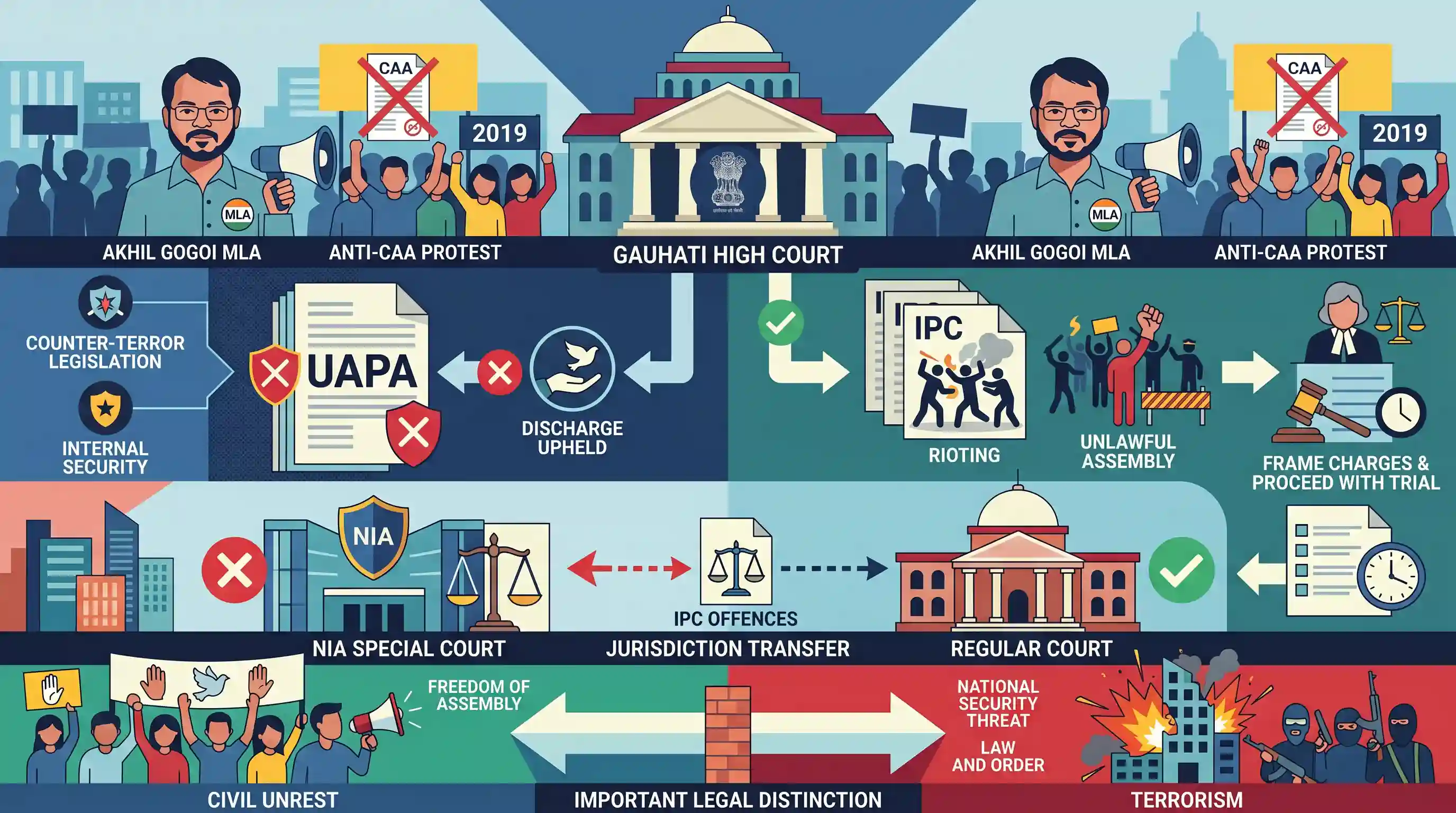
The Gauhati High Court has upheld the discharge of Assam MLA Akhil Gogoi from terrorism charges under the Unlawful Activities (Prevention) Act (UAPA) concerning the 2019 anti-CAA protests. However, the court found sufficient grounds for framing charges under the Indian Penal Code (IPC) for offences like rioting and unlawful assembly. Because the UAPA charges were dropped, the NIA Special Court no longer has jurisdiction over standalone IPC offences, prompting the High Court to direct a regular court to frame the IPC charges and proceed with the trial. The ruling draws an important legal distinction between civil unrest and terrorism.
Key Points
- The Gauhati High Court ordered a regular court to frame IPC charges against Assam MLA Akhil Gogoi for his role in the 2019 anti-CAA protests in Chabua.
- The High Court upheld a previous NIA special court ruling discharging Gogoi of terrorism charges under the Unlawful Activities (Prevention) Act (UAPA).
- The court ruled that while the protests involved blockades and vandalism, the actions did not qualify as a 'terrorist act' under Section 16 of the UAPA.
- Due to the dropping of UAPA charges (the scheduled offence), the NIA Special Court lost jurisdiction to try standalone IPC offences, resulting in the case being transferred to a regular trial court.
Important Terms
Unlawful Activities (Prevention) Act (UAPA)

India's primary anti-terrorism law (1967) targeting acts that threaten national sovereignty. It allows for extended pre-trial detention and was notably amended in 2019 to designate individuals as terrorists.
UPSC context
GS Paper 3 (Internal Security); focuses on the balance between national security and fundamental rights (Freedom of Speech/Assembly).
Citizenship Amendment Act (CAA)
A 2019 amendment granting citizenship to persecuted minorities (excluding Muslims) from Afghanistan, Pakistan, and Bangladesh who entered India before 2015. It sparked nationwide protests over secularism.
UPSC context
GS Paper 2 (Polity); tests understanding of citizenship laws and Article 14 (Right to Equality).
National Investigation Agency (NIA)
India's federal counter-terrorism agency established in 2008. It investigates crimes affecting national security, sovereignty, and integrity across state boundaries without requiring prior state consent.
UPSC context
GS Paper 3 (Security Agencies); examines federal investigative powers and the agency's mandate in counter-terrorism.
Indian Penal Code (IPC)
The official criminal code of India (1860) defining crimes and punishments. Replaced by Bharatiya Nyaya Sanhita (BNS) in 2024, but still applies to offences committed before the change.
UPSC context
GS Paper 2 (Criminal Justice System); vital for understanding the evolution of penal laws and current legal transitions.
Gauhati High Court
The common High Court for Assam, Nagaland, Mizoram, and Arunachal Pradesh. It represents the largest geographical jurisdiction among Indian High Courts.
UPSC context
GS Paper 2 (Judiciary); relevant for questions on the jurisdiction of common high courts (Article 231).
Prelims Trap
NIA Special Courts retain jurisdiction to try standalone IPC offences even if the Scheduled Offences are dropped.
Under the NIA Act, 2008, Special Courts try standalone IPC offences only when joined with a Scheduled Offence. If UAPA is dropped, regular courts take over.
Static Concepts Connected
How does the Supreme Court distinguish between public order and security of the state?
- Law and Order: The largest circle representing ordinary breaches of local peace, like an isolated physical altercation between individuals.
- Public Order: The middle circle involving disruptions that affect the community at large, such as widespread rioting or unlawful assembly.
- Security of State: The innermost circle involving existential threats to the nation, like terrorism or insurgency, justifying stringent laws like UAPA.
What are the RPA 1951 criteria for legislator disqualification upon conviction?
- Section 8(1): Triggers automatic disqualification upon conviction for specific severe offences (e.g., UAPA, promoting enmity), regardless of the sentence duration.
- Section 8(3): Triggers disqualification for general offences (like standard IPC crimes) only if the conviction results in a prison sentence of at least two years.
Cross-Topic Patterns
Article 19 vs Security Laws
The judiciary routinely distinguishes violent political protests (restricted under 'Public Order') from terrorism ('Security of State'), checking the overbroad application of UAPA against Article 19(1)(b) assembly rights.
Federalism and NIA Jurisdiction
Public order is a State Subject. Dropping UAPA shifts the case from a central agency's special court back to regular state-level trial courts, reaffirming federal jurisdictional boundaries.

A multi-statement question on NIA Special Court jurisdiction, specifically testing its power over standalone IPC offences, is highly likely.
Linked PYQs · 2
Linked PYQs · 2
- 2019MainsGS3
Indian Government has recently strengthened the anti-terrorism laws by amending the Unlawful Activities (Prevention) Act (UAPA), 1967 and the NIA Act. Analyze the changes in the context of prevailing security environment while discussing the scope and reasons for opposing the UAPA by human rights organizations.
- 2018MainsGS2
How far do you agree with the view that tribunals curtail the jurisdiction of ordinary courts? In view of the above, discuss the constitutional validity and competency of the tribunals in India.
