Dehradun Imposes Prohibitory Orders Under BNSS for NEET Re Examination
Source:The Hindu ↗
Why It Matters
This represents a practical, real-world application of India's new criminal codes (BNSS and BNS) replacing legacy colonial-era laws (CrPC and IPC). Understanding the transition of Section 144 CrPC to Section 163 BNSS, and Section 188 IPC to Section 223 BNS, is highly important for aspirants tracking current legal developments and administrative powers.
Summary
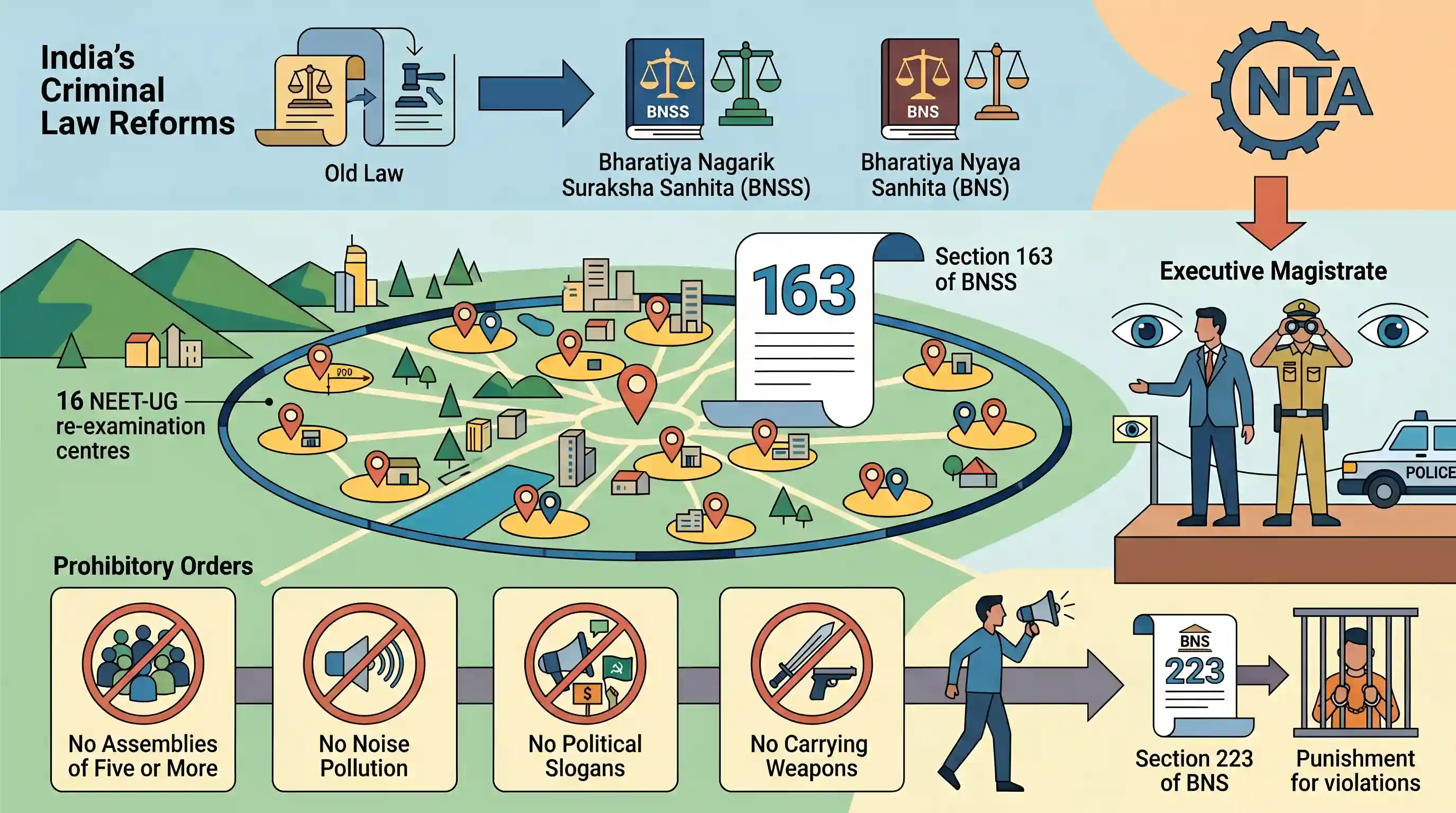
The Dehradun district administration has imposed strict prohibitory orders under Section 163 of the Bharatiya Nagarik Suraksha Sanhita (BNSS), 2023, around 16 designated NEET-UG re-examination centres on June 21, 2026 [1.1]. Triggered by a directive from the National Testing Agency (NTA) [1.1], the clampdown bans assemblies of five or more people, noise pollution, political slogans, and carrying weapons within a 200-metre radius of the centres [1.1]. Enforcement is being monitored by local magistrates and police, with violations punishable under Section 223 of the Bharatiya Nyaya Sanhita (BNS), 2023 [1.1].
Key Points
- The Dehradun district administration implemented prohibitory orders around 16 exam centres for the NEET re-examination to secure a distraction-free environment for candidates [1.1].
- Section 163 of the newly implemented Bharatiya Nagarik Suraksha Sanhita (BNSS), 2023—which replaces the historical Section 144 of the CrPC—was invoked within a 200-metre radius of all centres [1.1].
- Violators of the administration's restrictions face immediate prosecution under Section 223 of the Bharatiya Nyaya Sanhita (BNS), 2023, which replaces Section 188 of the IPC (disobedience to order duly promulgated by public servant) [1.1].
- The ban prohibits public assemblies of five or more people (excluding candidates), use of loudspeakers, political sloganeering, rallies, and possession of potential weapons like lathis or stones near exam centres [1.1].
- Sector and zonal magistrates were deployed to oversee the security protocol across major institutions, including local Kendriya Vidyalayas, Army Public School (Birpur), and the Women's Institute of Technology (Sudhowala) [1.1].
Important Terms
Bharatiya Nagarik Suraksha Sanhita, 2023 (BNSS)

The procedural law that replaced the Code of Criminal Procedure (CrPC) in India. It governs the machinery for criminal investigations, arrests, trial procedures, and preventive measures like prohibitory orders under Section 163.
UPSC context
GS Paper II: Criminal justice reforms, statutory powers of executive magistrates, and the administration of public order.
Bharatiya Nyaya Sanhita, 2023 (BNS)
The primary penal code of India, replacing the Indian Penal Code (IPC), 1860. It defines various offenses, outlines their punishments, and introduces modern provisions, including community service and updated definitions of organized crime.
UPSC context
GS Paper II: Law reform, judicial governance, and criminal jurisprudence impacting citizen rights and law enforcement.
Code of Criminal Procedure (CrPC), 1973
The historical law that provided the procedural framework for administering criminal justice in India before being replaced by the Bharatiya Nagarik Suraksha Sanhita (BNSS) in 2024.
UPSC context
GS Paper II: Historical evolution of criminal procedure, judicial reforms, and comparative analysis of colonial-era laws with modern laws.
Indian Penal Code (IPC), 1860
The official criminal code of India during the British Raj and post-independence era, which defined offenses and punishments until its replacement by the Bharatiya Nyaya Sanhita (BNS) in 2024.
UPSC context
GS Paper II: Evolution of India's penal framework, substantive criminal law reforms, and decolonizing of the judicial system.
National Testing Agency (NTA)
An autonomous, self-sustained testing organization registered under the Societies Registration Act, 1860. Established under the Ministry of Education, it conducts standardized entrance examinations for admissions and fellowships in higher educational institutions.
UPSC context
GS Paper II: Governance, statutory/autonomous bodies, educational reforms, and issues surrounding the integrity of national exams.
Prelims Trap
Section 144 of the Bharatiya Nagarik Suraksha Sanhita (BNSS) empowers magistrates to issue prohibitory orders in cases of apprehended danger.
Under the BNSS, the old Section 144 (prohibitory orders) is renumbered as Section 163. Section 144 of the BNSS now actually deals with the maintenance of families (formerly Section 125 of the CrPC).
Static Concepts Connected
What is the legal status and organizational structure of the National Testing Agency (NTA)?
- Legal Status: Registered under the Societies Registration Act, 1860, as an autonomous and self-sustained testing organization, making it non-statutory.
- Parent Ministry: Functions under the Department of Higher Education, Ministry of Education, Government of India.
- Governance Structure: Managed by a Governing Body chaired by an eminent educationist, with a Director General as its CEO.
What are the executive powers and limits under Section 163 of the BNSS (formerly Section 144 CrPC)?
- Nature of Power: Empowers Executive Magistrates to issue temporary orders in urgent cases of nuisance or apprehended danger to preserve public order.
- Duration Limits: Valid for a maximum of two months, extendable by the State Government up to a total of six months.
- Judicial Oversight: Can be passed ex-parte in emergencies, but remains subject to judicial review to prevent arbitrary executive action.
Cross-Topic Patterns
Executive Discretion vs Article 19
Using BNSS Section 163 around examination centers tests the limits of executive discretion and reasonable restrictions on freedom of assembly under Article 19.
Administrative Reforms in NTA
Restricting NTA to academic testing while deploying state administrative machinery highlights a dual-track reform strategy to secure public exams.

Renumbered provisions of BNSS (like Section 163 vs 144) and the non-statutory status of NTA are highly probable Prelims MCQ targets.
