Ganga Water Treaty needs revision amid emerging ecological realities
Source:The Hindu ↗
हे का महत्त्वाचे आहे
Hydro-diplomacy is a critical pillar of India's Neighbourhood First policy. With the 1996 Ganga Water Treaty approaching renewal, debates over its efficacy highlight the complexities of equitable water sharing, climate change adaptation, and basin-wide management between lower and upper riparians.
सारांश
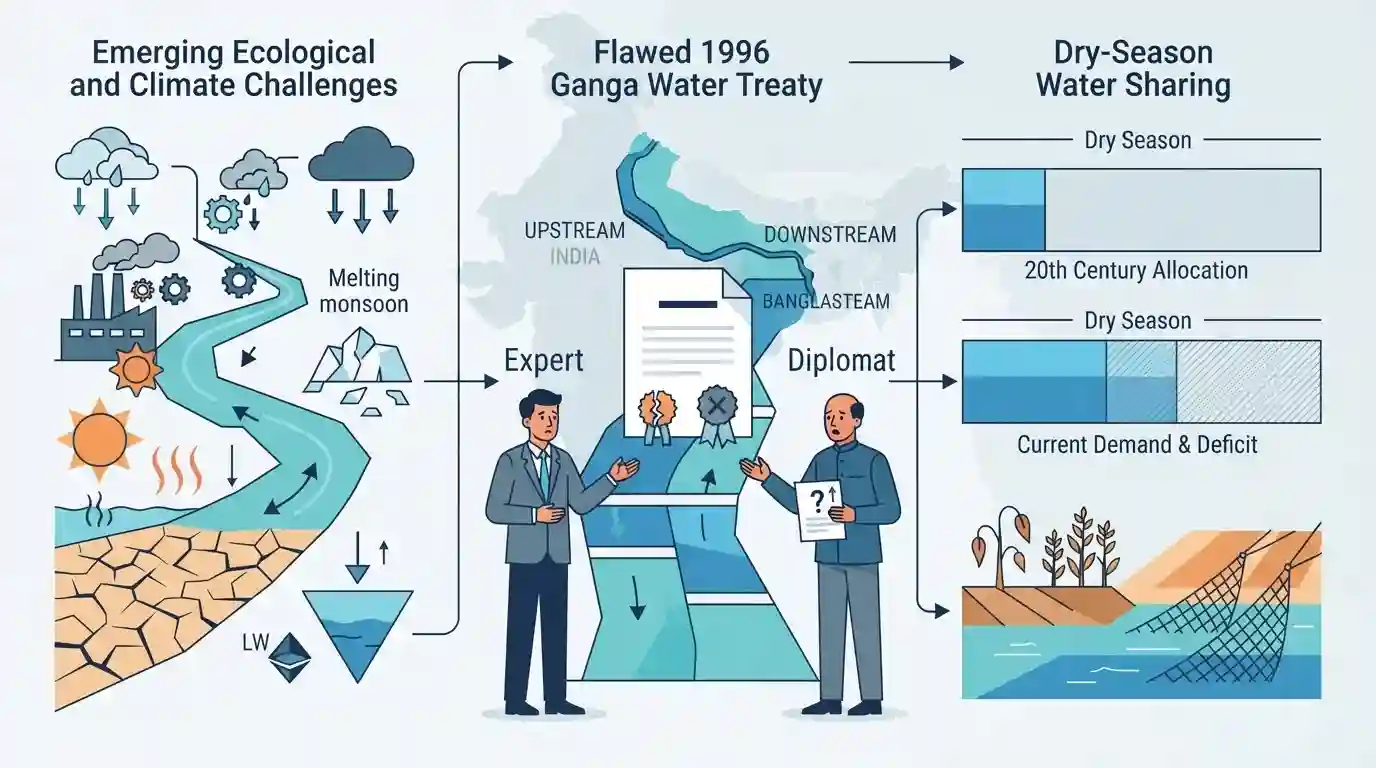
A Bangladesh river expert has termed the 1996 Ganga Water Treaty 'flawed' and called for its revision, highlighting emerging ecological and climate challenges that affect dry-season water sharing between India and Bangladesh.
मुख्य मुद्दे
- Bangladesh river experts have criticized the 1996 Ganga Water Treaty as flawed and in urgent need of updating ahead of its upcoming renewal.
- Key criticisms include declining dry-season water availability at Farakka, changing climate patterns, and ecological degradation of the basin.
- The debate underscores the complex nature of hydro-diplomacy in South Asia, balancing upstream developmental needs with downstream environmental and livelihood concerns.
महत्त्वाच्या संज्ञा
Ganga Water Treaty 1996

A 30-year bilateral agreement signed in December 1996 between India and Bangladesh to share the dry-season waters (January 1 to May 31) of the Ganga River, primarily based on flows at the Farakka Barrage.
UPSC context
Important for GS Paper II (International Relations - India-Bangladesh bilateral ties, transboundary water diplomacy, hydro-politics, and treaty renewals).
Indus Waters Treaty
A 1960 water-distribution treaty between India and Pakistan, brokered by the World Bank, governing the use of the Indus River system's six transboundary rivers.
UPSC context
Essential for GS Paper II (International Relations - India-Pakistan relations and regional hydro-diplomacy/treaty management).
Bangladesh Water Development Board
A key public sector engineering organization under Bangladesh's Ministry of Water Resources responsible for implementing flood control, drainage, irrigation projects, and hydrological data monitoring.
UPSC context
Relevant for GS Paper II (International Relations - institutional frameworks and domestic water administration in neighboring riparian states).
पूर्वपरीक्षा सापळा
equal 50:50 sharing throughout the year
Aspirants often assume the Ganga Water Treaty allocates water equally throughout the year, whereas its specific formula applies strictly to the lean dry season (January 1 to May 31).
संबंधित स्थिर संकल्पना
What are the key principles of international water law governing transboundary rivers?
- Equitable Utilization:: Equitable and reasonable utilization of shared water resources by all riparian states.
- No-Harm Rule:: Obligation of states not to cause significant harm to other riparian territories.
- Cooperation:: Duty of riparian states to cooperate and exchange hydrological data regularly.
आंतर-विषय नमुने
Transboundary Water Diplomacy & International Law
Transboundary river sharing intersects with international law, environmental degradation, and riparian rights under the Helsinki Rules.
Climate Change & Hydro-politics in South Asia
Climate change-induced hydrological shifts complicate traditional bilateral water-sharing arrangements across South Asian shared river basins.

1996 Ganga Treaty renewal (due Dec 2026) makes transboundary water diplomacy a high-yield topic for prelims and GS-2 international relations.
संबंधित PYQ · 1
संबंधित PYQ · 1
- 2012MainsGS2
The situation today is far different to that prevalent fifty years back when the Indus Water Treaty was signed." Highlight the complexity of the current challenges on both sides of the border in this regard. Do you think that a review of the Treaty is in India's best interests?
