Ganga Water Treaty Revision and Transboundary Hydro Diplomacy
Source:The Hindu ↗
কেন এটি গুরুত্বপূর্ণ
The Ganga Water Treaty is a cornerstone of India-Bangladesh bilateral relations. Discussions on updating or revising the 1996 treaty affect regional hydro-diplomacy, environmental sustainability, and geopolitical trust between the two neighboring countries.
সারসংক্ষেপ
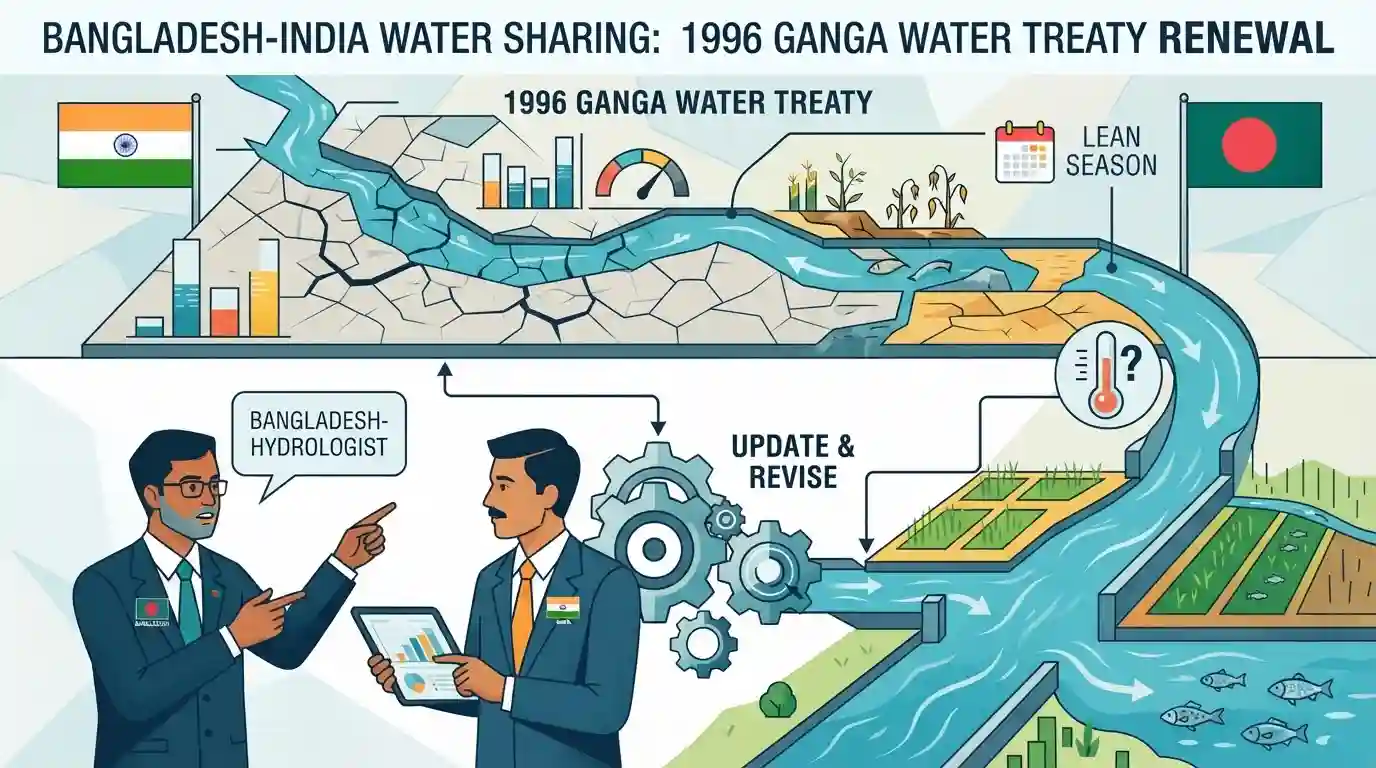
A Bangladeshi river expert has criticised the 1996 Ganga Water Treaty as flawed, emphasizing the urgent need to update it to address changing hydrological patterns, environmental flows, and declining lean-season water availability. This highlights ongoing challenges in India-Bangladesh transboundary water cooperation as the treaty approaches its renewal window.
মূল বিষয়
- A Bangladeshi river expert has termed the 1996 Ganga Water Treaty as 'flawed' and called for its revision, highlighting concerns over changing hydrological realities, reduced lean-season water flows, and environmental flows.
- The 1996 treaty, signed for a 30-year period, is due for review or renewal soon, making the debate over equitable water sharing and data transparency critical to India-Bangladesh bilateral relations.
- Experts point out that environmental changes, upstream abstractions, and shifting climate patterns require a more adaptive and comprehensive framework for transboundary water management.
গুরুত্বপূর্ণ শব্দ
Ganga Water Treaty 1996

A 30-year bilateral agreement signed in December 1996 to regulate the sharing of the Ganges River’s dry-season waters at Farakka between India and Bangladesh, set to expire in 2026.
UPSC context
UPSC Paper II (International Relations): Important bilateral agreements, transboundary water diplomacy, and India-Bangladesh regional cooperation challenges.
Bangladesh Joint Rivers Commission
A bilateral mechanism established in 1972 to maintain liaison, manage joint river systems, share flood data, and address water resource issues between India and Bangladesh.
UPSC context
UPSC Paper II (International Relations): Institutional mechanisms for resolving transboundary river disputes and bilateral water diplomacy in South Asia.
প্রিলিমস ফাঁদ
permanent water-sharing agreement with no provision for renegotiation or review
Aspirants often assume the 1996 Ganga Water Treaty was signed in perpetuity; however, it has a specific 30-year duration and is approaching its renewal window.
সংযুক্ত স্থির ধারণা
What are the core principles of international water law governing transboundary rivers?
- Equitable Utilization:: Equitable and reasonable utilization ensures all riparian states have a fair share of the water's beneficial uses.
- No-Harm Rule:: The principle obligates states to take all appropriate measures to prevent causing significant harm to other riparian states.
- Cooperation & Data:: Riparian states are expected to share hydrological data and consult on planned measures affecting the shared watercourse.
আন্তঃবিষয় প্যাটার্ন
Water Diplomacy + International Water Law
Transboundary water-sharing disputes intersect with bilateral diplomacy, requiring adaptive mechanisms under international water law principles like the Helsinki Rules.
Climate Change + South Asian Security
Climate-induced hydrological shifts directly threaten food and livelihood security in the lower riparian regions of South Asia.

Expect UPSC statements on the 1996 Ganga Treaty renewal terms, Joint Rivers Commission, and lower riparian water rights principles.
