Ganga Water Sharing Treaty Renewal and Hydro Diplomacy
Source:Indian Express ↗
Why It Matters
Transboundary water governance and treaty renewals are key aspects of India's neighborhood first policy and bilateral diplomacy with Bangladesh, making it essential for GS Paper 2.
Summary
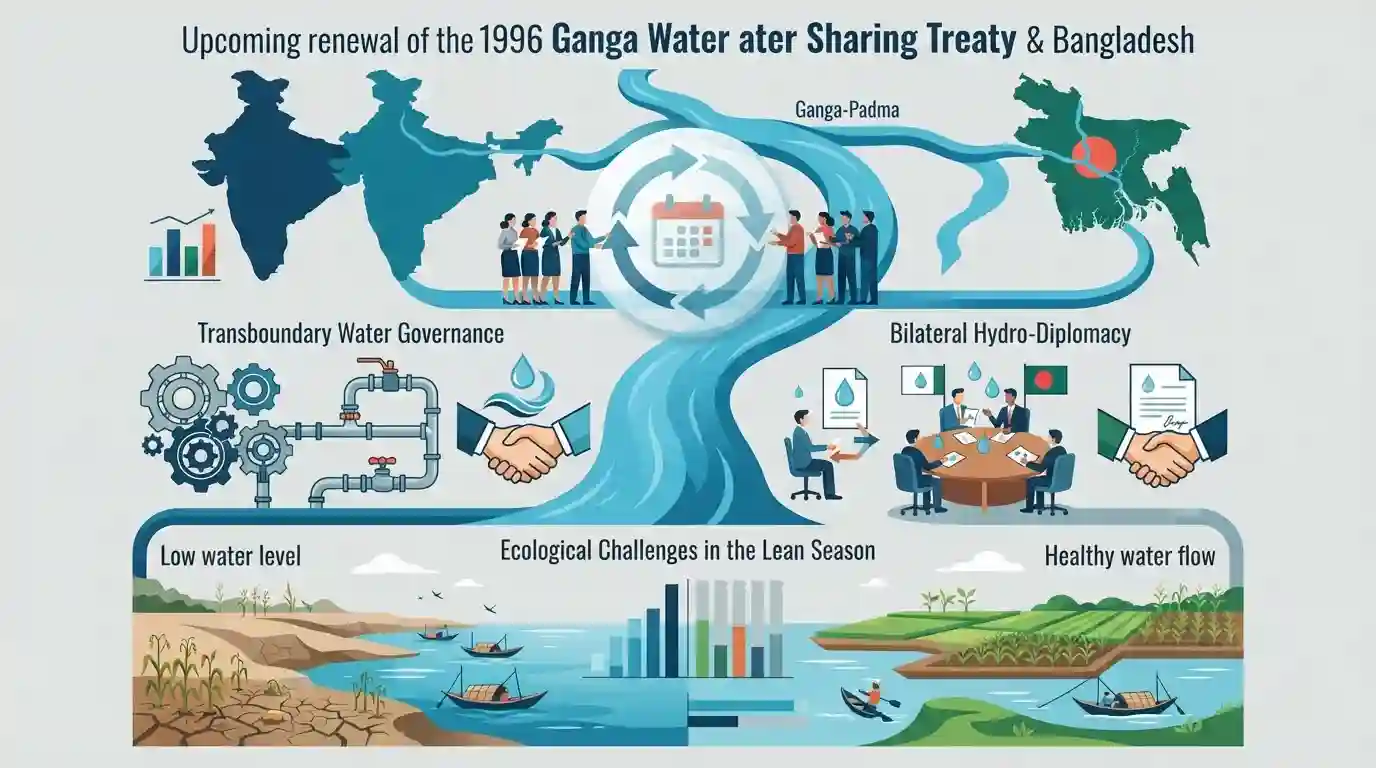
An analysis of the upcoming renewal of the 1996 Ganga Water Sharing Treaty between India and Bangladesh, focusing on transboundary water governance, bilateral hydro-diplomacy, and ecological challenges in the lean season.
Key Points
- The 1996 Ganga Water Sharing Treaty between India and Bangladesh is due for renewal or review, bringing bilateral transboundary water management into focus.
- The treaty governs water sharing at the Farakka Barrage during the lean season (January to May).
- Key geopolitical and ecological considerations include shifting rainfall patterns, upstream water extraction, delta management, and regional cooperation.
- Effective hydro-diplomacy is critical for maintaining stability and trust in India-Bangladesh relations.
Important Terms
Ganga Water Sharing Treaty

A 30-year bilateral pact signed in December 1996 governing the sharing of dry-season water flows of the Ganges River between India and Bangladesh at the Farakka Barrage.
UPSC context
Important for GS Paper II (International Relations - India-Bangladesh bilateral ties, transboundary water governance, hydro-diplomacy).
Static Concepts Connected
What are the key institutional mechanisms and allocation formulas under the 1996 Ganga Water Sharing Treaty?
- Duration & Scope: 30-year duration signed in 1996 to govern lean-season (Jan 1–May 31) water sharing at Farakka Barrage.
- Sharing Formula: Applies a 50:50 equal sharing rule when downstream flow at Farakka is 70,000 cusecs or less over 10-day periods.
- Joint Committee: Established a Joint Committee of representatives from both nations to monitor daily discharges at Farakka (India) and Hardinge Bridge (Bangladesh).
- Guarantee Clause: Includes a guarantee clause ensuring minimum water flows during critical dry periods based on historical 40-year flow data.
Cross-Topic Patterns
Hydro-Diplomacy and Federal Water Governance
Transboundary river treaties intersect with domestic water rights and interstate disputes like the Cauvery or Mahadayi tribunals under Article 262.
Ganga Treaty and BBIN Connectivity Dynamics
Bilateral water negotiations with Bangladesh directly impact India's broader Indo-Pacific security calculus and regional connectivity initiatives in the BBIN framework.

Expect a statement-based prelims question combining the 1996 Ganga Treaty's 30-year duration, 50:50 sharing formula, and institutional mechanisms.
Linked PYQs · 2
Linked PYQs · 2
- 2012MainsGS2
The situation today is far different to that prevalent fifty years back when the Indus Water Treaty was signed." Highlight the complexity of the current challenges on both sides of the border in this regard. Do you think that a review of the Treaty is in India's best interests?
- 2026PrelimsGS1
Identify the river of the Indian sub-continent on the basis of the following information : 1. It has an antecedent drainage system. 2. It flows through three countries. 3. It originates in the Tibetan Plateau and is an important river for irrigation. 4. It does not form distributaries. Select the answer from the following :
