Transboundary River Treaties and Hydro Diplomacy Frameworks
Source:Indian Express ↗
Why It Matters
Transboundary river management is a core friction point in India-Bangladesh relations. Understanding this issue is crucial for UPSC aspirants as it bridges International Relations (Neighbourhood First policy, hydro-diplomacy) with domestic Polity (the role of state governments in foreign policy) and Geography (Himalayan river systems).
Summary
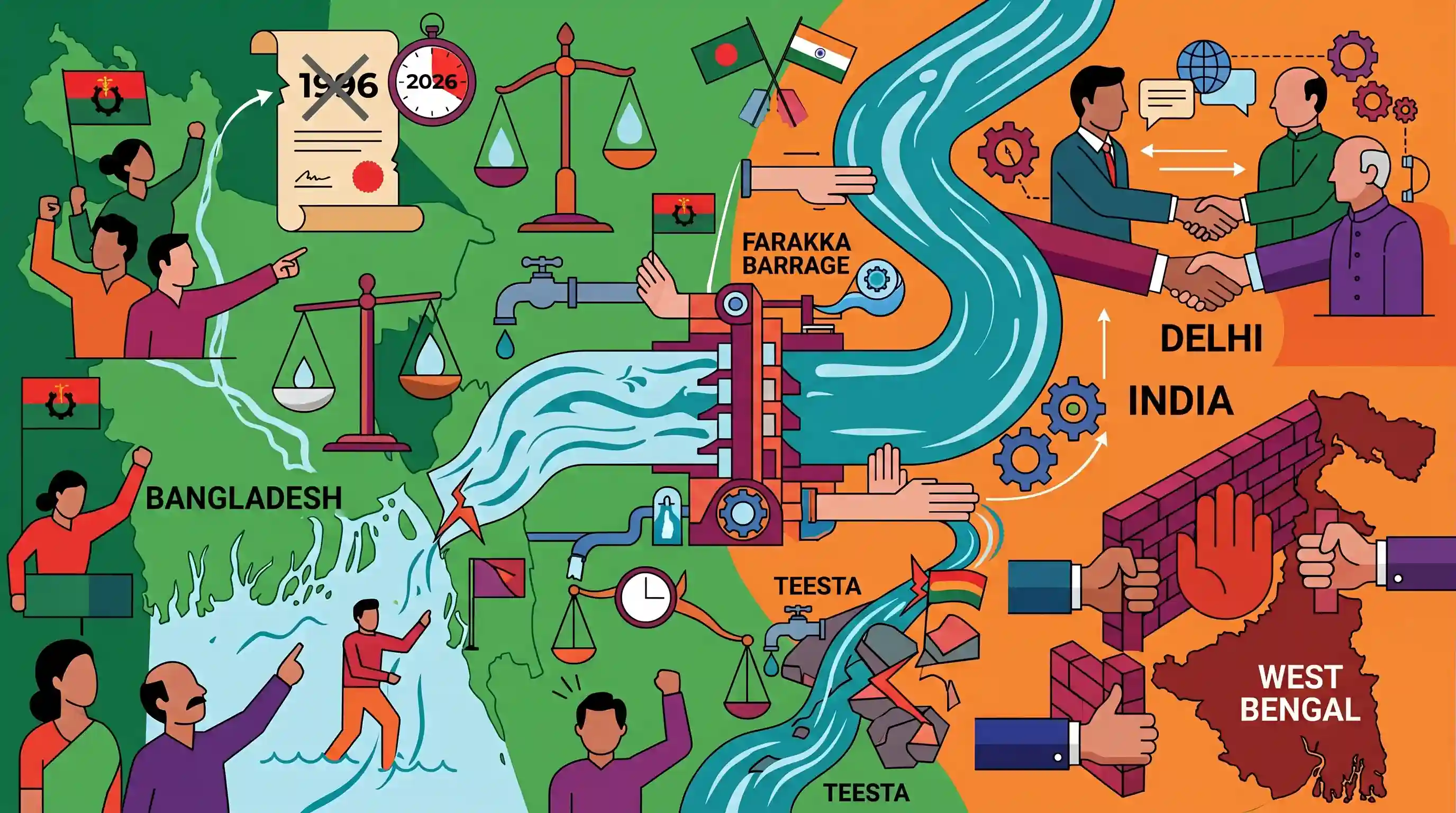
The 1996 Ganga Water Sharing Treaty between India and Bangladesh, which governs dry-season river flows via the Farakka Barrage, expires in 2026. With recent political upheaval in Dhaka, the Bangladesh Nationalist Party (BNP) has elevated the treaty's renegotiation to a top priority, claiming Bangladesh receives an unfair share. This demand presents a multi-layered challenge for India. New Delhi must balance maintaining stable ties with an important neighbor under a new political reality, managing the intricate hydro-diplomacy of transboundary rivers, and navigating domestic federalism, particularly the strong reservations of the West Bengal government regarding water concessions. The situation is further complicated by unresolved disputes over other shared rivers like the Teesta.
Key Points
- The 1996 Ganga Water Sharing Treaty, which dictates lean-season water allocation between India and Bangladesh, is set to expire in 2026.
- Following political changes in Bangladesh, the Bangladesh Nationalist Party (BNP) has made renegotiating the treaty on more favorable terms a top foreign policy priority.
- Bangladesh contends that the current flow measurements at West Bengal's Farakka Barrage fail to provide the lower riparian state with adequate water for dry-season agricultural and ecological needs.
- India's diplomatic response is constrained by domestic federal dynamics, as the West Bengal state government frequently opposes water-sharing concessions that might impact its own water security.
- The pressure to revise the Ganga pact adds to existing hydro-diplomacy friction, notably the longstanding deadlock over the Teesta River water-sharing agreement.
Important Terms
Ganga Water Sharing Treaty (1996)

A 30-year bilateral agreement (expiring 2026) between India and Bangladesh governing the dry-season sharing of Ganga waters at the Farakka Barrage.
UPSC context
GS-II: India and its Neighbourhood; important for understanding transboundary river management and bilateral diplomacy.
Teesta Water Sharing Agreement
A long-pending, sensitive water-sharing dispute over the Teesta River's lean-season flow, stalled since 2011 due to opposition from the West Bengal government.
UPSC context
GS-II: Federalism; tests the influence of state governments on India's foreign policy and international treaties.
Bangladesh Nationalist Party (BNP)
A major Bangladeshi political party that historically adopts a more critical stance toward India; it currently advocates for renegotiating water treaties to secure better terms.
UPSC context
GS-II: International Relations; significant for analyzing political transitions in neighboring countries and their impact on India.
Awami League
The political party in Bangladesh, formerly led by Sheikh Hasina, that signed the 1996 Ganga Treaty and is generally viewed as favoring closer ties with India.
UPSC context
GS-II: India's Neighbourhood Policy; relevant for historical context of bilateral cooperation and security.
Farakka Barrage
A barrage in West Bengal, India, used to divert Ganga water into the Hooghly River to maintain Kolkata Port's navigability, often causing downstream flow concerns.
UPSC context
GS-I: Geography; GS-III: Infrastructure; central to Indo-Bangla hydro-political disputes and regional ecology.
Hydro-diplomacy
The use of diplomatic tools to manage and resolve disputes over transboundary water resources to foster regional cooperation and stability.
UPSC context
GS-II: International Relations; a key theme in South Asian geopolitics involving shared river basins.
Joint Rivers Commission (JRC)
A bilateral technical body established in 1972 to manage the 54 shared rivers between India and Bangladesh and resolve water-sharing issues.
UPSC context
GS-II: Bilateral Institutions; crucial for technical cooperation and implementing water-sharing frameworks.
Prelims Trap
State government consent is constitutionally mandatory before the Union can sign international treaties on state subjects like water.
Article 253 grants Parliament overriding power to implement international treaties regardless of the State List. State consent is a political necessity, not a constitutional mandate.
Static Concepts Connected
How does the Constitution balance international treaties with State Subjects like water?
- Article 253: Empowers Parliament to enact laws implementing international agreements, explicitly overriding the State List if necessary.
- Entry 14 (Union): Grants the Union exclusive legislative competence over foreign affairs, treaties, and agreements with foreign countries.
- Entry 17 (State): Places water supplies, irrigation, and canals under state jurisdiction, giving states a strong political—though not constitutional—veto in negotiations.
What is the bilateral mechanism for India-Bangladesh transboundary river management?
- Joint Rivers Commission: Established in 1972 as a bilateral mechanism to manage the 54 transboundary rivers shared by India and Bangladesh, focusing on floods, irrigation, and cyclones.
- 1996 Ganga Treaty: Governs lean season (Jan 1-May 31) flows. Expires in 2026. Negotiated alongside historical pain points like the Farakka Barrage diversions.
Cross-Topic Patterns
Paradiplomacy in transboundary river treaties
The Teesta and Ganga treaty stalemates highlight how regional governments (e.g., West Bengal) increasingly shape India's 'Neighborhood First' policy, bridging GS2 Polity (Federalism) and International Relations.
Ecological engineering vs Port survival
Farakka Barrage was built to flush silt from the Hooghly to save Kolkata Port. Its downstream ecological impact perfectly connects GS1 Geography (river mechanics) to bilateral diplomatic friction.

A 2026 GS-2 question linking Article 253 (paradiplomacy) and hydro-politics via the expiring 1996 Ganga Treaty is highly probable.
Linked PYQs · 3
Linked PYQs · 3
- 2017PrelimsGS1
With reference to river Teesta, consider the following statements: 1. The source of river Teesta is the same as that of Brahmaputra but it flows through Sikkim. 2. River Rangeet originates in Sikkim and it is a tributary of river Teesta. 3. River Teesta flows into Bay of Bengal on the border of India and Bangladesh. Which of the statements given above is/are correct?
- 2020PrelimsGS1
Consider the following statements: 1. The value of Indo-Sri Lanka trade has consistently increased in the last decade. 2. "Textile and textile articles" constitute an important item of trade between India and Bangladesh. 3. In the last five years, Nepal has been the largest trading partner of India in South Asia. Which of the statements given above is/are correct?
- 2012MainsGS2
The situation today is far different to that prevalent fifty years back when the Indus Water Treaty was signed." Highlight the complexity of the current challenges on both sides of the border in this regard. Do you think that a review of the Treaty is in India's best interests?
