Ganeshotsav: Maharashtra Administration Steps Up Festival Preparations
Source:telanganatoday ↗
Why It Matters
Ganeshotsav holds profound historical and cultural importance in Maharashtra, frequently featuring in MPSC exams regarding Lokmanya Tilak's role in the freedom struggle. Additionally, the modern governance aspects—such as FDA food safety protocols and High Court directives on environmental conservation—highlight the intersection of tradition with contemporary civic challenges.
Summary
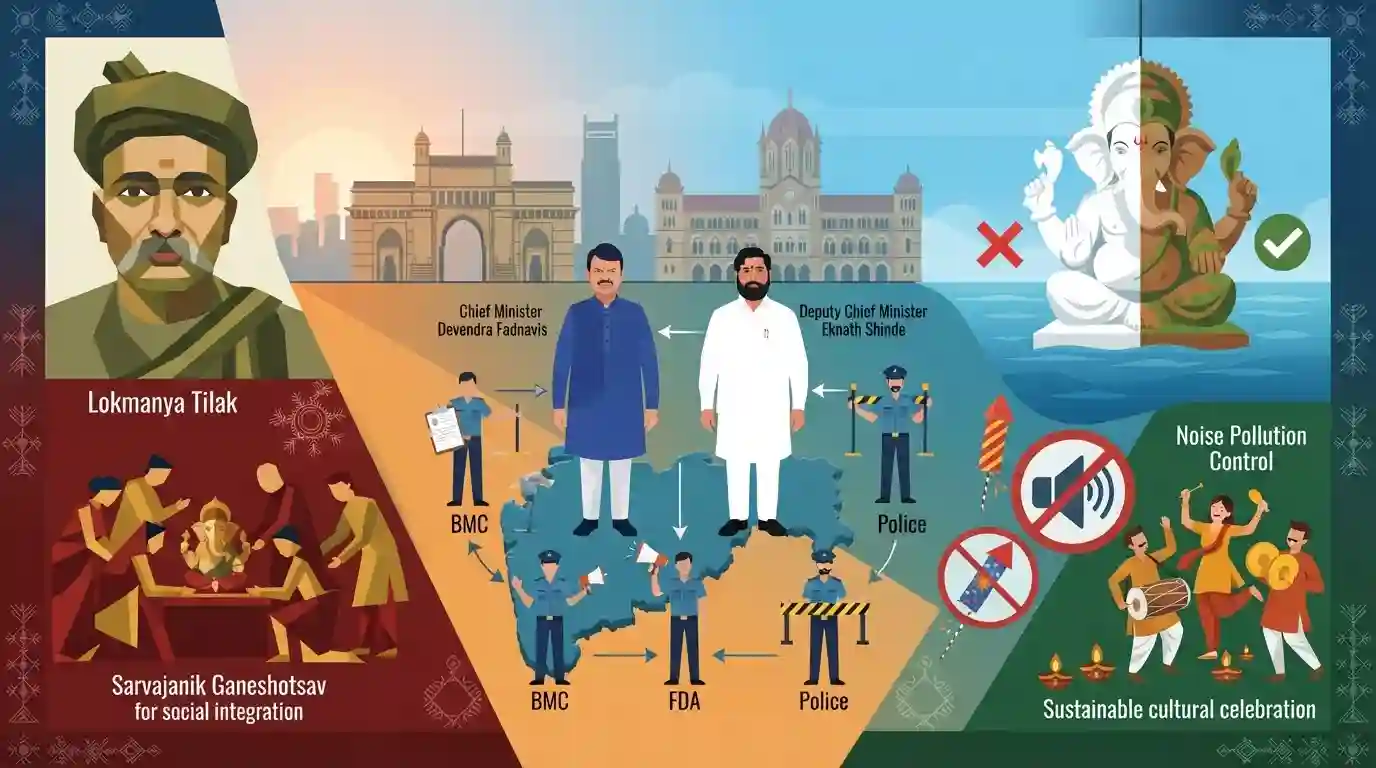
The Maharashtra government, led by CM Devendra Fadnavis and Deputy CM Eknath Shinde, has ramped up preparations for Ganeshotsav 2026. The administration is focusing on multi-departmental coordination involving the BMC, FDA, and police to ensure smooth public celebrations. A major priority is enforcing Bombay High Court guidelines to curb noise and water pollution, particularly concerning loudspeakers, firecrackers, and the immersion of Plaster of Paris (PoP) idols. Historically transformed into a public festival by Lokmanya Tilak for social integration, the event requires careful modern-day governance to balance cultural significance with environmental sustainability and public health.
Key Points
- The Maharashtra government is executing a multi-agency approach involving the Police, BMC, and FDA to ensure a smooth and safe Ganeshotsav in 2026.
- Strict adherence to Bombay High Court directives is being enforced to control noise pollution (loudspeakers, firecrackers) and prevent water pollution by limiting Plaster of Paris (PoP) idols.
- The Food and Drug Administration (FDA) is assigned to monitor the quality and hygiene of prasad distributed at various public pandals.
- Historically, the public form of Ganeshotsav (Sarvajanik Ganeshotsav) was initiated by Lokmanya Tilak to circumvent British assembly bans and foster social mobilization and nationalism.
Important Terms
Bombay High Court environmental directives

Judicial mandates issued to curb festival-related environmental degradation. These include strict guidelines on mitigating noise pollution from loudspeakers and preventing water pollution by banning the immersion of Plaster of Paris idols in natural water bodies.
UPSC context
Highly relevant for MPSC GS Paper 4 (Environmental Pollution) and GS Paper 2 (Judicial Interventions).
Brihanmumbai Municipal Corporation (BMC)
Mumbai's primary civic administrative body. It is responsible for urban infrastructure, such as road maintenance, and enforcing public safety and ecological guidelines—like creating artificial ponds for idol immersions—during large-scale festivals.
UPSC context
Crucial for MPSC GS Paper 2 (Urban Local Self-Government and Civic Administration in Maharashtra).
Food and Drug Administration (FDA) Maharashtra
The state regulatory authority overseeing food safety and hygiene. During public festivals, it enforces licensing and monitors the quality of food distributed at pandals and bhandaras to prevent public health hazards.
UPSC context
Vital for MPSC GS Paper 2 (Statutory Bodies) and GS Paper 3 (Public Health).
Plaster of Paris (PoP) Idols
Festival idols made from calcium sulfate hemihydrate. Because they are non-biodegradable and release toxic chemicals into water bodies, courts and pollution control boards heavily regulate or ban their immersion to protect aquatic ecosystems.
UPSC context
Important for MPSC GS Paper 4 (Environmental Degradation and Water Pollution).
Sarvajanik Ganeshotsav
The public celebration of the Ganesh festival. Lokmanya Tilak transformed it from a private ritual into a mass community event in 1893 to foster social integration, unite citizens across castes, and mobilize anti-colonial nationalism.
UPSC context
Essential for MPSC GS Paper 1 (Modern Indian History and Social Reformers of Maharashtra).
Prelims Trap
"Use of loudspeakers during religious festivals is a protected fundamental right under Article 25."
The Supreme Court and Bombay High Court have clearly ruled that using loudspeakers is not an essential religious practice; it is subordinate to noise laws.
Static Concepts Connected
How did Lokmanya Tilak use festivals for political mobilization in Maharashtra?
- Ganeshotsav (1893): Transformed a private household festival into a mass public event to bypass British anti-assembly laws.
- Shivaji Utsav (1895): Initiated to stimulate Maratha historical pride and foster nationalist sentiments against colonial rule.
- Media Support: Used his newspapers Kesari (Marathi) and Mahratta (English) to actively promote these mass gatherings.
What is the regulatory framework for noise pollution during festivals?
- Legal Basis: Governed by Noise Pollution (Regulation and Control) Rules, 2000, under the Environment Protection Act, 1986.
- Zonal Limits: Residential areas are strictly capped at 55 dB(A) during the day and 45 dB(A) at night.
- Judicial Precedent: Courts maintain that Article 21 (Right to a peaceful life) overrides Article 25 regarding noise nuisance.
Cross-Topic Patterns
Right to Religion vs Environment Law
The clash between Article 25 and Article 21 (right to a healthy environment) frequently appears in questions regarding firecracker bans, PoP idols, and noise restrictions.
Civic Governance & Food Safety
FDA monitoring prasad hygiene links traditional festival administration directly to the Food Safety and Standards Act enforcement, highlighting modern multi-departmental urban governance.

Expect a multi-statement question linking Tilak’s 1893 Ganeshotsav with modern Environment Protection Act rules on noise and water pollution.
Linked PYQs · 2
Linked PYQs · 2
- 2015MPSC_PRELIMSGS1
In 1893, Tilak converted the Ganapati celebration into a public ceremony by drawing inspiration from the ________.
- 2024MPSC_PRELIMSGS1
Which article empowers the High Courts to issue directions for the enforcement of Fundamental Rights ?
