August Kranti Maidan Artificial Immersion Pond For Ganeshotsav
Source:freepressjournal ↗
Why It Matters
Balancing cultural practices with environmental sustainability and public health is a crucial governance challenge. The use of historical public festivals as platforms for modern social awareness (like anti-drug campaigns) highlights the evolving role of cultural events in contemporary civic life.
Summary
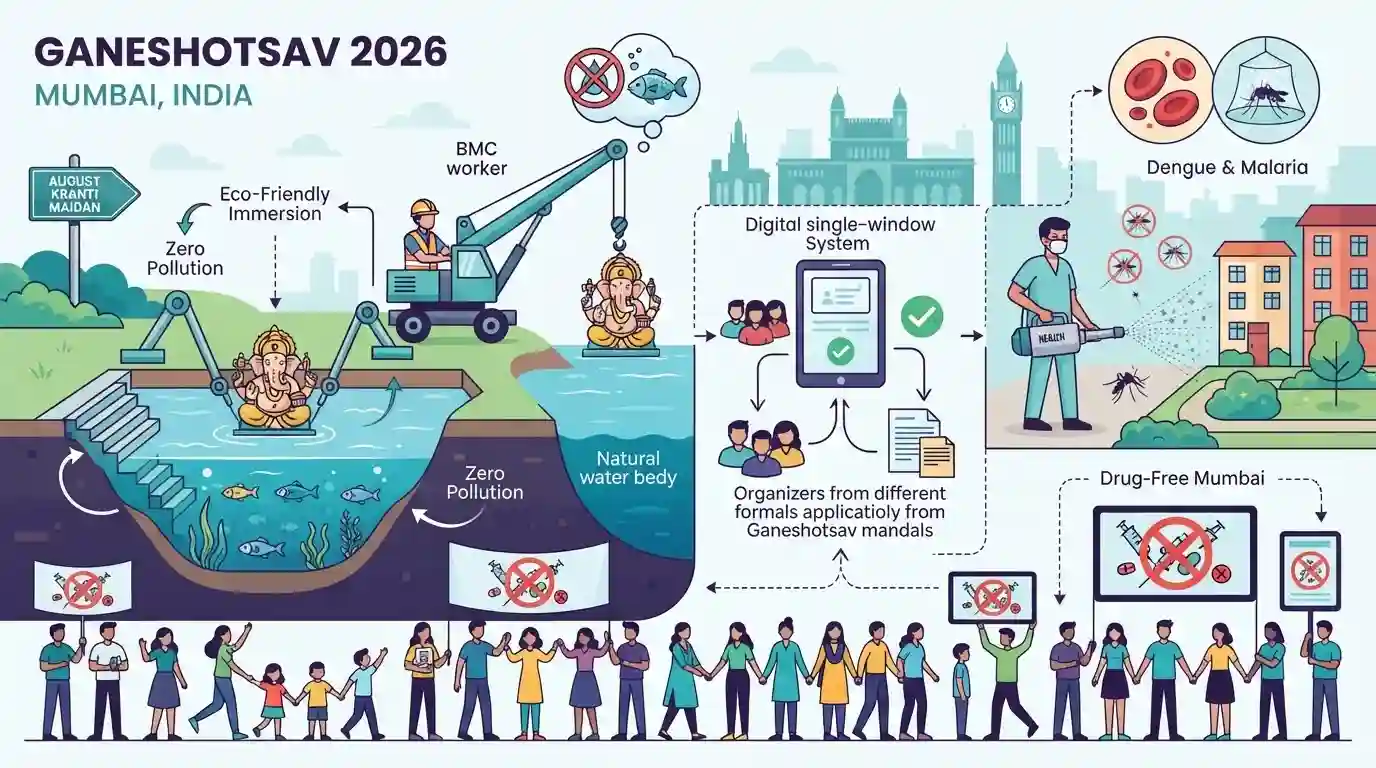
Maharashtra Minister Mangal Prabhat Lodha announced the construction of a large artificial immersion pond at August Kranti Maidan for Ganeshotsav 2026. The initiative is a key eco-friendly measure to curb water pollution and protect marine life from the harmful effects of idol immersion. To further mitigate environmental damage, the BMC has been instructed to use cranes for the immediate removal of idols immersed in natural water bodies. The preparations also include a streamlined single-window permission system for mandals, preventive mosquito spraying to combat dengue and malaria, and leveraging the festival's massive public reach to promote a 'Drug-Free Mumbai' social awareness campaign.
Key Points
- A large artificial immersion pond will be constructed at August Kranti Maidan for Ganeshotsav 2026 to facilitate the eco-friendly immersion of large idols.
- The BMC has been directed to deploy cranes to immediately lift idols after immersion in natural water bodies, significantly reducing marine and coastal pollution.
- A Coordinated Single-Window System is being implemented to streamline administrative permissions for Ganeshotsav mandals.
- Preventive health measures, including mosquito spraying, will be undertaken around artificial ponds to control vector-borne diseases like dengue and malaria.
- Ganesh mandals are encouraged to spearhead the 'Drug-Free Mumbai' campaign, echoing the historical purpose of public Ganeshotsav as a platform for social awakening initiated by Lokmanya Tilak.
Important Terms
August Kranti Maidan

Formerly Gowalia Tank Maidan, a historic ground in Mumbai where the All India Congress Committee passed the Quit India Resolution on August 8, 1942, and Gandhi delivered his "Do or Die" call.
UPSC context
Important for GS1 (Modern Indian History), testing key events and locations of the freedom struggle.
Sarvajanik Ganeshotsav
The public celebration of the Ganesh festival, originally transformed from a private household puja by Bal Gangadhar Tilak in 1893 to build cross-caste unity and nationalist sentiment against British colonial rule.
UPSC context
Relevant to GS1 (Modern History/Culture), covering mass mobilization and use of cultural symbols in the independence movement.
Artificial Immersion Ponds
Man-made, enclosed water tanks constructed by urban local bodies to facilitate eco-friendly religious idol immersions. They prevent toxic paints and non-biodegradable materials from polluting natural water bodies and harming marine life.
UPSC context
Tested in GS3 (Environment & Ecology) regarding strategies for water pollution mitigation and sustainable urban management.
Drug-Free Mumbai Campaign
An active public awareness initiative ("Nasha Mukt Janjagruti Abhiyan") extending through 2026-2027 to combat substance abuse among youth. The government leverages massive public platforms like Ganeshotsav to promote this movement.
UPSC context
Ties into GS2 (Social Justice) and GS3 (Internal Security), focusing on state interventions and community awareness against drug abuse.
Brihanmumbai Municipal Corporation (BMC)
The governing civic body of Mumbai, responsible for local infrastructure, public health initiatives, and managing city-wide arrangements for major festivals like Ganeshotsav, including sanitation and eco-friendly measures.
UPSC context
Relates to GS2 (Governance/Local Self-Government), illustrating the role and responsibilities of Urban Local Bodies.
Prelims Trap
CPCB's 2020 Idol Immersion Guidelines are statutorily binding nationwide.
While CPCB issued the 2020 guidelines, they have argued in court that these are mere 'advisories.' Strict enforcement legally depends on subsequent High Court or NGT mandates.
Static Concepts Connected
How did B.G. Tilak use festivals for political mobilization?
- Public Ganeshotsav (1893): He transformed a private household ritual into a grand public event to legally bypass British restrictions on political gatherings.
- Shivaji Jayanti (1895): Initiated to stimulate Maratha pride, historical consciousness, and anti-colonial nationalistic fervor among the youth.
- Structural Inspiration: He notably adopted community procession formats, drawing structural and cultural inspiration from the Muslim festival of Moharram.
What are the core environmental rules governing idol immersion in India?
- PoP Ban: Complete ban on Plaster of Paris (PoP), toxic chemical dyes, and oil-based paints to prevent heavy metal contamination (lead, mercury).
- Biodegradable Materials: Mandatory use of natural, biodegradable clay; strict prohibition of single-use plastics and thermocol for decorations.
- Artificial Ponds: Municipalities are directed to set up temporary artificial ponds with synthetic liners to prevent toxic seepage into natural water bodies.
Cross-Topic Patterns
History + Urban Ecology
Historic political sites like August Kranti Maidan are evolving into dual-use urban ecological infrastructure (like artificial immersion ponds) to combat municipal water pollution while retaining cultural significance.
Cultural Festivals + Public Health Administration
Community festivals are increasingly regulated for public health (disease control, anti-drug campaigns), reflecting an evolution of their original design by Tilak as mass platforms for social awakening.

Expect a linked question combining Tilak's socio-cultural mobilization with CPCB's statutory vs advisory powers under pollution rules.
Linked PYQs · 3
Linked PYQs · 3
- 2015MPSC_PRELIMSGS1
In 1893, Tilak converted the Ganapati celebration into a public ceremony by drawing inspiration from the ________.
- 2019MPSC_PRELIMSGS1
Which of the following is the major cause of poor health in Indians ?
- 2025MPSC_PRELIMSGS1
Match the pollutants given in List - I with their effects given in List - II. List - I Pollutants a. Phosphate fertilizers in water b. Methane in air c. Synthetic detergents in water d. Nitrogen oxides in air List - II Effects of Pollutants i. Biochemical oxygen demand level increase ii. Acid Rain iii. Global warming iv. Eutrophication Code: a b c d
