Bhopal Hamidia Hospital Dialysis Machine Shortage
Source:freepressjournal ↗
Why It Matters
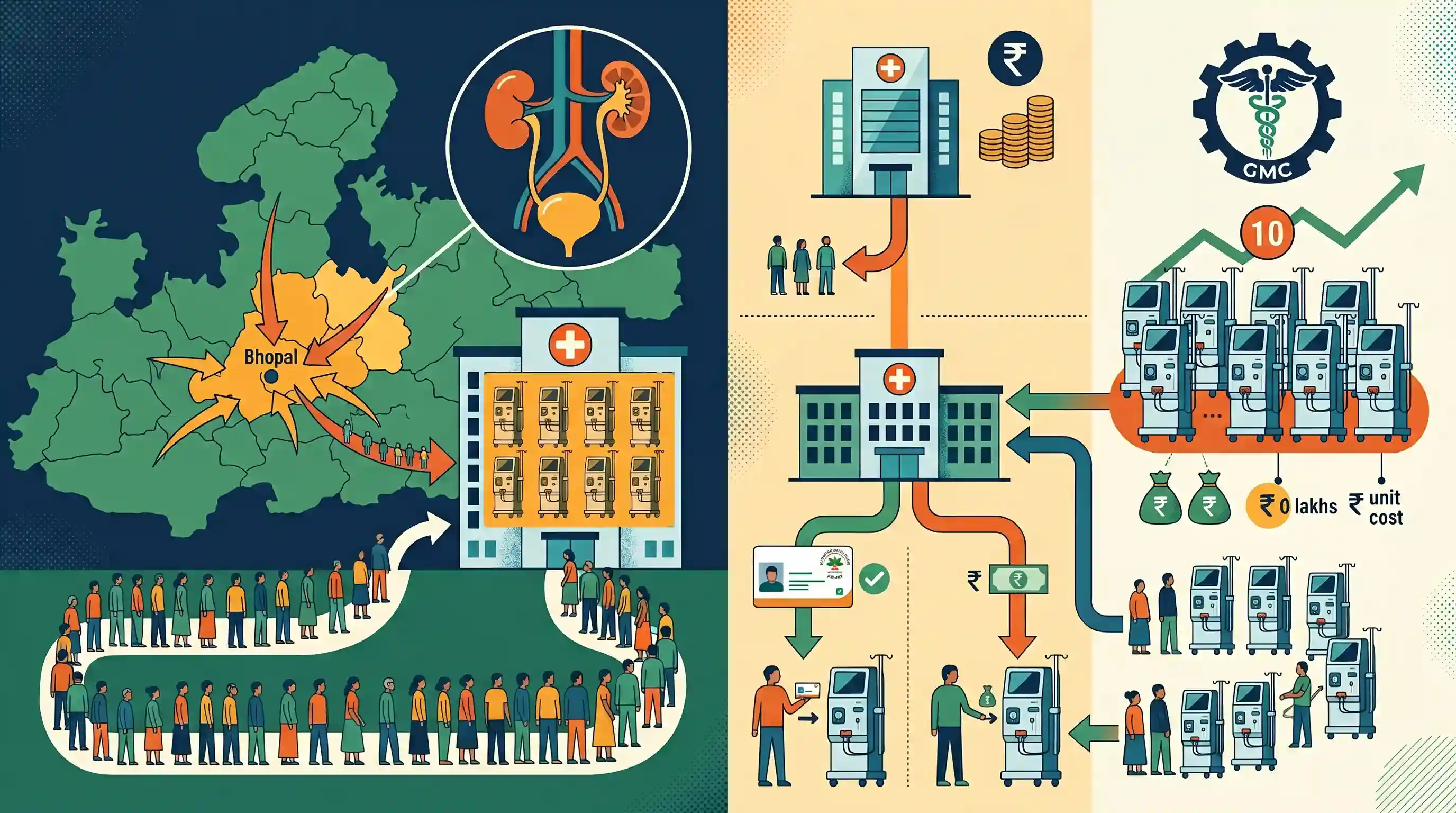
This development illustrates the acute pressure on public healthcare infrastructure in Madhya Pradesh. It highlights the gap between welfare policies—such as free healthcare under the Ayushman Bharat scheme—and the physical medical infrastructure required to support those schemes at major regional government hospitals.
Summary
Gandhi Medical College (GMC) has submitted a proposal to the Madhya Pradesh government requesting 10 new dialysis machines, priced at Rs 7 lakh each, for the renal unit of Hamidia Hospital in Bhopal. Currently, the hospital has only eight active machines, which is inadequate for the heavy influx of kidney patients from Bhopal and adjacent districts (including Sehore, Raisen, Vidisha, Rajgarh, and Narmadapuram). While private hospitals charge Rs 2,000 to Rs 3,000 per dialysis session, Hamidia Hospital offers it for free to Ayushman card holders and at a highly subsidized rate of Rs 200 to general patients, resulting in immense public demand and long waitlists.
Key Points
- Gandhi Medical College (GMC) in Bhopal has sent a proposal to the Madhya Pradesh Health Department demanding 10 new dialysis machines (costing Rs 7 lakh each) to meet the growing patient demand at Hamidia Hospital.
- Currently, Hamidia Hospital operates with only eight functioning dialysis machines, which is insufficient for the patient load from Bhopal and surrounding districts like Sehore, Raisen, Vidisha, Rajgarh, and Narmadapuram.
- Hamidia Hospital provides dialysis completely free of charge to Ayushman Bharat cardholders and charges a subsidized rate of Rs 200 per session for general patients, compared to private healthcare facilities where a session costs Rs 2,000–Rs 3,000.
- Due to the severe shortage of equipment and the highly affordable costs, the hospital faces tremendous pressure, forcing many renal patients to compromise and undergo fewer dialysis sessions per week than medically recommended.
Important Terms
Ayushman Bharat Pradhan Mantri Jan Arogya Yojana (PM-JAY)

India's flagship public health assurance scheme providing up to ₹5 lakh per family annually for cashless, secondary, and tertiary healthcare to poor households.
UPSC context
GS Paper II (Welfare Schemes). Tests knowledge of health policy, social justice, and universal healthcare.
Hemodialysis
A medical procedure where a machine acts as an artificial kidney to filter waste and excess fluid from the blood when natural kidney function fails.
UPSC context
GS Paper III (General Science). Tests understanding of human excretory systems, renal disorders, and medical technology.
Hamidia Hospital
A major public multispecialty teaching hospital in Bhopal, Madhya Pradesh, providing subsidized tertiary care and acting as a primary referral center for several districts.
UPSC context
GS Paper II (Social Sector/Health). Tests understanding of public health infrastructure and accessibility challenges.
Gandhi Medical College (GMC)
A premier government-run medical school in Bhopal, established in 1955, providing undergraduate and postgraduate medical education and hosting key tertiary healthcare services.
UPSC context
GS Paper II (Social Sector/Education). Tests knowledge of public institutional capacity in medical education and healthcare delivery.
Prelims Trap
Hemodialysis utilizes the patient's own abdominal peritoneal membrane as a semi-permeable filter to cleanse waste products directly inside the body.
This describes Peritoneal Dialysis, not Hemodialysis. Hemodialysis uses an external artificial dialyzer machine to filter blood, whereas peritoneal dialysis uses the abdominal lining (peritoneum) as the natural filter.
Static Concepts Connected
What are the differences between Hemodialysis and Peritoneal Dialysis?
- External Filtration: Uses an artificial machine (dialyzer) with a synthetic semi-permeable membrane to clean blood outside the body.
- Internal Filtration: Uses the patient’s own abdominal lining (peritoneum) as the filter; dialysis fluid is introduced and drained from the abdomen.
- Clinical vs Home: Hemodialysis requires specialized clinical infrastructure and frequent hospital visits, whereas peritoneal dialysis can be administered at home.
What are the features of the Pradhan Mantri National Dialysis Programme?
- NHM Integration: Launched in 2016 under the National Health Mission (NHM) to provide free dialysis services in district hospitals.
- Target Beneficiaries: Offers 100% free services to Below Poverty Line (BPL) patients; non-BPL patients can access dialysis at subsidized rates.
- One Nation-One Dialysis: Enabled via the PMNDP IT portal using the 14-digit ABHA ID, allowing nationwide patient tracking and treatment portability.
Cross-Topic Patterns
NCD burden vs Demographic Dividend
Rising Chronic Kidney Disease rates and End-Stage Renal Disease strain India's working-age population, translating public health crises into economic growth barriers.
Tertiary care skew vs Primary prevention
The heavy utilization of PM-JAY funds on hemodialysis highlights the urgent need to strengthen primary health centers to detect and arrest renal decline early.

PM-JAY tertiary claim skewness (e.g. hemodialysis) will likely frame 2026 GS2 questions on primary healthcare vs curative fiscal burden.
Linked PYQs · 1
Linked PYQs · 1
- 2017MPPSC_PRELIMSGS1
The kidneys in human beings are a part of system for
