Contemporary youth perspective on relevance of Gandhian values today
Source:Indian Express ↗
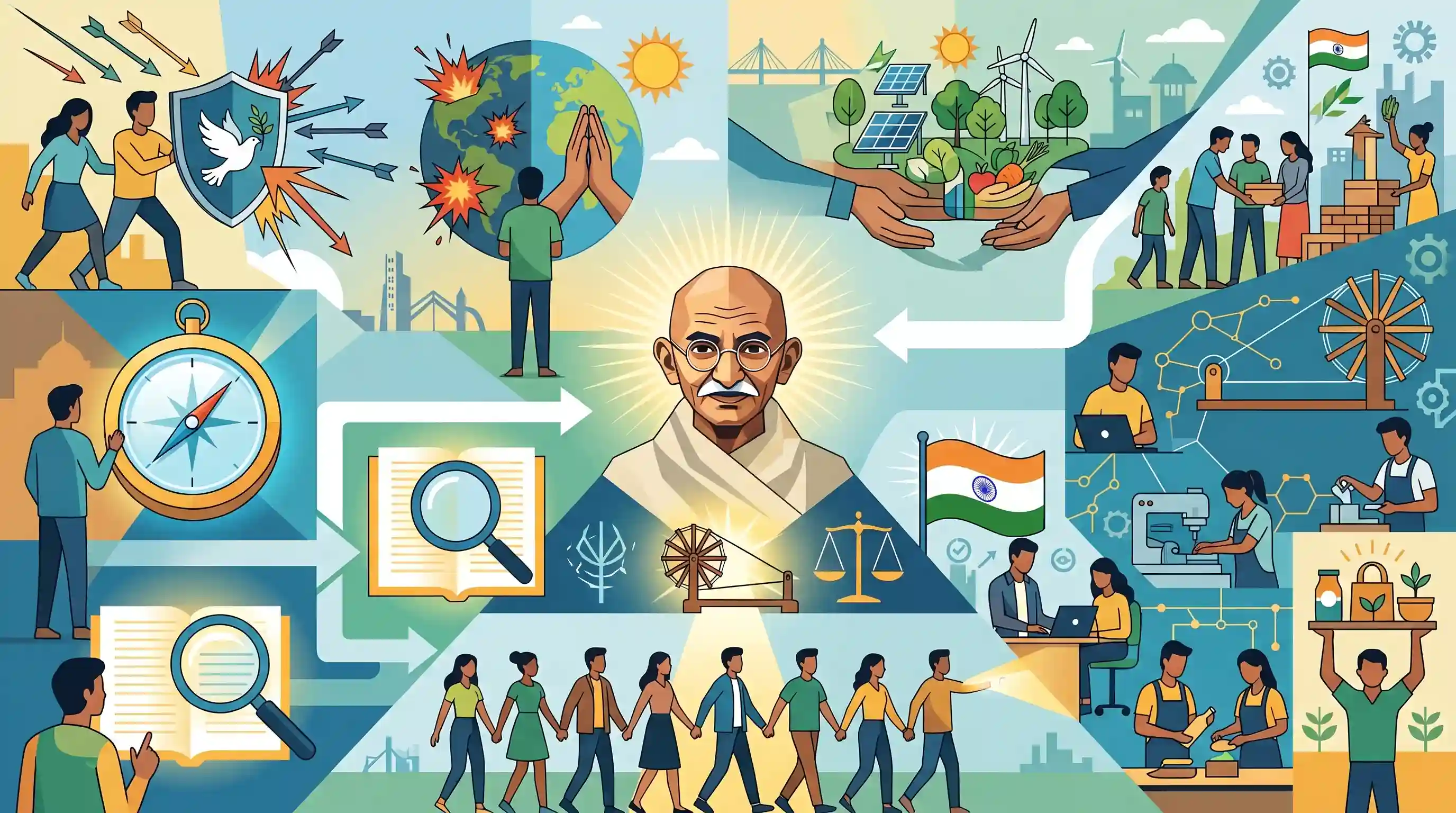
Why It Matters
Gandhian thought is a core component of both the GS-I (Modern Indian History) and GS-IV (Contributions of Moral Thinkers) syllabi. Understanding the contemporary application of concepts like Ahimsa, Satyagraha, and Trusteeship helps aspirants write relevant, forward-looking answers about ethics, governance, and conflict resolution in the modern world.
Summary
The article explores the perspectives of Pune's youth on the contemporary relevance of Mahatma Gandhi's values, including truth, non-violence (ahimsa), and trusteeship, as of Gandhi Jayanti 2025. While recognizing the limitations of absolute non-violence in a world facing geopolitical wars and extremism, young Indians find his philosophy adaptable to modern issues. Gandhian principles are seen as effective antidotes to digital hate, consumer excess, and political opacity, demonstrating his enduring legacy as a guide for personal integrity, transparency, and self-reliance (Aatmanirbhar Bharat).
Key Points
- Indian youth admire Gandhian values such as truth and ahimsa, though many question the absolute application of non-violence in an era of global polarization and geopolitical conflicts.
- Principles like simplicity and non-violence are increasingly viewed as practical tools to combat modern challenges like social media trolling, digital hate, and excessive consumerism.
- Gandhi's economic philosophy of 'trusteeship' and insistence on transparency remain highly relevant to modern professional environments and corporate governance.
- Young students believe that if Gandhi were alive today, his methods would be adapted to champion modern causes like farmers' rights, Aatmanirbhar Bharat, and diplomatic resolution of global wars.
Important Terms
Aatmanirbhar Bharat

A national mission aiming for a self-reliant India by bolstering domestic industries, innovation, and infrastructure while remaining integrated with the global economy.
UPSC context
GS Paper III/Economy; tests understanding of self-reliance, import substitution, and post-pandemic economic resilience strategies.
Trusteeship
Mahatma Gandhi’s ethical theory where wealth is viewed as a social trust; owners act as stewards for societal welfare rather than personal gain.
UPSC context
GS Paper IV/Ethics; examines socio-economic justice, corporate social responsibility, and ethical management of wealth.
Ahimsa
The core Gandhian value of non-violence, emphasizing that love and peace are superior to physical or mental force in resolving conflicts.
UPSC context
GS Paper IV/Ethics; a core value for conflict resolution and personal integrity, frequently relevant for essays on peace.
Satyagraha
A non-violent method of resisting injustice by adhering to truth (Satya) and enduring suffering to appeal to the opponent’s conscience.
UPSC context
GS Paper I/History; tests knowledge of the Indian National Movement's unique protest methodology and its global legacy.
Maharashtra Gandhi Smarak Nidhi
A national trust created after 1948 (with state branches) to preserve Gandhi’s legacy and implement his 'constructive program' at the grassroots.
UPSC context
GS Paper I/History; illustrates the institutional preservation of the freedom struggle’s legacy and Gandhian constructive programs.
Savitribai Phule Pune University (SPPU)
A premier public university in Pune, Maharashtra, significant for its naming after the 19th-century social reformer and education pioneer Savitribai Phule.
UPSC context
GS Paper I/Society; highlights the legacy of social reformers like Savitribai Phule in India’s educational history.
Prelims Trap
Gandhi's Swadeshi and the modern Aatmanirbhar Bharat initiative both advocate for complete import substitution and a closed, protectionist economy.
Both Swadeshi and Aatmanirbhar Bharat aim for self-reliance and resilience, not isolationism. They advocate strengthening domestic capacity to engage globally, not autarky or banning all imports.
Static Concepts Connected
What is Mahatma Gandhi's concept of Trusteeship?
- Wealth as trust: Wealth ultimately belongs to society; capitalists should act merely as trustees for any surplus wealth they generate.
- Non-violent economics: It aims to achieve an egalitarian society and economic equality without resorting to class war or violent expropriation.
- Modern CSR linkage: It serves as the ethical bedrock for modern Corporate Social Responsibility (CSR), emphasizing societal welfare over pure profit.
How did Gandhi define 'Swadeshi' within his constructive programme?
- Duty to neighbors: Restricting the use and service of goods to those produced by one's immediate neighbors, supporting local industries.
- Beyond political boycott: It was a positive, permanent economic strategy for village self-reliance (Khadi), unlike the punitive and temporary nature of a boycott.
- Decentralized economy: It aimed at decentralization of production and distribution, ensuring economic empowerment for the rural poor and preventing wealth concentration.
Cross-Topic Patterns
Trusteeship & Corporate Governance regulations
Gandhi’s model of Trusteeship increasingly bridges GS4 (Ethics) with GS2/GS3, serving as the philosophical foundation for India's mandatory Corporate Social Responsibility (CSR) and equitable corporate governance frameworks.
Ahimsa applied to Cyber Ethics
The application of non-violence is evolving into 'Digital Satyagraha'—framing Gandhian ethics (Satya and Ahimsa) as moral antidotes to algorithmic polarization, deepfakes, and digital hate speech.

A GS4 question linking Gandhian 'Ahimsa' and 'Satya' to the ethics of social media algorithms and digital hate is highly likely in 2026.
Linked PYQs · 3
Linked PYQs · 3
- 2018MainsGS1
Throw light on the significance of the thoughts of Mahatma Gandhi in the present times.
- 2023MainsGS4
Given below are three quotations of great thinkers. What do each of these quotations convey to you in the present context ? "The simplest acts of kindness are by far more powerful than a thousand heads bowing in prayer." – Mahatma Gandhi
- 2018MainsGS4
What do each of the following quotations mean to you in the present context? "Anger and intolerance are the enemies of correct understanding." Mahatma Gandhi
