Post-independence archival letters on right-wing groups
Source:Indian Express ↗
Why It Matters
The ideological fault lines between the founding leaders of the Indian Republic (Nehru, Patel) and right-wing nationalist groups remain central to understanding post-independence consolidation, national integration, and contemporary political narratives. This historical context is vital for UPSC aspirants studying the early challenges faced by the Indian State and the varying approaches of key national leaders.
Summary
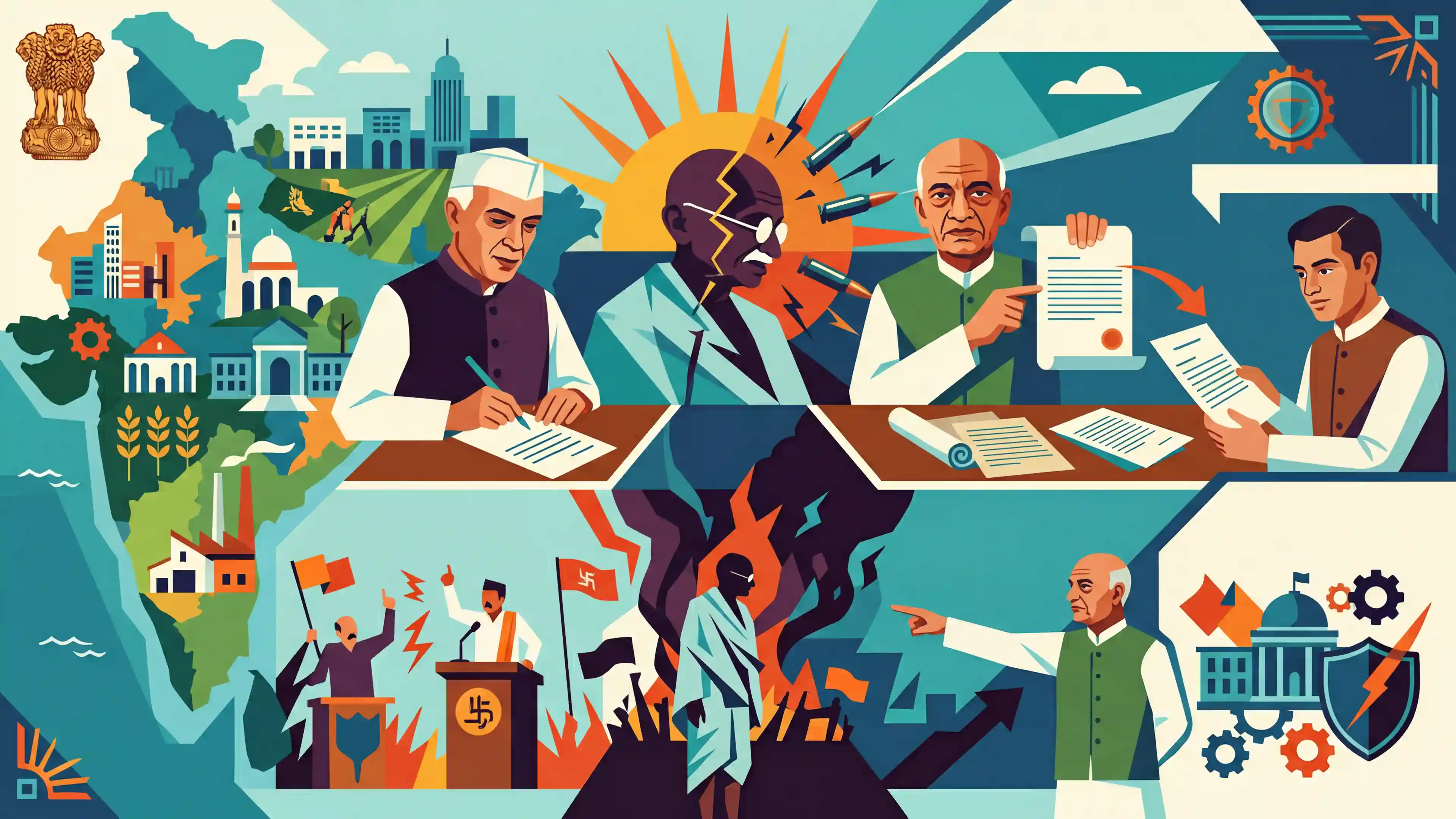
On Mahatma Gandhi's 78th death anniversary, the Congress party released archival letters from Jawaharlal Nehru and Sardar Vallabhbhai Patel addressed to Syama Prasad Mookerjee, highlighting their sharp criticisms of the RSS and Hindu Mahasabha. Nehru's letter, written two days before Gandhi's assassination, condemned the increasingly provocative activities and speeches of the Hindu Mahasabha. Patel’s subsequent letter in July 1948 emphasized that these organizations had fostered a toxic atmosphere that culminated in Gandhi’s murder, describing the RSS as a clear threat to the newly formed Indian government. These historical documents shed light on the ideological friction and political challenges confronting India's leadership during the critical post-independence consolidation phase.
Key Points
- On Mahatma Gandhi's 78th death anniversary, Congress shared archival letters from Jawaharlal Nehru and Sardar Vallabhbhai Patel to Syama Prasad Mookerjee concerning the RSS and Hindu Mahasabha.
- Nehru's letter, written two days before Gandhi's assassination, warned of the highly provocative speeches and activities of the Hindu Mahasabha, which portrayed Gandhi as an impediment.
- Patel's letter from July 1948 emphasized that the aggressive ideological climate fostered by the RSS and Hindu Mahasabha created the toxic atmosphere that culminated in Gandhi's murder.
- Patel explicitly described the activities of the RSS as a 'clear threat to the existence of the Government and the State' during the critical post-independence phase.
- The historical documents highlight the deep ideological battles, political friction, and security concerns faced by India's leadership during its early post-independence consolidation.
Important Terms
RSS (Rashtriya Swayamsevak Sangh)

A Hindu nationalist volunteer organization founded in 1925 by K.B. Hedgewar, promoting cultural discipline and 'Hindutva.' It serves as the ideological fountainhead for the Bharatiya Janata Party (BJP).
UPSC context
GS Paper 1 (Modern History); tests understanding of non-Congress ideological movements and post-independence challenges like the 1948 ban.
Hindu Mahasabha
A political organization established in 1915 to protect Hindu interests. Under V.D. Savarkar, it advocated for a 'Hindu Rashtra' and was an ideological rival to the Congress's secular nationalism.
UPSC context
GS Paper 1; relevant for the rise of communalism and ideological friction during the freedom struggle and partition era.
Indian National Congress
The primary political vehicle of the Indian independence movement, founded in 1885. Post-independence, it championed a secular, socialist democratic framework under the leadership of Jawaharlal Nehru.
UPSC context
GS Paper 1 & 2; central to the national movement, constitutional development, and the post-1947 political landscape.
Bharatiya Jana Sangh
A political party founded in 1951 by Syama Prasad Mookerjee in collaboration with the RSS. It served as the precursor to the modern Bharatiya Janata Party (BJP).
UPSC context
GS Paper 2; tests knowledge of the evolution of political parties and the development of right-wing opposition in India.
Syama Prasad Mookerjee
A prominent leader who served as India's first Minister for Industry but resigned to found the Jana Sangh. He was a key critic of Nehru's policies on Kashmir.
UPSC context
GS Paper 1 (Personalities); important for studying the ideological diversity within the early post-independence Cabinet.
Prelims Trap
"Syama Prasad Mookerjee refused to join Nehru's first cabinet due to his ideological affiliation with the Hindu Mahasabha."
Mookerjee actually served as Minister for Industry and Supply in Nehru’s first cabinet, resigning only later in 1950 over the Nehru-Liaquat Pact.
Static Concepts Connected
Who founded the Hindu Mahasabha and what was its stance?
- Formation: Officially established in 1915 by leaders like Madan Mohan Malaviya to advocate for Hindu political interests.
- Ideological opposition: Emerged as a strong counter to the Indian National Congress's secular nationalism and opposed the Quit India Movement.
Why did Syama Prasad Mookerjee resign from the first independent cabinet?
- The Delhi Pact: Resigned in 1950 protesting the Nehru-Liaquat Pact, which addressed minority rights and refugee issues between India and Pakistan.
- Kashmir integration: Strongly opposed Article 370, campaigning against Kashmir's special status with the slogan 'Ek desh mein do Vidhan... nahi chalenge'.
- Bharatiya Jana Sangh: Following his exit, he founded the Bharatiya Jana Sangh in 1951, which became a major political opposition force.
Cross-Topic Patterns
First Cabinet's ideological diversity
Nehru’s interim cabinet included staunch critics like SP Mookerjee and BR Ambedkar, illustrating early post-independence efforts to build national consensus despite deep ideological divides.
Communalism & Post-Independence Consolidation
The trajectory from Gandhi's assassination to the RSS ban and the Nehru-Liaquat Pact highlights the immense internal security challenges facing the newly formed Indian State.

Expect chronological mapping of early post-1947 events: Gandhi's assassination, the RSS ban, Nehru-Liaquat Pact, and the First Elections.
Linked PYQs · 5
Linked PYQs · 5
- 2024PrelimsGS1
Consider the following pairs (Party — Its Leader): 1. Bharatiya Jana Sangh — Dr. Shyama Prasad Mukherjee 2. Socialist Party — C. Rajagopalachari 3. Congress for Democracy — Jagjivan Ram 4. Swatantra Party — Acharya Narendra Dev How many of the above are correctly matched?
- 2025MainsGS1
Trace India's consolidation process during early phase of independence in terms of polity, economy, education and international relations.
- 2015MainsGS1
How different would have been the achievement of Indian independence without Mahatma Gandhi? Discuss.
- 2018MainsGS1
Throw light on the significance of the thoughts of Mahatma Gandhi in the present times.
- 2016MainsGS1
Highlight the differences in the approach of Subhash Chandra Bose and Mahatma Gandhi in the struggle for freedom.
