PSU Renewable Energy Transition and Captive Storage
Source:The Hindu ↗
Why It Matters
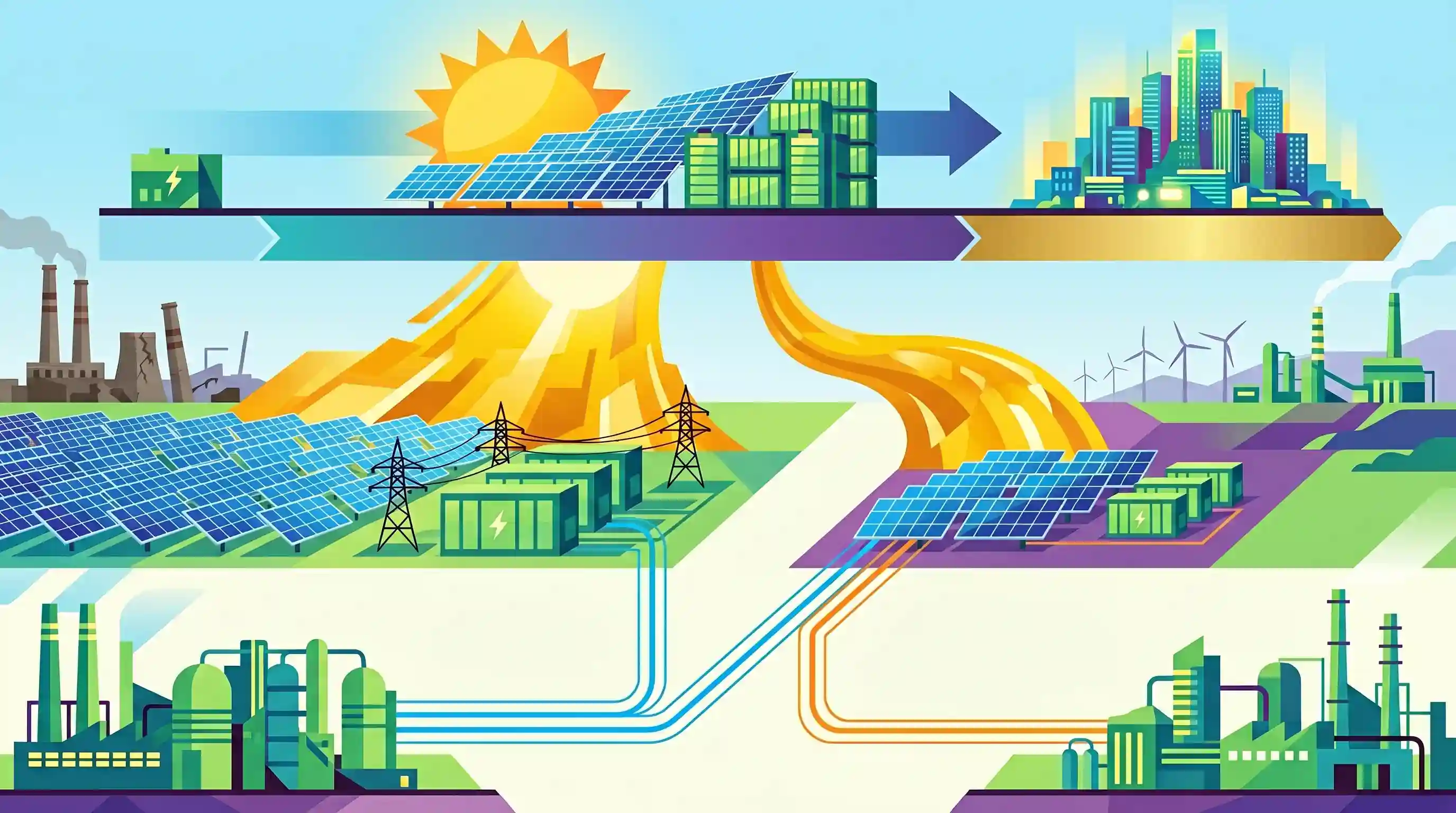
It illustrates how major Indian PSUs are actively decarbonizing their operations by transitioning to renewable energy for their captive requirements. The integration of Battery Energy Storage Systems (BESS) also underscores the technological evolution necessary to manage the intermittency of solar power in large-scale industrial applications, directly aligning with India's climate commitments and GS3 themes on infrastructure and energy.
Summary
GAIL (India) Ltd has announced an investment of ₹3,800 crore to set up 700 MW of solar power generation capacity, complemented by Battery Energy Storage Systems (BESS), in Uttar Pradesh and Maharashtra. The projects include a 600 MW facility in Jhansi and a 100 MW facility in Chhatrapati Sambhaji Nagar, designed specifically to meet the captive power needs of GAIL's industrial plants in Pata and Usar. This strategic move highlights the public sector's increasing commitment to green energy, projecting an expansion of GAIL's renewable capacity from 147 MW to over 1,000 MW.
Key Points
- GAIL is investing ₹3,800 crore to develop 700 MW of solar power projects in Uttar Pradesh and Maharashtra.
- A 600 MW solar project with a 55 MWh Battery Energy Storage System (BESS) will be built at TUSCO Solar Park in Jhansi, UP.
- A 100 MW solar project with a 22 MWh BESS is planned for Chhatrapati Sambhaji Nagar in Maharashtra.
- The electricity generated will fulfill the captive power requirements of GAIL's petrochemical plant in Pata (UP) and its PDH-PP plant in Usar (Maharashtra).
- This expansion will boost GAIL's installed renewable energy capacity from the current 147 MW to over 1,000 MW.
Important Terms
GAIL (India) Limited

A Maharatna Public Sector Undertaking under the Ministry of Petroleum and Natural Gas, leading India's natural gas transmission and increasingly diversifying into green hydrogen and solar energy.
UPSC context
GS Paper III: Energy, Infrastructure, and PSUs; relevant for discussing the role of state-owned enterprises in India's energy transition.
Captive Power Plant
A power generation facility established by an industrial or commercial user for self-consumption, helping reduce grid dependency and operational costs.
UPSC context
GS Paper III: Infrastructure and Energy; relates to industrial efficiency and the Electricity Act, 2003.
Battery Energy Storage Systems (BESS)
Technology using electrochemical batteries (like lithium-ion) to store electricity for later use, crucial for balancing intermittent renewable energy sources like solar and wind.
UPSC context
GS Paper III: Science and Technology and Environment; vital for grid stability and achieving renewable energy targets.
Panchamrit Targets
India's pledge to reach 500 GW of non-fossil fuel capacity by 2030 and achieve Net Zero emissions by 2070, announced at COP26.
UPSC context
GS Paper III: Environment and Climate Change; core to India's climate policy and international commitments.
Maharatna Status
A status granted to top-tier Central Public Sector Enterprises (CPSEs) in India, allowing them to invest up to ₹5,000 crore independently to enhance global competitiveness.
UPSC context
GS Paper III: Indian Economy; concerns the autonomy, governance, and financial powers of public sector undertakings.
Prelims Trap
A power plant qualifies as captive only if 100% of the electricity generated is consumed by its owner.
Under the Electricity Rules 2005, a captive power plant requires the user to hold at least 26% ownership and consume a minimum of 51% of the generated electricity, not 100%.
Static Concepts Connected
What are the key criteria for the Battery Energy Storage System (BESS) VGF Scheme?
- Funding limit: Provides up to 40% of the capital cost for setting up 4,000 MWh of BESS projects by 2030-31.
- Discom allocation: A minimum of 85% of power from VGF-funded BESS projects must be offered to Distribution Companies (Discoms) to aid grid stability.
What are the mandatory criteria for a CPSE to achieve Maharatna status?
- Prerequisites: The entity must already possess Navratna status and be listed on Indian stock exchanges.
- Financial thresholds: Over the last 3 years: average annual turnover >₹25,000 crore, net worth >₹15,000 crore, and net profit >₹5,000 crore.
- Global footprint: The company should have a significant global presence or international operations.
Cross-Topic Patterns
Maharatnas front-running Net Zero
PSUs like GAIL are advancing Net Zero targets (Scope 1 & 2 by 2035) well ahead of India's national 2070 commitment, acting as state-led decarbonization engines.
BESS solving renewable intermittency
Linking Battery Energy Storage Systems with captive solar helps heavy industries bypass grid fluctuations and manage the 'duck curve' during peak evening demand.

Expect a 2026 Prelims question mixing Captive Power Plant criteria (26% ownership/51% consumption) with BESS Viability Gap Funding targets.
Linked PYQs · 3
Linked PYQs · 3
- 2022MainsGS3
Do you think India will meet 50 percent of its energy needs from renewable energy by 2030 ? Justify your answer. How will the shift of subsidies from fossil fuels to renewables help achieve the above objective ? Explain.
- 2020MainsGS3
Describe the benefits of deriving electric energy from sunlight in contrast to the conventional energy generation. What are the initiatives offered by our Government for this purpose?
- 2024PrelimsGS1
Consider the following: 1. Battery storage 2. Biomass generators 3. Fuel cells 4. Rooftop solar photovoltaic units How many of the above are considered "Distributed Energy Resources"?
