Gaganyaan Crew Module Passes Re Entry Test
Source:Indian Express ↗
Why It Matters
Understanding the technological and logistical challenges of human spaceflight is a core component of the Science and Technology syllabus. The Gaganyaan mission represents a major leap in India's space capabilities, addressing previous obstacles in manned missions.
Summary
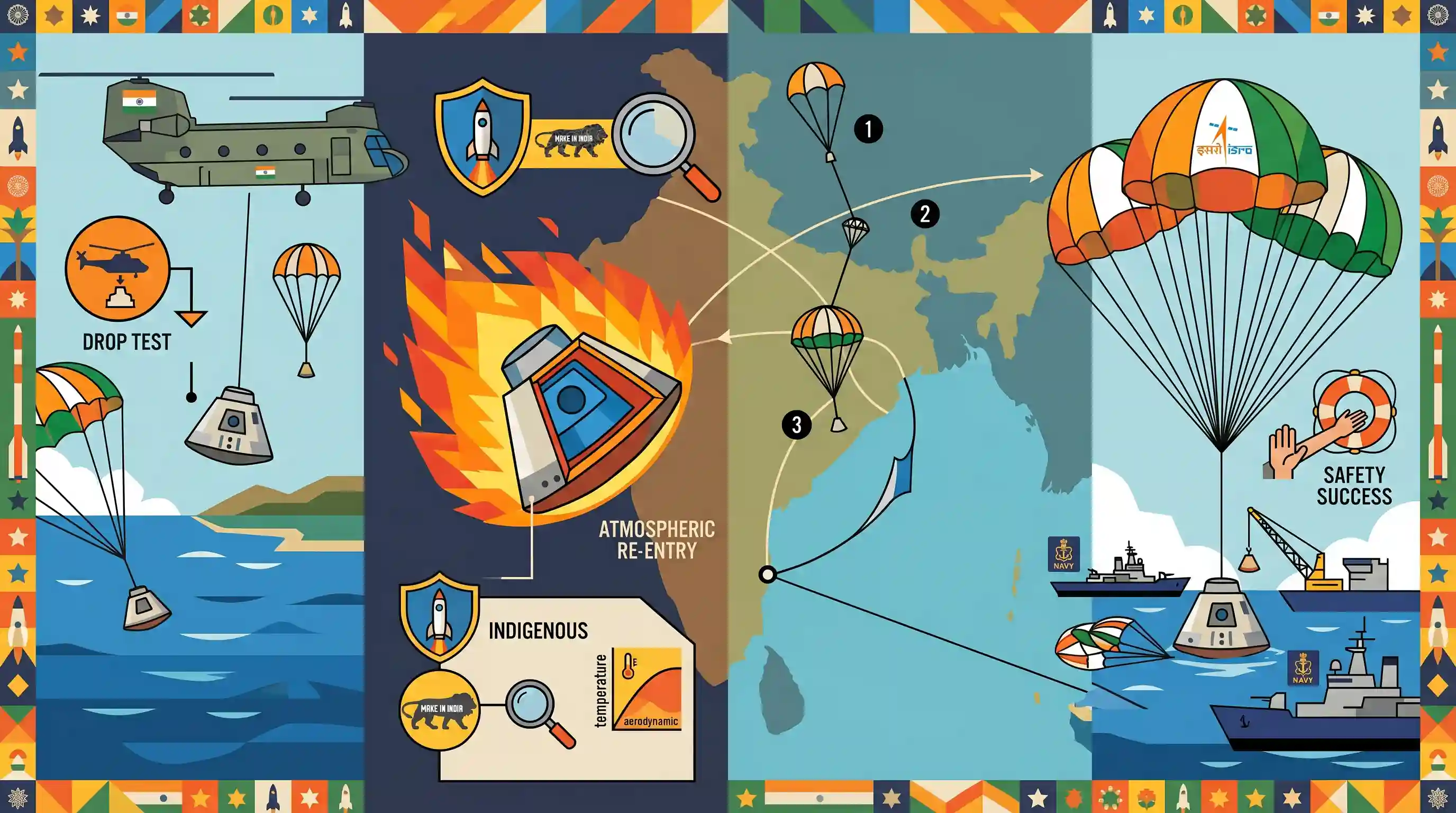
The Indian Space Research Organisation (ISRO) has achieved a significant milestone in its Gaganyaan human spaceflight mission. The Gaganyaan crew module successfully passed a crucial atmospheric re-entry test, a major leap forward in ensuring the safety of astronauts. The test validates critical indigenous technologies, including the thermal protection system and aerodynamic design, which are required to survive the intense heat and forces during the module's safe return to Earth from Low Earth Orbit.
Key Points
- The Gaganyaan crew module has successfully passed a crucial re-entry test.
- The successful test validates critical systems such as thermal protection and aerodynamic stability, which are essential for safe atmospheric re-entry.
- This achievement marks a significant milestone in ensuring astronaut safety for India's first indigenous human spaceflight mission.
- The crew module is central to the Gaganyaan mission's objective of taking Indian astronauts to low Earth orbit and bringing them safely back.
Important Terms
Gaganyaan Mission

India's flagship human spaceflight programme aimed at demonstrating indigenous capability to send a 3-member crew to a 400 km orbit for 3 days and return them safely to Earth.
UPSC context
GS Paper III (Science & Tech); tests knowledge of India's space milestones and strategic capabilities in the global space race.
Crew Module (CM)
The habitable, pressurized spacecraft component designed to carry astronauts, housing life-support systems and protecting the crew during the intense heat and aerodynamic forces of atmospheric re-entry.
UPSC context
GS Paper III (Science & Tech); tests understanding of spacecraft components and engineering for human safety.
Thermal Protection System (TPS)
A specialized shield on the Crew Module's exterior designed to withstand temperatures exceeding 1,000°C caused by atmospheric friction during high-speed re-entry.
UPSC context
GS Paper III (Science & Tech); focuses on material science and the technological challenges of atmospheric re-entry.
Crew Escape System (CES)
An emergency safety mechanism designed to quickly pull the Crew Module away from the launch vehicle to a safe distance in case of mission failure during launch or ascent.
UPSC context
GS Paper III (Science & Tech); emphasizes safety protocols and mission reliability in high-stakes space exploration.
Low Earth Orbit (LEO)
An orbit ranging from 160 to 2,000 km above Earth. It is the preferred altitude for human spaceflight missions due to lower energy requirements for launch.
UPSC context
GS Paper III (Science & Tech); essential for understanding satellite types and human spaceflight missions.
Human-Rated LVM3
A modified version of the LVM3 (formerly GSLV Mk III) rocket, re-engineered with enhanced safety features and redundancies to meet stringent human-rating standards for astronaut transport.
UPSC context
GS Paper III (Science & Tech); tests knowledge of launch vehicle evolution and indigenous hardware modification for safety.
Indigenization of Technology
The process of developing critical technologies within India to reduce foreign dependency and achieve self-reliance in strategic sectors like space exploration.
UPSC context
GS Paper III (Syllabus keyword); central to discussions on Atmanirbhar Bharat, R&D, and reducing strategic dependency.
Prelims Trap
"The Gaganyaan mission aims to place Indian astronauts into a Geosynchronous Earth Orbit (GEO) for up to 7 days."
Gaganyaan targets Low Earth Orbit (LEO) at ~400 km altitude, not Geosynchronous orbits (~35,786 km). Human spaceflight missions utilize LEO to avoid the Van Allen radiation belts.
Static Concepts Connected
What makes a launch vehicle "human-rated" (like the HLVM3)?
- System Redundancy: Multiple backup systems for critical avionics, sensors, and hardware to ensure fail-safe operations.
- Abort Capabilities: Integration of a high-burn-rate Crew Escape System (CES) to rapidly eject the module during launch emergencies.
- Reliability Margins: Stricter safety margins, lower acceleration loads, and rigorous failure-mode testing compared to standard satellite launchers.
What are the primary physics challenges during a spacecraft's atmospheric re-entry?
- Plasma Heating: Rapid compression of atmospheric gases ahead of the module creates an ionized plasma sheath, generating temperatures exceeding 2000°C.
- Communication Blackout: The superheated, ionized plasma layer surrounding the module temporarily blocks all radio frequencies, cutting off ground control.
- Aerodynamic Stress: Extreme deceleration generates high G-forces, requiring precise aerodynamic stability and robust structural integrity.
Cross-Topic Patterns
Indigenization in critical deep-tech
Developing an indigenous Environmental Control and Life Support System (ECLSS) prevents reliance on foreign space agencies, echoing the strategic autonomy goals of Aatmanirbhar Bharat in dual-use sectors.
Space Policy 2023 & private MSMEs
Gaganyaan acts as an anchor project, driving deep-tech manufacturing demand for domestic MSMEs and private startups, aligning with the commercialization goals of the Indian Space Policy 2023.

Expect a 2026 multi-statement question combining Gaganyaan's LEO altitude (~400km), HLVM3's CE20 cryogenic engine, and Vyommitra's ECLSS role.
Linked PYQs · 2
Linked PYQs · 2
- 2017MainsGS3
India has achieved remarkable successes in unmanned space missions including the Chandrayaan and Mars Orbitter Mission, but has not ventured into manned space missions. What are the main obstacles to launching a manned space mission, both in terms of technology and logistics? Examine critically.
- 2025PrelimsGS1
Consider the following space missions : I. Axiom-4 II. SpaDeX III. Gaganyaan How many of the space missions given above encourage and support micro-gravity research?
