Human Spaceflight Programme and Autonomous Docking Technologies
Source:The Hindu ↗
Why It Matters
Gaganyaan is a cornerstone of India's space program, marking its transition into human space exploration. The development of critical technologies like autonomous docking (Spadex) demonstrates self-reliance and lays the groundwork for advanced strategic goals, such as a sovereign space station and lunar sample returns. These milestones are highly relevant for GS3 S&T questions concerning the logistics, technological hurdles, and achievements of India's space endeavors.
Summary
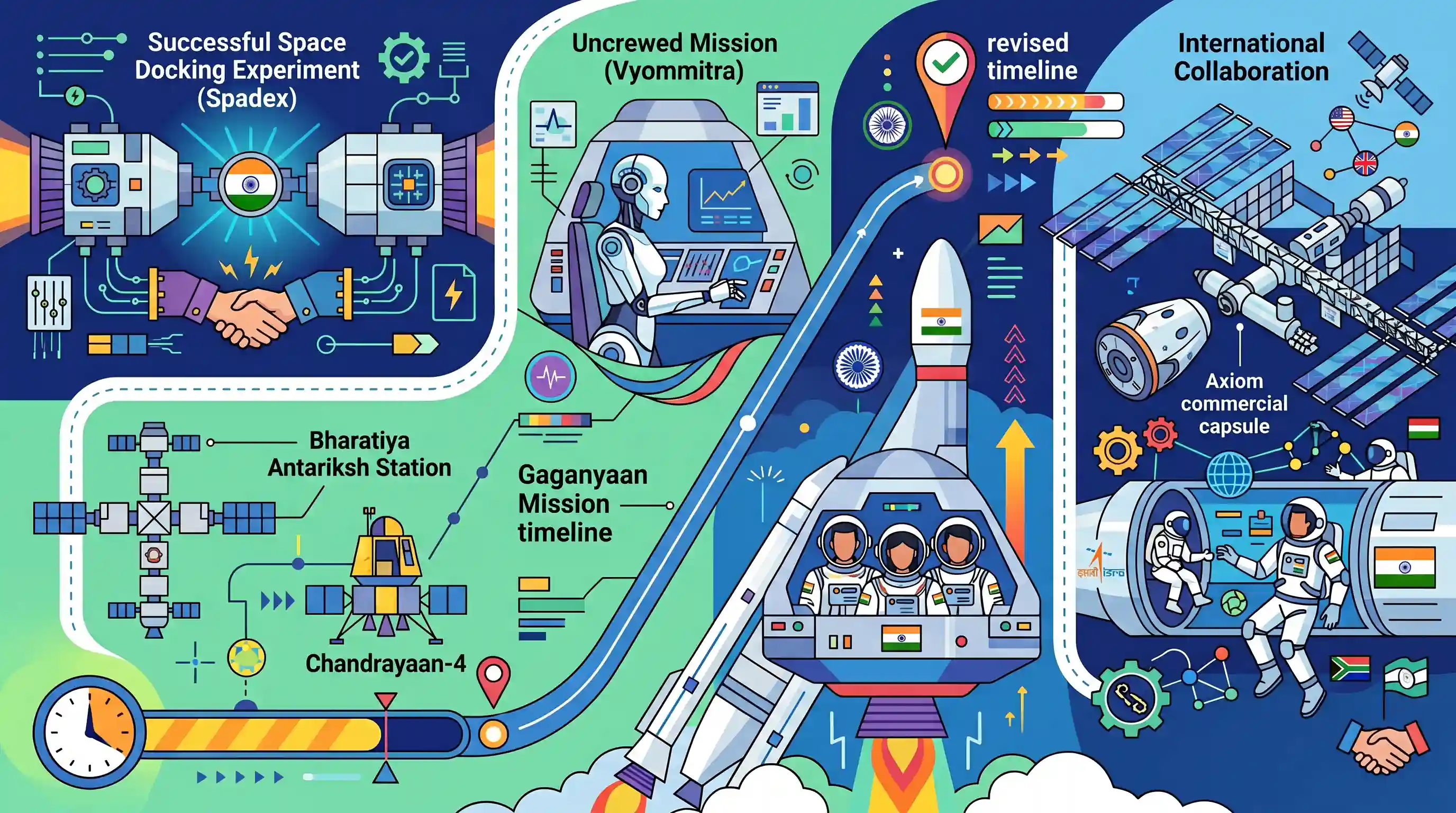
ISRO has revised the timeline for the Gaganyaan mission, India's inaugural human spaceflight, to the first quarter of 2027. Preceding this, an uncrewed robotic mission featuring "Vyom-mitra" is scheduled for later this year. The agency also announced the successful demonstration of the Space Docking Experiment (Spadex), an autonomous docking technology critical for future ambitions, including the Bharatiya Antariksh Station (planned for 2035) and the Chandrayaan-4 lunar sample return mission. Additionally, Indian astronaut Shubhanshu Shukla will soon travel to the International Space Station on the commercial Axiom-4 mission, reflecting India's growing international space collaborations.
Key Points
- The launch of India's first human spaceflight mission, Gaganyaan, has been pushed to the first quarter of 2027, according to an ISRO official.
- An uncrewed Gaganyaan test mission featuring a robotic payload named "Vyom-mitra" is scheduled for later this year.
- Indian astronaut Shubhanshu Shukla will travel to the International Space Station (ISS) in May/June on the commercial Axiom-4 mission, funded by India at ₹550 crore.
- ISRO successfully tested the Space Docking Experiment (Spadex) in January, demonstrating autonomous docking of two satellites.
- Spadex is a critical foundational technology for building the Bharatiya Antariksh Station by 2035 and for the Chandrayaan-4 sample return mission.
Important Terms
Gaganyaan Mission

India's inaugural human spaceflight mission, managed by ISRO, aimed at sending a three-member crew to a 400 km low Earth orbit for a three-day duration.
UPSC context
GS Paper III (Space Technology). Tests knowledge of indigenization, human-rated launch vehicles, and India's status in the global space race.
Space Docking Experiment (SPADEX)
A twin-satellite technology demonstration by ISRO to master autonomous docking, undocking, and rendezvous in orbit, essential for space station assembly and lunar sample returns.
UPSC context
GS Paper III (Science & Tech). Crucial for understanding orbital mechanics and the technical precursors to a permanent space station.
Bharatiya Antariksh Station (BAS)
India's planned modular space station, expected to be operational by 2035, serving as a permanent platform for microgravity research and a gateway for lunar exploration.
UPSC context
GS Paper III (Space Technology). Reflects India’s long-term strategic space vision (Viksit Bharat@2047) and technological self-reliance.
Chandrayaan-4
A future lunar mission designed to collect moon rocks and soil and return them to Earth, involving complex maneuvers like orbital assembly and sample transfer.
UPSC context
GS Paper III (Science & Tech). Highlights advancement from soft-landing (Chandrayaan-3) to high-precision robotic return capabilities.
Axiom-4 Mission
A joint commercial-government mission with NASA and Axiom Space, sending an Indian astronaut (Gaganyatri) to the International Space Station for research and training.
UPSC context
GS Paper II (International Relations) and III (Space). Focuses on Indo-US bilateral space cooperation and technology sharing frameworks (iCET).
Space Commission
The highest policy-making body for India's space program, chaired by the Secretary of the Department of Space and reporting directly to the Prime Minister.
UPSC context
GS Paper II (Governance). Important for understanding the institutional framework and administrative hierarchy governing India's high-tech sectors.
Prelims Trap
The Gaganyaan mission aims to place Indian astronauts in a Geosynchronous Earth Orbit (GEO).
Gaganyaan targets a Low Earth Orbit (LEO) of roughly 400 km, not a Geosynchronous Orbit (35,786 km). UPSC frequently swaps orbital altitudes to create incorrect statements.
Static Concepts Connected
What is space docking and why is it a critical technology?
- Definition: The mechanical and electrical joining of two independent space vehicles in orbit.
- Mechanism: Typically involves a 'Chaser' spacecraft actively navigating, aligning, and mating with a passive 'Target' satellite using autonomous sensors.
- Applications: Essential for assembling modular space stations (like the Bharatiya Antariksh Station), crew transfers, and sample return missions.
Why are human spaceflight missions (like Gaganyaan) placed in Low Earth Orbit (LEO)?
- Radiation Shielding: LEO is safely below the inner Van Allen radiation belt, shielding astronauts from severe cosmic and solar radiation.
- Fuel Efficiency: Reaching altitudes of 300-400 km requires significantly less launch energy and simplifies cargo resupply logistics.
- Emergency Aborts: Lower altitude allows for easier execution of emergency mission aborts and rapid atmospheric re-entry if needed.
Cross-Topic Patterns
Commercial spaceflight & ISS transition
The Axiom-4 mission illustrates the global shift toward privatized low Earth orbit access, aligning with India's IN-SPACe policies that encourage commercial participation in space missions.
Spadex links to Chandrayaan-4
Autonomous docking isn't just for space stations. It is the core mechanical prerequisite for lunar sample return (Chandrayaan-4), which requires linking an ascender module with a return module in orbit.

A combined prelims question in 2026 will likely test Spadex's docking technology alongside the objectives of Chandrayaan-4.
Linked PYQs · 2
Linked PYQs · 2
- 2017MainsGS3
India has achieved remarkable successes in unmanned space missions including the Chandrayaan and Mars Orbitter Mission, but has not ventured into manned space missions. What are the main obstacles to launching a manned space mission, both in terms of technology and logistics? Examine critically.
- 2023MainsGS3
What is the main task of India's third moon mission which could not be achieved in its earlier mission? List the countries that have achieved this task. Introduce the subsystems in the spacecraft launched and explain the role of the Virtual Launch Control Centre' at the Vikram Sarabhai Space Centre which contributed to the successful launch from Sriharikota.
