ISRO conducts first SOLVE ground test for Gaganyaan deceleration
Source:The Hindu ↗
Why It Matters
The deceleration and recovery system is one of the most technologically challenging components of any manned spaceflight mission, as it directly impacts crew survival during reentry. By using a cost-effective, modular approach (modifying PSLV's strap-on motors to create the SOLVE testbed), ISRO continues to demonstrate its capability for frugal, high-efficiency engineering. Furthermore, the focus on psycho-physiological training through programs like Mission MITRA addresses the long-standing critical human-centric challenges of manned space missions.
Summary
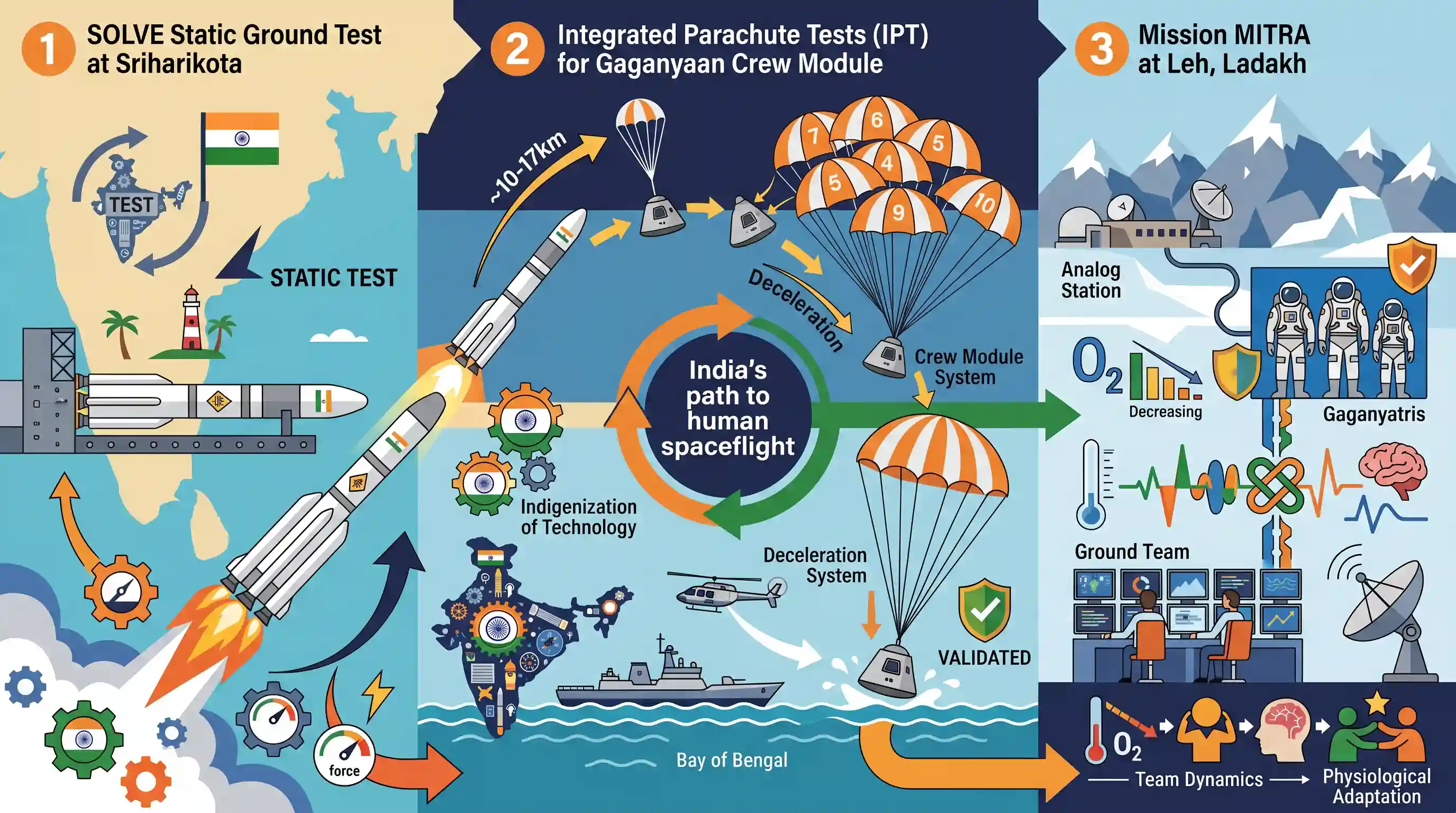
ISRO has successfully conducted the first static ground test of its Sub-Orbital Launch Vehicle for Experiments (SOLVE) solid motor at Sriharikota. Developed as a testbed, SOLVE will carry out Integrated Parachute Tests (IPT) to validate the critical deceleration system of India's maiden human spaceflight mission, Gaganyaan, during atmospheric reentry and splashdown. Additionally, ISRO's comprehensive preparation has advanced through the high-altitude behavioral study, 'Mission MITRA', conducted in Leh to evaluate astronaut team dynamics and physiological adaptation.
Key Points
- ISRO successfully completed the first ground test of the Sub-Orbital Launch Vehicle for Experiments (SOLVE) solid motor at SDSC, Sriharikota, on July 3, 2026.
- SOLVE is a newly developed solid motor-based test platform designed specifically to conduct Integrated Parachute Tests (IPT) to validate the crucial deceleration and recovery system of the Gaganyaan Crew Module.
- During the test flights, the SOLVE vehicle will launch the Crew Module to an altitude of 10 to 17 km, where it will separate, deploying a sequence of 10 parachutes to slow its velocity prior to sea splashdown.
- The solid stage of the SOLVE vehicle is derived and modified from the Polar Satellite Launch Vehicle (PSLV) Strap-on Motor (PSOM), incorporating a newly developed slow-burning propellant and a straight nozzle with Secondary Injection Thrust Vector Control (SITVC).
- The article also highlights other key precursor activities, including the second Integrated Air Drop Test (IADT-02) and Mission MITRA (Mapping of Interoperable Traits and Response Assessment)—a week-long behavioral and environmental acclimatization study conducted in the high-altitude region of Leh, Ladakh, involving the four designated astronauts, scientists, and medical teams.
Important Terms
Gaganyaan Mission

India's flagship human spaceflight programme aimed at demonstrating indigenous capability to launch a three-member crew into a 400 km Low Earth Orbit for a three-day mission and return them safely to Earth.
UPSC context
GS Paper III (Science and Technology); tests knowledge of indigenous space exploration programmes, key space technologies, and human spaceflight achievements.
Mission MITRA (Mapping of Interoperable Traits and Response Assessment)
A space analog and behavioral study conducted in Leh to evaluate physiological, psychological, and team-operational dynamics of Gaganyaan astronauts and ground control under extreme environmental and hypoxic stress.
UPSC context
GS Paper III (Science and Technology); tests understanding of aerospace medicine, astronaut training, and psychological challenges of long-duration spaceflight.
Sub-Orbital Launch Vehicle for Experiments (SOLVE)
A newly developed compact, solid-motor-based experimental test vehicle designed by ISRO to conduct integrated parachute deceleration and recovery system tests for the Gaganyaan Crew Module.
UPSC context
GS Paper III (Science and Technology); tests knowledge of indigenous launch vehicles, sub-orbital technology, and critical mission-recovery safety protocols.
Indian Space Research Organisation (ISRO)
India's premier national space agency, operating under the Department of Space, responsible for space exploration, satellite launch vehicles, and developing indigenous space technologies.
UPSC context
GS Paper III (Science and Technology); tests awareness of major national institutions, their mandates, and contribution to technological self-reliance.
Satish Dhawan Space Centre (SDSC)
Located in Sriharikota, Andhra Pradesh, it is India’s primary spaceport and orbital launch facility, housing static solid motor testing facilities and launch pads for ISRO missions.
UPSC context
GS Paper III (Science and Technology); tests awareness of critical national scientific infrastructure and geographic locations of strategic space facilities.
Prelims Trap
Mission MITRA is the half-humanoid AI-enabled robot designed by ISRO to fly aboard early uncrewed Gaganyaan flights.
UPSC may conflate 'Vyommitra' (the semi-humanoid robot) with 'Mission MITRA' (the high-altitude physiological and behavioral analogue mission conducted in Leh, Ladakh).
Static Concepts Connected
What is Secondary Injection Thrust Vector Control (SITVC)?
- Core Function: It is a mechanism used in solid rocket motors to control a vehicle's flight trajectory (pitch and yaw) without needing a heavy gimbaled nozzle.
- Mechanism: It works by injecting a liquid injectant (like strontium perchlorate) into the divergent section of the main nozzle.
- Steering force: The injected fluid creates an asymmetric shock wave and pressure distribution, generating the lateral force required to steer the rocket.
What are Space Analogue Missions?
- Definition: Field tests conducted in extreme Earth environments (like Antarctica, deserts, or high altitudes) that mimic aspects of space environments.
- Objectives: They study physiological adaptation, team cohesion, isolation stress, and hardware performance under conditions of hypoxia, extreme cold, or confinement.
- Indian Context: India's first such analogue mission was conducted in Leh, Ladakh, owing to its cold-arid climate, low pressure, and high-altitude hypoxia.
Cross-Topic Patterns
Space medicine meets high-altitude defense
Physiological datasets from Mission MITRA in Ladakh help optimize both astronaut safety and the Indian Army's extreme-cold acclimatization protocols along high-altitude borders.
Frugal space engineering and legacy adaptation
Modifying legacy PSOM solid motors into sub-orbital testbeds demonstrates India's cost-effective, indigenous strategy of adapting proven launch systems for new safety profiles.

2026 papers will likely test Gaganyaan safety protocols, specifically distinguishing Mission MITRA (analogue study) from Vyommitra (robot).
Linked PYQs · 2
Linked PYQs · 2
- 2025PrelimsGS1
Consider the following space missions : I. Axiom-4 II. SpaDeX III. Gaganyaan How many of the space missions given above encourage and support micro-gravity research?
- 2017MainsGS3
India has achieved remarkable successes in unmanned space missions including the Chandrayaan and Mars Orbitter Mission, but has not ventured into manned space missions. What are the main obstacles to launching a manned space mission, both in terms of technology and logistics? Examine critically.
