Parachute deceleration system validation for human spaceflight mission
Source:The Hindu ↗
Why It Matters
The Gaganyaan mission is a flagship project that will demonstrate India's capability to send humans to space and return them safely. The development and successful testing of complex systems like the parachute deceleration and recovery mechanisms highlight India's growing self-reliance in advanced space technologies. This topic is highly relevant for UPSC questions evaluating India's achievements in space science and its future trajectory in space exploration.
Summary
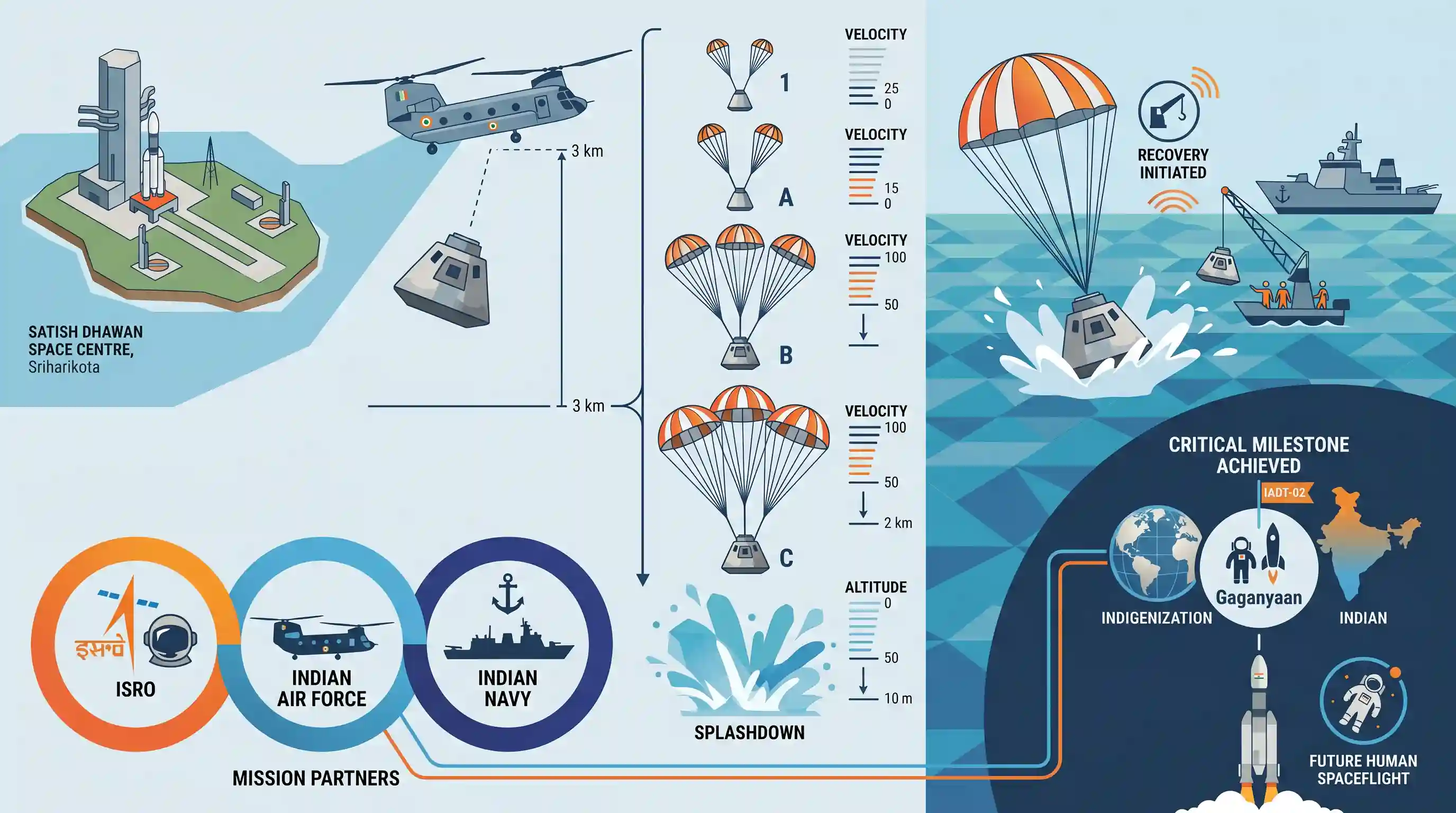
The Indian Space Research Organisation (ISRO) has successfully conducted the second Integrated Air Drop Test (IADT-02) at the Satish Dhawan Space Centre in Sriharikota. The test was a critical validation of the parachute deceleration system designed for the Gaganyaan mission, India's first human spaceflight program. During the test, an Indian Air Force Chinook helicopter dropped a simulated Crew Module weighing 5.7 tonnes from an altitude of 3 kilometers. A complex deployment sequence of ten parachutes successfully slowed the module for a safe splashdown in the sea, after which it was recovered by the Indian Navy. The successful test, supported by the IAF, Navy, and DRDO, marks a significant milestone in ensuring the safe return of astronauts.
Key Points
- ISRO successfully completed the second Integrated Air Drop Test (IADT-02) at Sriharikota to validate the parachute-based deceleration system for the Gaganyaan mission.
- An Indian Air Force Chinook helicopter lifted a simulated 5.7-tonne Crew Module to an altitude of 3 km before releasing it over the sea drop zone.
- A precise sequence involving ten parachutes of four different types was deployed to effectively reduce the module's velocity during descent.
- The module successfully splashed down and was recovered in a coordinated operation with the Indian Navy.
- The test saw active collaboration between ISRO, the IAF, the Indian Navy, and the DRDO's Aerial Delivery Research and Development Establishment (ADRDE).
Important Terms
Gaganyaan Mission

India's first human spaceflight program aimed at sending a 3-member crew to a 400 km Low Earth Orbit (LEO) for three days.
UPSC context
GS Paper 3: Science and Technology; critical for topics on indigenous space capabilities and international space standing.
Indian Space Research Organisation (ISRO)
The primary agency responsible for India's space program, leading the design and execution of the Gaganyaan mission and its human-rated launch vehicle (HLVM3).
UPSC context
GS Paper 3: Science and Technology; tests knowledge of institutional frameworks and major national space milestones.
Aerial Delivery Research and Development Establishment (ADRDE)
An Agra-based laboratory under DRDO that developed the complex 10-parachute deceleration system for the Gaganyaan Crew Module's safe splashdown.
UPSC context
GS Paper 3: Indigenization of Technology; focuses on the role of specialized R&D labs in mission-critical technology.
Indian Navy
The lead agency for the sea-based recovery of the Gaganyaan Crew Module, responsible for splashdown operations and training divers for astronaut retrieval.
UPSC context
GS Paper 3: Internal Security & Disaster Management; tests inter-agency coordination in high-stakes recovery operations.
Defence Research and Development Organisation (DRDO)
The nodal organization for defense R&D in India, which, through ADRDE, provides critical sub-systems like parachutes and survival gear for human spaceflight.
UPSC context
GS Paper 3: Science and Technology; important for understanding the intersection of defense and space technologies.
Indian Air Force (IAF)
Provides technical support for the Gaganyaan mission, including air-dropping modules from Chinook helicopters for testing and conducting astronaut selection and training.
UPSC context
GS Paper 3: Science and Technology; relevant for inter-service cooperation and human-centric mission aspects.
Prelims Trap
Gaganyaan will place astronauts into a Geosynchronous Earth Orbit (GEO) for three days.
Aspirants often confuse orbits. Gaganyaan is strictly a Low Earth Orbit (LEO) mission (at ~400 km altitude), not GEO.
Static Concepts Connected
What distinguishes Low Earth Orbit (LEO) from Geosynchronous Orbit (GEO)?
- Altitude: LEO ranges from 160 to 2,000 km above Earth, whereas GEO is located precisely at 35,786 km above the equator.
- Applications: LEO is used for human spaceflight (like Gaganyaan) and Earth observation; GEO is primarily used for continuous telecommunications and broadcasting.
What are the three stages of the LVM3 launch vehicle?
- Solid Boosters: Two S200 strap-on motors that provide massive thrust at liftoff.
- Liquid Core: The L110 core stage powered by twin Vikas engines utilizing liquid propellants.
- Cryogenic Stage: The C25 upper stage using liquid hydrogen and liquid oxygen, crucial for heavy payload injection.
Cross-Topic Patterns
Civil-Military Space Synergy
Gaganyaan relies on IAF for testing/astronauts, the Navy for sea recovery, and DRDO for parachute/life-support systems, highlighting a major shift towards inter-agency strategic space synergy.
Indigenization of Life Support Tech
ADRDE’s indigenous parachute systems and ISRO’s Human-Rated LVM3 reflect India's push for self-reliance in critical life-support and crew escape technologies, bypassing historical dependencies.

Expect a multi-statement question on Gaganyaan targeting its orbital altitude (LEO) and specific indigenous subsystems developed by DRDO.
Linked PYQs · 2
Linked PYQs · 2
- 2016MainsGS3
Discuss India's achievements in the field of Space Science and Technology. How the application of this technology has helped India in its socio-economic development?
- 2018PrelimsGS1
With reference to India's satellite launch vehicles, consider the following statements: 1. PSLVs launch the satellites useful for Earth resources monitoring whereas GSLVs are designed mainly to launch communication satellites. 2. Satellites launched by PSLV appear to remain permanently fixed in the same position in the sky, as viewed from a particular location on Earth. 3. GSLV Mk III is a four-staged launch vehicle with the first and third stages using solid rocket motors; and the second and fourth stages using liquid rocket engines. Which of the statements given above is/are correct?
