ISRO completes second integrated air drop test for Gaganyaan mission
Source:The Hindu ↗
Why It Matters
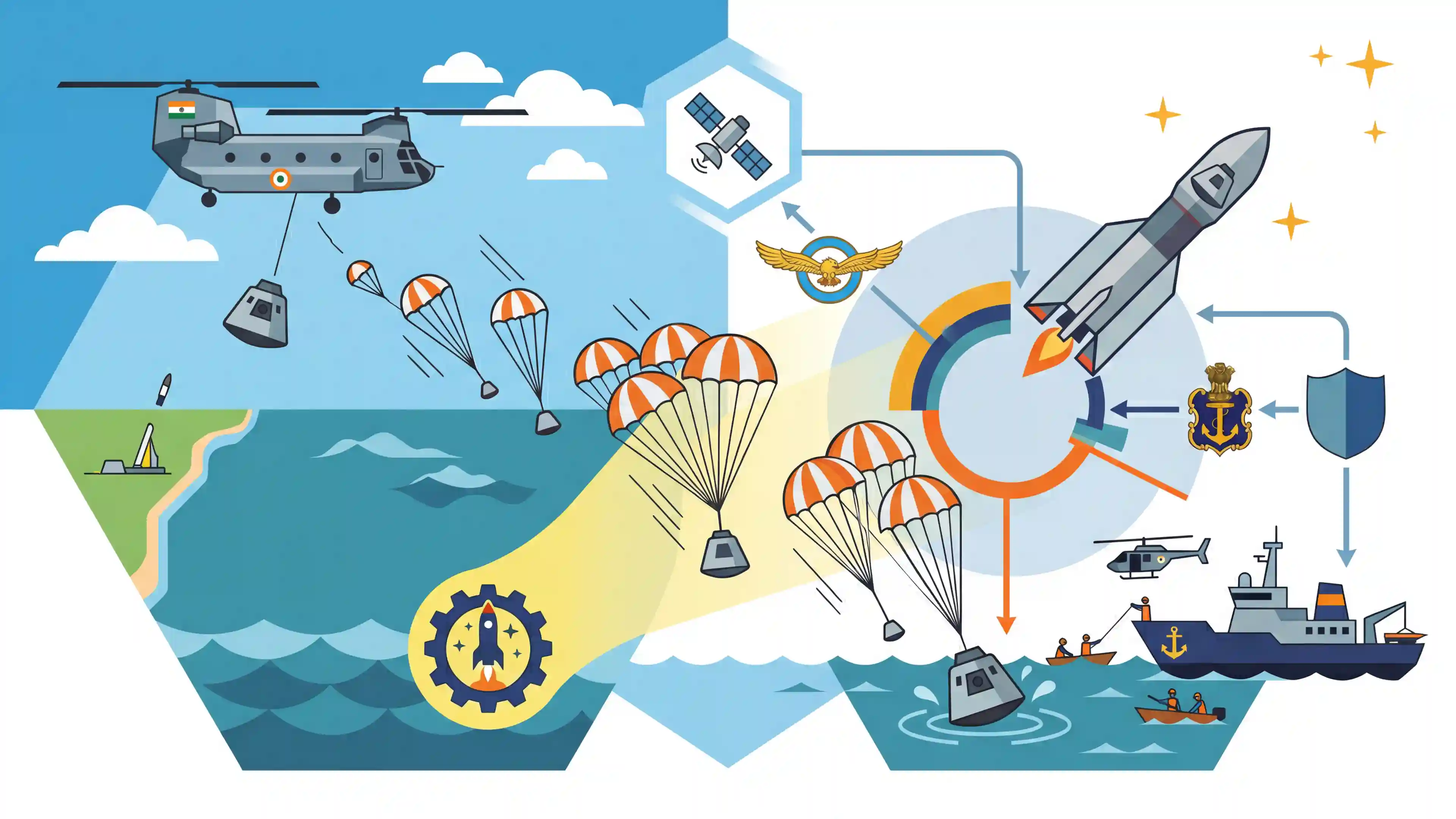
Gaganyaan is India's flagship human spaceflight program. The successful validation of parachute and recovery systems during IADT-02 is essential for ensuring crew safety and survival upon re-entry. It also demonstrates India's capability to execute complex, multi-agency technological operations in pursuit of strategic space capabilities.
Summary
The Indian Space Research Organisation (ISRO) has successfully conducted the second Integrated Air Drop Test (IADT-02) for the Gaganyaan mission at the Satish Dhawan Space Centre in Sriharikota. A simulated Crew Module was dropped from an Indian Air Force Chinook helicopter at an altitude of 3 km over the Bay of Bengal to validate the parachute-based deceleration systems. The test featured the sequential deployment of 10 parachutes, leading to a safe splashdown and subsequent recovery by the Indian Navy. This successful trial highlights the advanced indigenous technology and strong inter-agency coordination (ISRO, IAF, Navy, and DRDO) required for India's upcoming uncrewed Gaganyaan (G1) mission, bringing the nation closer to its human spaceflight goals.
Key Points
- ISRO completed the Integrated Air Drop Test (IADT-02) for the Gaganyaan mission, releasing a simulated Crew Module from an altitude of 3 km using an IAF Chinook helicopter.
- The test successfully validated the parachute-based deceleration system, which deployed 10 parachutes in sequence to ensure a safe splashdown.
- The Crew Module was safely recovered by the Indian Navy, demonstrating successful multi-agency coordination between ISRO, IAF, Navy, DRDO, and ADRDE.
- This successful test is a critical preparatory milestone ahead of the first un-crewed Gaganyaan (G1) space mission.
Important Terms
Gaganyaan mission

India's first human spaceflight program aiming to send a 3-member crew to a 400 km Low Earth Orbit for 3 days and return them safely via sea splashdown.
UPSC context
GS Paper 3 (Science & Technology); tests knowledge of indigenous space capabilities and mission objectives.
ISRO (Indian Space Research Organisation)
India's national space agency responsible for the design, development, and execution of the Gaganyaan mission and other national space exploration projects.
UPSC context
GS Paper 3 (S&T); crucial for understanding institutional frameworks and achievements in Indian science.
Integrated Air Drop Test (IADT)
A critical validation trial where a simulated crew module is dropped from an aircraft to test the sequential deployment and performance of the parachute-based deceleration system.
UPSC context
GS Paper 3 (S&T); tests technical milestones and safety protocols required for human spaceflight.
Crew Module (CM)
The habitable, pressurized part of the Gaganyaan spacecraft designed to house astronauts, featuring life support, avionics, and thermal protection for safe atmospheric re-entry.
UPSC context
GS Paper 3 (S&T); relates to spacecraft architecture and critical technologies for crew safety.
ADRDE (Aerial Delivery Research and Development Establishment)
An Agra-based DRDO laboratory specializing in parachute systems and aerial delivery, responsible for developing the complex 10-parachute deceleration system for Gaganyaan.
UPSC context
GS Paper 3 (S&T); highlights inter-agency collaboration and specialized indigenous R&D for space missions.
DRDO (Defence Research and Development Organisation)
India's premier defense R&D agency providing human-centric technologies like parachutes, space-grade food, and life support systems for the Gaganyaan mission.
UPSC context
GS Paper 3 (S&T); tests understanding of multi-disciplinary technology development and inter-agency synergy.
Prelims Trap
The Gaganyaan mission's Integrated Air Drop Test (IADT) evaluates the Crew Escape System during launch aborts.
The IADT validates the parachute deceleration and recovery system for final splashdown. The Crew Escape System (CES) is tested via separate missions like the Pad Abort Test and Test Vehicle (TV-D1) flights.
Static Concepts Connected
What distinguishes Low Earth Orbit (LEO) used for human space missions?
- Altitude range: Located between 160 km and 1,000 km above Earth. The Gaganyaan mission specifically targets a 400 km circular orbit.
- Orbital period: Spacecraft complete one revolution around the Earth in roughly 90 to 120 minutes, allowing for rapid and frequent orbits.
- Human safety: Lies below the inner Van Allen radiation belt, protecting astronauts and sensitive electronics from severe cosmic radiation.
What makes LVM3 suitable for India's human spaceflight program?
- Payload capacity: It is India's heaviest rocket, capable of placing up to 8,000 kg into LEO, easily lifting the Gaganyaan Orbital Module.
- Three-stage design: Utilizes two solid strap-ons, a liquid core stage, and a cryogenic upper stage for maximum thrust and efficiency.
- Human-rating: Reconfigured as HLVM3 (Human-Rated LVM3) with enhanced redundancies and an integrated Crew Escape System (CES) for emergency aborts.
Cross-Topic Patterns
Civil-military fusion in strategic tech
The integration of ISRO, IAF, Navy, and DRDO reflects growing civil-military fusion in India's strategic projects, a theme highly relevant for Mains GS-3 internal security and technology indigenization.
Indigenization of critical space subsystems
DRDO's development of complex parachute systems highlights the shift from importing specialized aerospace materials to indigenous R&D, aligning with the Atmanirbhar Bharat push in defense and space.

Expect a multi-statement Prelims question mixing Gaganyaan's orbit (LEO), launch vehicle (HLVM3), and precursor tests like TV-D1 vs IADT.
Linked PYQs · 3
Linked PYQs · 3
- 2016MainsGS3
Discuss India's achievements in the field of Space Science and Technology. How the application of this technology has helped India in its socio-economic development?
- 2025PrelimsGS1
Consider the following space missions : I. Axiom-4 II. SpaDeX III. Gaganyaan How many of the space missions given above encourage and support micro-gravity research?
- 2018PrelimsGS1
With reference to India's satellite launch vehicles, consider the following statements: 1. PSLVs launch the satellites useful for Earth resources monitoring whereas GSLVs are designed mainly to launch communication satellites. 2. Satellites launched by PSLV appear to remain permanently fixed in the same position in the sky, as viewed from a particular location on Earth. 3. GSLV Mk III is a four-staged launch vehicle with the first and third stages using solid rocket motors; and the second and fourth stages using liquid rocket engines. Which of the statements given above is/are correct?
