ISRO Delays Gaganyaan Uncrewed Test Flight to 2027
Source:Indian Express ↗
Why It Matters
India's space capabilities are a recurring theme in GS3. Tracking the progress, challenges, and delays of flagship missions like Gaganyaan and crucial infrastructure like NavIC provides vital context for questions on the maturity of India's space sector, its commercial viability, and its strategic self-reliance.
Summary
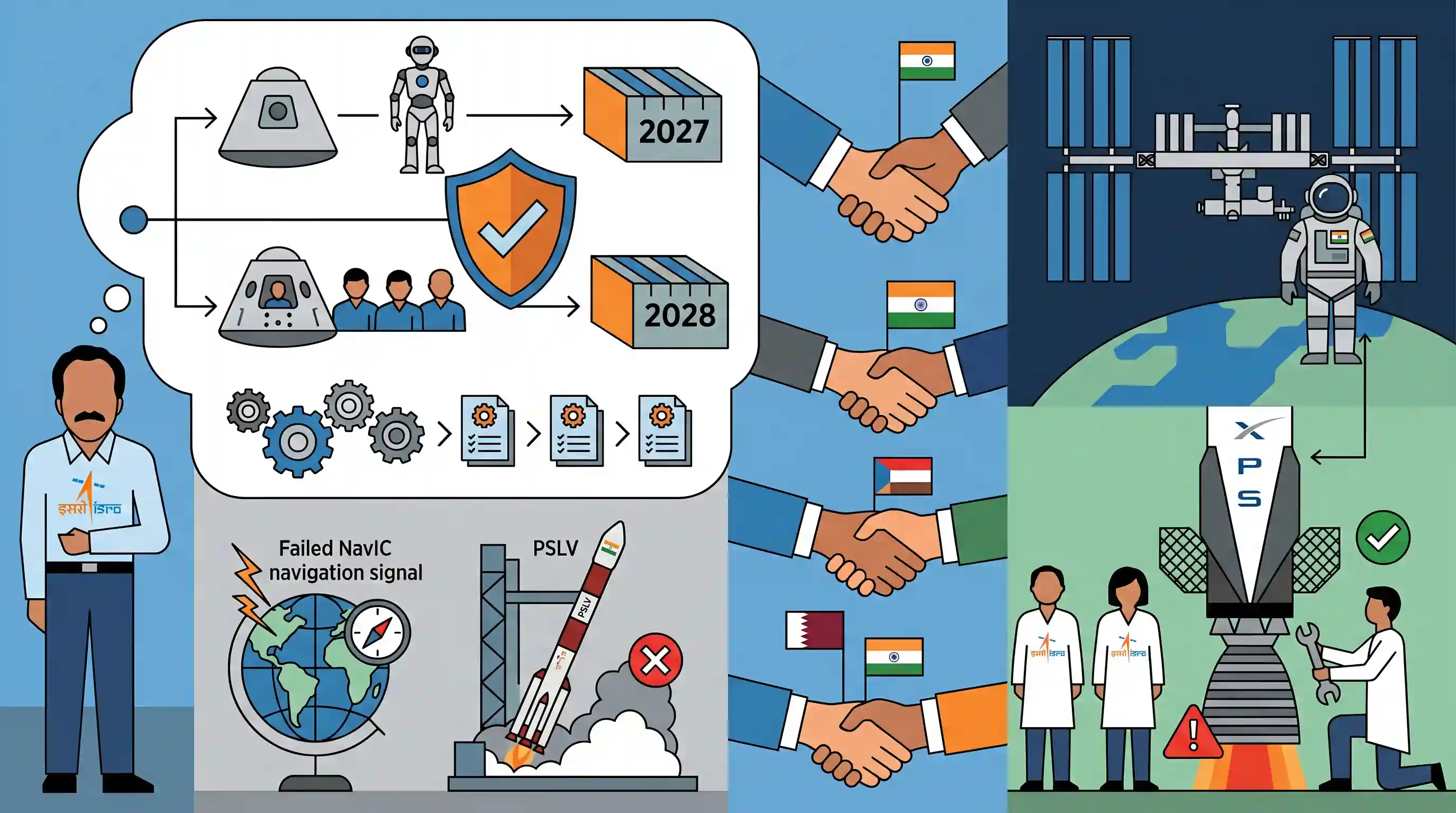
ISRO Chairman S Somanath indicated that the first uncrewed test flight of the Gaganyaan mission may be pushed to 2027, delaying the crewed flight to 2028. This decision reflects a commitment to zero-compromise crew safety, necessitating exhaustive testing. The cautious approach is partly informed by recent operational hurdles, including sub-optimal performance of the NavIC navigation system and setbacks with PSLV launches. Meanwhile, international cooperation remains strong, highlighted by Indian astronaut Shubhanshu Shukla's flight to the ISS on the Axiom-4 mission, where ISRO scientists actively assisted SpaceX in resolving a technical issue.
Key Points
- The first uncrewed test flight of ISRO's Gaganyaan mission is likely delayed to 2027, with the crewed mission pushed to 2028.
- The delay is driven by an absolute priority on crew safety, prompting rigorous testing and cautious timelines.
- Recent setbacks for ISRO include issues with PSLV rockets in 2025 and 2026, and the sub-optimal functioning of the NavIC constellation (only 3 of 4 required satellites are fully operational).
- Indian astronaut Shubhanshu Shukla participated in the Axiom-4 mission to the ISS, during which Indian scientists contributed by identifying a leak in the SpaceX rocket.
- Continued focus is being placed on the indigenous development and testing of cryogenic propulsion systems for the GSLV Mk III (LVM3) to ensure mission reliability.
Important Terms
Gaganyaan Mission

India's maiden human spaceflight program designed to send a crew to Low Earth Orbit (LEO). It involves three uncrewed test flights (G1, G2, G3) before a crewed mission planned for 2028.
UPSC context
GS Paper III (Science & Tech). Key for questions on indigenous technology, human spaceflight milestones, and India's 'Space Vision 2047'.
NavIC
India's independent regional satellite navigation system (formerly IRNSS). It provides accurate positioning over India and 1,500 km beyond. Currently under strain with only three fully functional satellites for PNT services.
UPSC context
GS Paper III (Science & Tech). Tests knowledge of strategic autonomy in navigation, satellite constellations, and technological challenges like atomic clock failures.
Axiom-4 mission
A private mission to the International Space Station (ISS) involving ISRO, NASA, and SpaceX. Indian astronaut Shubhanshu Shukla served as pilot, gaining critical operational experience for future Gaganyaan missions.
UPSC context
GS Paper III (Space Exploration). Important for understanding international space diplomacy, private-public partnerships, and astronaut training protocols.
Operation Sindoor
A 2025 tri-services military operation following the Pahalgam terror attack. ISRO played a critical role by providing 24/7 satellite surveillance and communication support using over 10 operational satellites.
UPSC context
GS Paper III (Internal Security/Science & Tech). Relevant for the 'dual-use' nature of space technology and its application in national defense.
IN-SPACe
An autonomous agency under the Department of Space that acts as a single-window regulator to promote and authorize private sector participation in the Indian space industry.
UPSC context
GS Paper III (Economy/Space). Tests understanding of regulatory reforms, the 'New Space' era, and encouraging commercial space entrepreneurship.
LVM3
ISRO's heaviest launch vehicle (formerly GSLV Mk-III) used for the Gaganyaan mission. It has been 'human-rated,' meaning it meets safety standards required to transport humans into space.
UPSC context
GS Paper III (Science & Tech). Fundamental for questions on launch vehicle evolution and cryogenic engine indigenization.
Prelims Trap
"Gaganyaan will be placed in a Geosynchronous Orbit using the LVM3 rocket."
LVM3 (formerly GSLV Mk-III) is famous for geosynchronous launches, but for Gaganyaan, it will place the crew module into a 400 km Low Earth Orbit (LEO).
Static Concepts Connected
What is the orbital configuration and coverage of NavIC (IRNSS)?
- Constellation setup: NavIC's full constellation consists of 7 satellites: 3 placed in Geostationary Orbit (GEO) and 4 in Geosynchronous Orbit (GSO).
- Coverage area: It provides accurate position information service to users in India as well as the region extending up to 1500 km from its boundary.
- Service types: It offers Standard Positioning Service (SPS) for civilian users and Restricted Service (RS) (an encrypted service) for authorized, strategic users.
How does LVM3 differ from PSLV in stage configuration and utility?
- Stage configuration: PSLV is a 4-stage vehicle (alternating solid and liquid), while LVM3 is a 3-stage vehicle consisting of solid strap-ons, a liquid core, and a cryogenic upper stage.
- Payload and Orbit: PSLV is primarily for polar/sun-synchronous orbits (lighter payloads). LVM3 can lift 4,000 kg to GTO or 8,000 kg to LEO (required for Gaganyaan).
Cross-Topic Patterns
Space commercialization and FDI norms
Axiom-4 (a private ISS mission) and ISRO-SpaceX collaboration highlight the growing role of private spaceflight, connecting directly to India's recent 100% space FDI liberalization and IN-SPACe's regulatory mandate.
NavIC integration in Disaster Management
NavIC's operational hurdles directly impact strategic and civilian early warning systems. Its messaging service is crucial for cyclone tracking, linking GS-3 Space Tech directly with GS-3 Disaster Management.

Expect a Prelims question blending LVM3’s payload capacity to LEO (for Gaganyaan) with NavIC’s exact GEO/GSO satellite configuration.
Linked PYQs · 5
Linked PYQs · 5
- 2019MainsGS3
What is India's plan to have its own space station and how will it benefit our space programme?
- 2023MainsGS3
What is the main task of India's third moon mission which could not be achieved in its earlier mission? List the countries that have achieved this task. Introduce the subsystems in the spacecraft launched and explain the role of the Virtual Launch Control Centre' at the Vikram Sarabhai Space Centre which contributed to the successful launch from Sriharikota.
- 2018PrelimsGS1
With reference to the Indian Regional Navigation Satellite System (IRNSS), consider the following statements: 1. IRNSS has three satellites in geostationary and four satellites in geosynchronous orbits. 2. IRNSS covers entire India and about 5500 sq. km beyond its borders. 3. India will have its own satellite navigation system with full global coverage by the middle of 2019. Which of the statements given above is/are correct?
- 2023PrelimsGS1
Which one of the following countries has its own Satellite Navigation System?
- 2018PrelimsGS1
With reference to India's satellite launch vehicles, consider the following statements: 1. PSLVs launch the satellites useful for Earth resources monitoring whereas GSLVs are designed mainly to launch communication satellites. 2. Satellites launched by PSLV appear to remain permanently fixed in the same position in the sky, as viewed from a particular location on Earth. 3. GSLV Mk III is a four-staged launch vehicle with the first and third stages using solid rocket motors; and the second and fourth stages using liquid rocket engines. Which of the statements given above is/are correct?
