Gaganyaan Milestone: ISRO Reports 90 Percent Development Done
Source:The Hindu ↗
Why It Matters
The Gaganyaan mission represents India's first indigenous human spaceflight endeavor, marking a critical leap in technological capabilities like human-rating rockets and life support systems. The article also highlights important satellite projects (NISAR and NVS-02) that are highly relevant for questions on India's space achievements and international scientific cooperation.
Summary
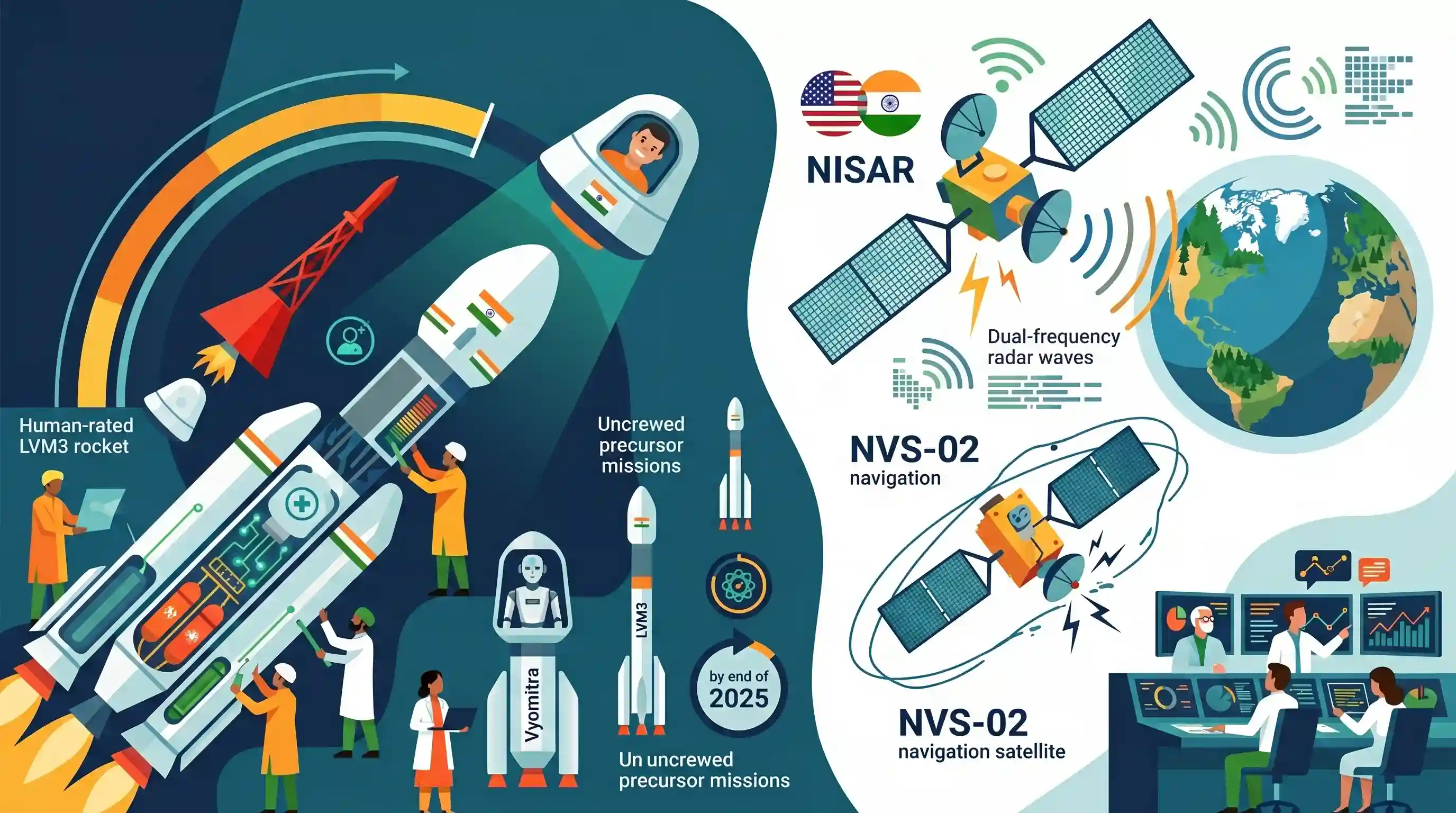
ISRO has successfully completed 90% of the development work for its ambitious Gaganyaan human spaceflight mission, with the final crewed flight scheduled for 2027. The project requires extensive technological development, including human-rated launch vehicles, life support, and crew escape systems. In the lead-up to the 2027 launch, ISRO plans three uncrewed precursor missions, the first of which will carry the humanoid robot Vyomitra by the end of 2025. Additionally, the recently launched dual-frequency NISAR satellite, a collaboration with NASA, is healthy and will soon begin comprehensive earth observations, while ISRO continues to investigate a valve malfunction that affected the orbit of the NVS-02 navigation satellite.
Key Points
- The development work for the Gaganyaan mission is 90% complete, targeting a crewed flight of three astronauts in a 400 km orbit by 2027.
- Prior to the crewed mission, three uncrewed flights will be conducted, starting with the humanoid 'Vyomitra' by late 2025.
- Critical progress includes human-rating the rocket and developing essential life support and crew escape systems.
- The dual-frequency NISAR (NASA-ISRO Synthetic Aperture Radar) satellite, launched recently, is fully healthy and will be operational soon to provide all-weather earth observation.
- The NVS-02 navigation satellite faced a valve malfunction that prevented it from reaching a circular orbit, leading to a failure analysis.
Important Terms
Gaganyaan mission

India's first human spaceflight mission designed to send a crew of three to Low Earth Orbit (400 km) for three days and return them safely.
UPSC context
GS-III: Science and Tech; tests indigenization of technology and India's standing as a space superpower.
NISAR
A joint NASA-ISRO Synthetic Aperture Radar satellite using dual frequencies (L-band and S-band) for high-resolution global Earth observation and disaster monitoring.
UPSC context
GS-III: Science and Tech; emphasizes international collaboration and advancements in remote sensing.
Vyomitra
An AI-powered half-humanoid robot developed by ISRO to act as a human proxy in uncrewed Gaganyaan missions, monitoring cabin parameters and operating controls.
UPSC context
GS-III: Science and Tech; tests awareness of robotics, AI, and mission safety protocols in space exploration.
NVS-02
A second-generation navigation satellite for India's NavIC constellation that suffered a pyro-valve failure in 2025, preventing its placement into a circular orbit.
UPSC context
GS-III: Science and Tech; highlights challenges in satellite technology and the reliability of regional navigation systems.
Vikram Sarabhai Space Centre (VSSC)
A premier ISRO research center in Thiruvananthapuram responsible for the design and development of launch vehicles and Gaganyaan's critical hardware like Vyomitra.
UPSC context
GS-III: Science and Tech; tests knowledge of India's space institutional framework and infrastructure.
ISRO
The premier Indian agency responsible for space research and planetary exploration, currently executing the Gaganyaan program and international missions like NISAR.
UPSC context
GS-III: Science and Tech; fundamental agency for all topics related to Indian space achievements and policy.
Prelims Trap
Gaganyaan aims to place astronauts into a Geostationary Earth Orbit (GEO) for long-term space exploration.
Gaganyaan is strictly a Low Earth Orbit (LEO) mission (approximately 400 km altitude). Placing human crews in GEO requires vastly more energy and radiation shielding.
Static Concepts Connected
What are the key differences between Low Earth Orbit (LEO) and Geosynchronous Orbit (GEO)?
- Altitude & Position: LEO is situated under 2,000 km, while GEO is placed exactly at 35,786 km, matching the Earth's rotation to appear stationary from the ground.
- Mission Applications: LEO is ideal for crewed missions (Gaganyaan, ISS) and high-resolution Earth observation. GEO is used for continuous regional coverage like navigation (NVS-02) and telecommunications.
How does Synthetic Aperture Radar (SAR) technology compare to optical imaging?
- Active vs Passive: SAR actively emits microwave pulses to map the surface and record backscatter, whereas optical imaging passively relies on reflected sunlight.
- Weather Independence: SAR's longer microwave wavelengths easily penetrate clouds, smoke, and dense foliage, allowing the satellite to operate 24/7 in all weather conditions, unlike optical sensors.
- Data Application: SAR is highly sensitive to surface textures and moisture content, making it ideal for tracking structural deformations and agricultural biomass.
Cross-Topic Patterns
NavIC and Strategic Autonomy
The NVS-02 anomaly affects India's independent navigation system (NavIC), highlighting the strategic imperative of indigenous positioning systems for defense over foreign GPS dependencies.
NISAR + Disaster Management
NISAR's ability to measure minute crustal deformations links space technology directly to GS-3 disaster management, enabling early warnings for landslides, earthquakes, and glacial bursts.

Expect a multi-statement question in 2026 mixing Gaganyaan’s LEO specifics (HLVM3) with NISAR’s dual-band SAR capabilities.
Linked PYQs · 2
Linked PYQs · 2
- 2017MainsGS3
India has achieved remarkable successes in unmanned space missions including the Chandrayaan and Mars Orbitter Mission, but has not ventured into manned space missions. What are the main obstacles to launching a manned space mission, both in terms of technology and logistics? Examine critically.
- 2024PrelimsGS1
Consider the following activities : 1. Identification of narcotics on passengers at airports or in aircraft 2. Monitoring of precipitation 3. Tracking the migration of animals In how many of the above activities can the radars be used?
