ISRO completes critical test ahead of uncrewed Gaganyaan flight
Source:The Hindu ↗
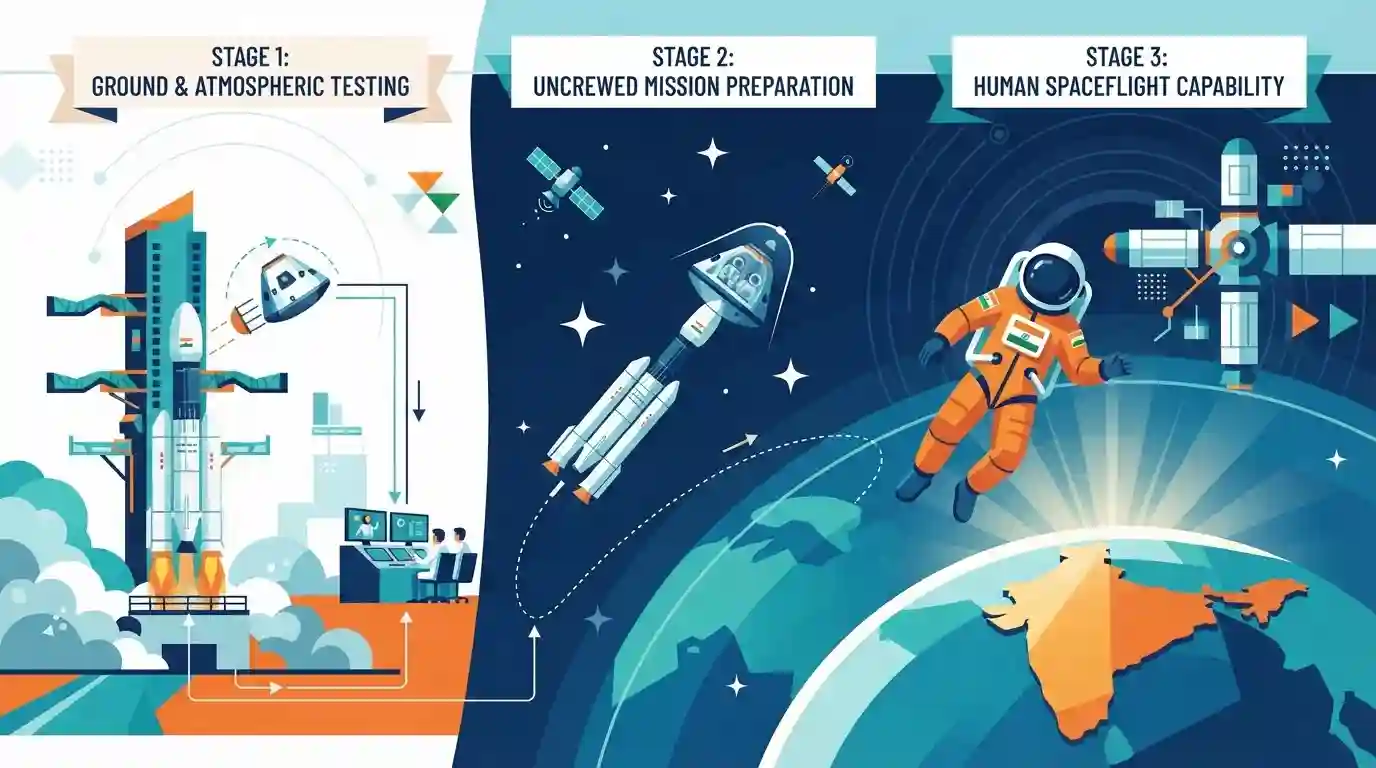
Why It Matters
The Gaganyaan mission represents a major technological leap for India's space program, transitioning from robotic missions to human spaceflight, which requires critical advancements in life support, crew escape systems, and safety protocols.
Summary
The Indian Space Research Organisation (ISRO) has successfully completed a key test ahead of the first uncrewed mission of the Gaganyaan human spaceflight program, highlighting India's steady progress toward indigenous human space exploration capabilities.
Key Points
- ISRO has completed a critical test for the Gaganyaan mission, which marks an important milestone ahead of its first uncrewed flight.
- The Gaganyaan project aims to demonstrate human spaceflight capability by launching a crew to an orbit of 400 km and bringing them safely back to Earth.
- Rigorous testing of propulsion systems, crew escape systems, and parachute deployment mechanisms is vital for ensuring astronaut safety in human-rated space missions.
Important Terms
Gaganyaan

India's premier human spaceflight initiative by ISRO, designed to demonstrate indigenous capability by sending astronauts into low Earth orbit and safely returning them to Earth.
UPSC context
UPSC Mains GS Paper 3: Science and Technology - Awareness in the fields of Space and developments/applications.
ISRO
India's national space agency responsible for planning, developing, and executing space research, satellite launches, and ambitious exploration programs like Gaganyaan and Chandrayaan.
UPSC context
UPSC Mains GS Paper 3: Science and Technology - Achievements of Indians in science & technology; indigenization of technology.
Prelims Trap
HLVM3 is a completely newly engineered launch vehicle with no technological lineage from existing ISRO launch systems.
Aspirants often assume human-rated LVM3 (HLVM3) uses liquid core stages only or newly developed cryogenic stages without derivative heritage from standard GSLV Mk-III.
Static Concepts Connected
What are the key technical components and objectives of India's Gaganyaan Human Spaceflight Programme?
- Orbit Parameters: Orbital Target: Sends a crew of astronauts to a Low Earth Orbit (LEO) of approximately 400 km for a planned duration and safely returns them.
- HLVM3 Rocket: Launch Vehicle: Utilizes the human-rated Launch Vehicle Mark-3 (HLVM3), equipped with redundant safety systems and fault-tolerant architecture.
- Escape System: Crew Safety: Features a dedicated Crew Escape System (CES) powered by solid motors to pull the module away during launch anomalies.
- ECLSS Module: Life Support: Employs an Environmental Control and Life Support System (ECLSS) to maintain earth-like atmospheric conditions inside the crew capsule.
Cross-Topic Patterns
Human Spaceflight and Deep Ocean Submersibles
Gaganyaan's ECLSS and life support tech leverage similar domestic R&D pipelines as India's Deep Ocean Mission (Samudrayaan), testing human survival in extreme pressurized chambers.
Human-Rated Launch Vehicles and Space Diplomacy
ISRO's transition from robotic planetary probes to human-rated LVM3 reflects India's broader strategic push for space diplomacy and joint orbital platforms like the proposed Bharatiya Antariksha Station.

Expect statement-based Qs on HLVM3 configurations, crew escape system mechanics, and LEO orbital parameters (400 km).
Linked PYQs · 1
Linked PYQs · 1
- 2016MainsGS3
Discuss India's achievements in the field of Space Science and Technology. How the application of this technology has helped India in its socio-economic development?
