Geneva Protesters Target UN Office and Vehicles during Anti G7 March
Source:The Hindu ↗
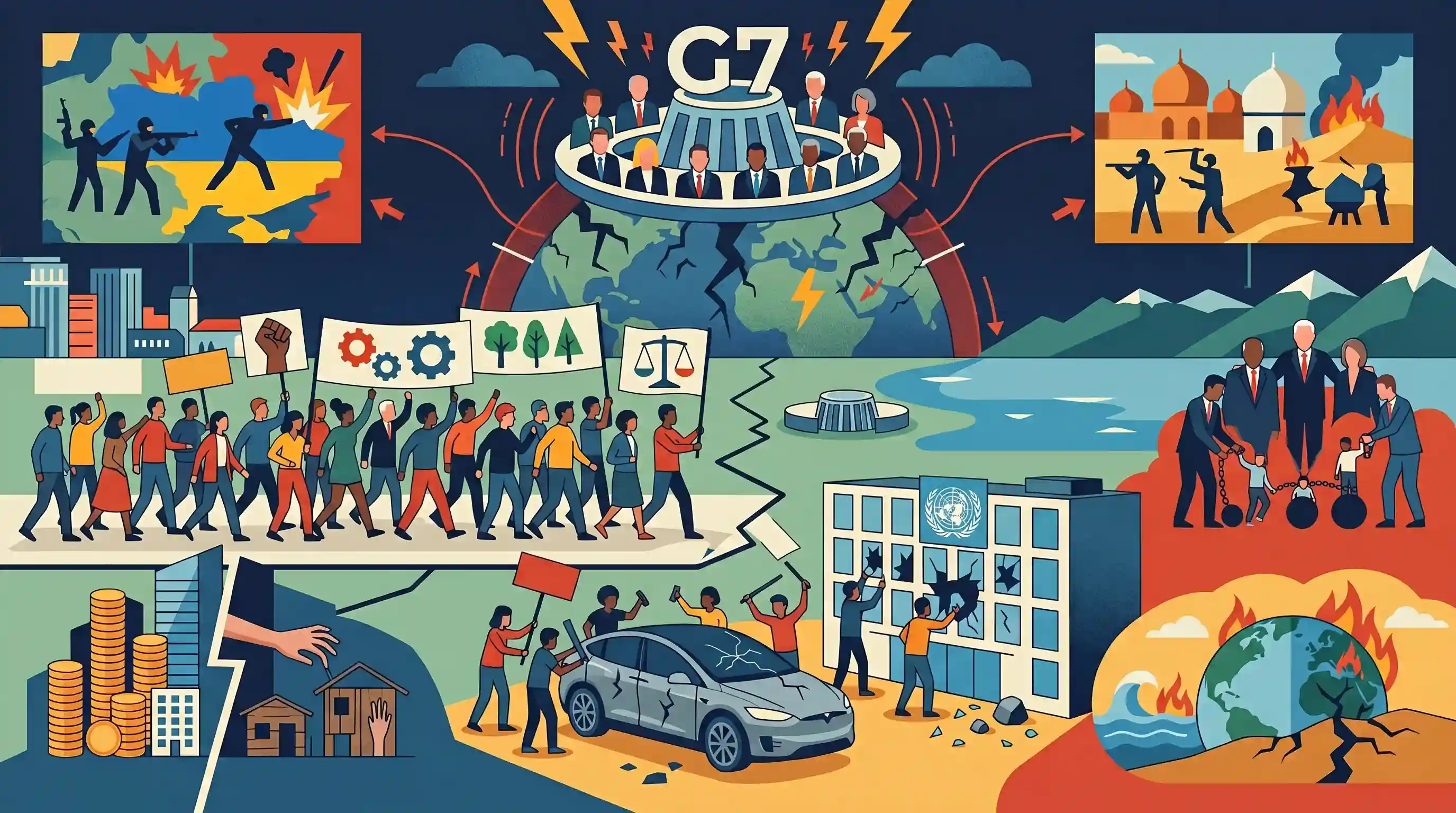
Why It Matters
Provides a real-world example of anti-globalisation sentiment and public criticism of exclusive plurilateral forums like the G7. It connects issues of economic inequality, climate inaction, and geopolitical conflicts to debates over the effectiveness and legitimacy of current global governance mechanisms.
Summary
Protesters in Geneva marched against the G7 summit held in nearby Evian-les-Bains, France, targeting symbols of capitalism and multilateralism. They vandalized a Tesla and broke windows at the UN office, expressing anger over global wealth inequality, climate change, and the concentration of power within the G7. The demonstrations reflect broader global anxieties over ongoing geopolitical conflicts in Ukraine and West Asia and a perceived failure of current global governance structures.
Key Points
- Around 5,000 protesters marched in Geneva against the G7 summit being held in nearby Evian-les-Bains, France.
- Demonstrators vandalised symbols of wealth and multilateralism, including setting a Tesla on fire and smashing windows at the UN's Palais des Nations.
- The protests highlighted growing discontent with capitalism, extreme wealth inequality, climate change, and the perceived unrepresentative nature of the G7.
- The geopolitical backdrop to the summit and the protests includes ongoing wars in Ukraine and West Asia, and a potential Iran peace deal.
Important Terms
G7 (Group of Seven)

An informal forum of seven of the world's most advanced economies—Canada, France, Germany, Italy, Japan, the UK, and the USA—plus the European Union, focusing on global economic and security coordination.
UPSC context
GS Paper 2 (International Relations); tests knowledge of informal groupings, global economic order, and India's 'outreach' role despite non-membership.
United Nations Office at Geneva (UNOG)
The second-largest of the four major office sites of the UN, serving as a focal point for multilateral diplomacy, human rights, and humanitarian action.
UPSC context
GS Paper 2 (International Relations); relevant to multilateralism, institutional vulnerability to protests, and global administrative structures.
Anti-globalisation Movement
A social movement critical of economic globalization, neoliberalism, and the perceived concentration of power in international financial institutions and advanced economies.
UPSC context
GS Paper 1 (Social Issues) & GS Paper 2 (IR); concerns critiques of capitalism, wealth inequality, and the legitimacy of global governance.
Global Governance
The collective efforts by states, international organizations, and non-state actors to manage shared global problems through norms, treaties, and institutional cooperation.
UPSC context
GS Paper 2 (International Relations); critical for understanding the evolving role of the UN and G7 in managing geopolitical conflicts.
Tesla
A leading American electric vehicle and clean energy company, often targeted in protests as a symbol of billionaire wealth and transnational capitalism.
UPSC context
GS Paper 4 (Ethics) or GS Paper 3 (Economy); used to illustrate corporate influence and public resentment toward extreme wealth concentration.
Prelims Trap
The G7 operates out of its permanent secretariat located in Geneva.
The G7 is an informal intergovernmental forum. It has no legal charter and no permanent secretariat; its presidency and administrative functions rotate annually.
Static Concepts Connected
How does the G7 differ structurally from formal international organizations like the UN?
- Informal Forum: The G7 operates purely as an informal bloc without a founding legal charter, international treaty, or permanent secretariat.
- Rotating Presidency: Administrative leadership and hosting duties rotate annually among member states, who independently set the agenda for that year's summit.
- Exclusive Nature: Formed after the 1973 oil crisis for macroeconomic coordination, its exclusive nature often draws criticism compared to broader groupings like the G20.
What are the core drivers of contemporary Anti-Globalization movements?
- Wealth Inequality: A perception that neo-liberal policies and free trade disproportionately benefit transnational corporations, exacerbating the wealth gap between advanced and developing economies.
- Democratic Deficit: Frustration that global economic and environmental rules are set by unrepresentative, exclusive forums without direct public accountability or sovereign control.
Cross-Topic Patterns
Multilateralism reform & UNSC
Protests targeting the UN reflect frustration with institutional paralysis, linking directly to India's push for UNSC reform and the Global South's demand for equitable representation.
Climate Change & Global Inequality
Targeting elite EV symbols (Tesla) over climate grievances mirrors the 'Common but Differentiated Responsibilities' (CBDR) debate, highlighting the rich-poor divide in global climate action.

Crisis of Multilateralism linking exclusive blocs like the G7 to global inequality and Global South demands is a prime 2026 Mains theme.
Linked PYQs · 2
Linked PYQs · 2
- 2012MainsGS2
What is meant by the G8 + 5 group?
- 2025MainsGS2
"With the waning of globalization, post-Cold War world is becoming a site of sovereign nationalism.” Elucidate.
