G7 Summit Geopolitics: Protectionism and Middle East Conflict
Source:The Hindu ↗
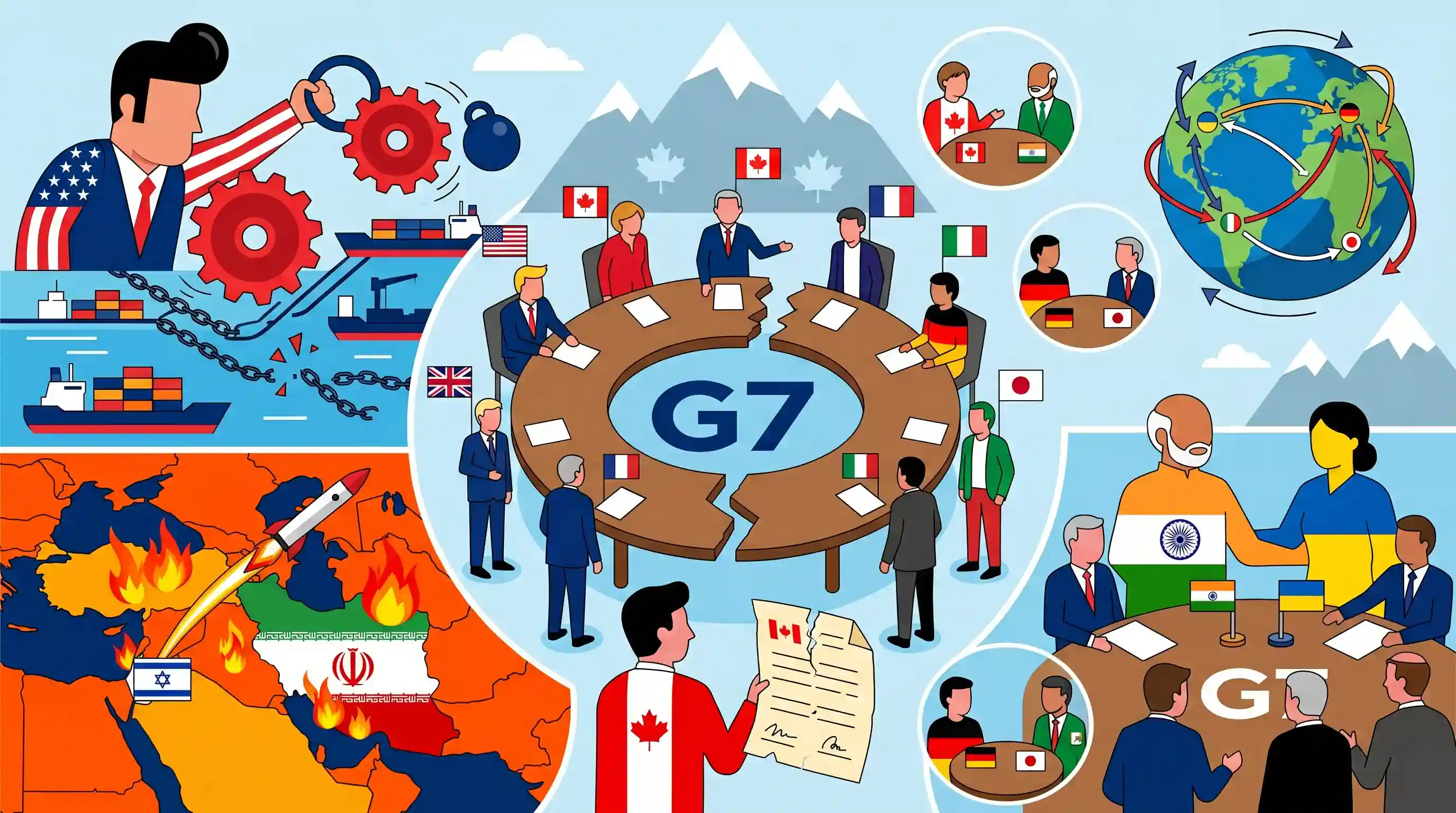
Why It Matters
The article illustrates the weakening of post-Cold War multilateralism and the rise of transactional diplomacy, highly relevant for GS Paper 2 (International Relations) and GS Paper 3 (Economy). It highlights the impact of US protectionism and Middle Eastern instability on global governance, while also showcasing India's strategic positioning as an essential invitee to major global economic forums.
Summary
The 2025 Group of Seven (G7) summit, hosted by Canada, unfolds amid significant global fractures, primarily overshadowed by the escalating military conflict between Israel and Iran and unresolved trade wars fueled by US President Donald Trump. Traditional G7 unity is challenged by Trump's protectionist tariffs and unconventional geopolitical threats, leading host Prime Minister Mark Carney to abandon the customary joint communique in favor of bilateral discussions. The summit underscores a shifting global order characterized by reduced US multilateral leadership, growing volatility in the Middle East, and the increasing inclusion of non-G7 nations like India and Ukraine to navigate complex global security and economic challenges.
Key Points
- The 2025 G7 Summit in Canada is dominated by bilateral diplomacy rather than unified multilateralism, driven by US President Donald Trump's preference for one-on-one engagements and protectionist trade tariffs.
- The escalating military conflict between Israel and Iran looms large over the summit, reflecting a more volatile global security environment as the US scales back its traditional role as a global policeman.
- The summit breaks from tradition, as Canadian PM Mark Carney opted not to issue a joint communique, highlighting the deep fractures within the G7 over trade wars and territorial sovereignty issues.
- India, along with Ukraine, Brazil, South Africa, and other key nations, was invited to the summit, indicating the G7's recognition of the Global South and broader middle powers in addressing global trade and security challenges.
Important Terms
Group of Seven (G7)

An informal intergovernmental forum of seven advanced economies—Canada, France, Germany, Italy, Japan, the UK, and the US—plus the EU, coordinating global economic and security policies.
UPSC context
GS Paper II: International Relations and global groupings. Important for understanding global governance and India's role as a consistent outreach partner.
Protectionism
The economic policy of restricting imports through tariffs, quotas, or regulations to favor domestic industries, often resulting in retaliatory 'trade wars' and disrupted global supply chains.
UPSC context
GS Paper III: Economy; GS Paper II: Effect of policies of developed countries on India's interests. Tests impact on trade and macroeconomic stability.
Multilateralism
A system of international relations where three or more countries cooperate based on shared norms, rules, and institutions to solve global problems.
UPSC context
GS Paper II: Global groupings. Central to debates on 'reformed multilateralism' and the weakening of international institutions like the UN and WTO.
Joint Communiqué
A formal collective statement issued by leaders at the end of a summit, representing negotiated consensus on policy goals, security stances, and economic cooperation.
UPSC context
GS Paper II: International Relations/Diplomacy. Its absence or failure signifies significant geopolitical rifts and a breakdown in diplomatic consensus.
Global South
A term referring to developing and emerging nations, primarily in Africa, Asia, and Latin America, which often share history of colonization and face systemic economic challenges.
UPSC context
GS Paper II: India and its Neighborhood/Global interests. Highlights India's leadership role and strategic positioning between the West and developing nations.
Strategic Autonomy
A state's ability to pursue national interests and adopt foreign policy independent of external pressure from other powers, while maintaining diverse strategic partnerships.
UPSC context
GS Paper II: International Relations. Crucial for understanding India's 'multi-alignment' approach, especially when dealing with rival blocs or conflicting global interests.
Prelims Trap
"The G7 operates under a formal multilateral charter and mandates a joint communique after every annual leaders' summit."
The G7 is strictly an informal bloc with no treaty, charter, or permanent secretariat. Joint communiques are customary, not legally or structurally mandated.
Static Concepts Connected
What is the structural nature and membership of the G7?
- Informal forum: It operates without a formal charter, international treaty, or permanent secretariat. The presidency rotates annually among member states.
- Core members: Comprises the US, UK, Canada, France, Germany, Italy, and Japan. The European Union is a "non-enumerated" member.
- Russian exit: Originally the G8, it reverted to the G7 after Russia was suspended (and subsequently withdrew) following its 2014 annexation of Crimea.
What are the core trade remedy measures permitted under the WTO framework?
- Anti-dumping duty: Imposed on imports priced below their fair domestic market value to protect domestic industries.
- Countervailing duty: Levied to neutralize market-distorting export subsidies provided by the exporting country's government.
- Safeguard measures: Temporary import restrictions applied when a sudden, unforeseen import surge threatens to cause serious injury to a domestic industry.
Cross-Topic Patterns
Crisis of Multilateralism and WTO
The G7's inability to issue a joint communique mirrors the broader paralysis in global multilateral institutions like the WTO, driven by rising protectionist trade policies and sovereign nationalism.
Global South as balancing powers
Inviting India, Brazil, and South Africa (IBSA) underlines Western recognition that contemporary trade and Eurasian/Middle Eastern security conflicts cannot be managed without Global South consensus.

Expect a multi-statement Prelims question on G7 structure (lack of charter/secretariat) vs G20, or a GS2 Mains Q on minilateral decline.
Linked PYQs · 5
Linked PYQs · 5
- 2025MainsGS2
"With the waning of globalization, post-Cold War world is becoming a site of sovereign nationalism.” Elucidate.
- 2016MainsGS2
The broader aims and objectives of WTO are to manage and promote international trade in the era of globalization. But the Doha round of negotiations seem doomed due to differences between the developed and the developing countries." Discuss in the Indian perspective.
- 2025MainsGS2
"Energy security constitutes the dominant kingpin of India's foreign policy, and is linked with India's overarching influence in Middle Eastern countries.” How would you integrate energy security with India's foreign policy trajectories in the coming years?
- 2018MainsGS2
“India’s relations with Israel have, of late, acquired a depth and diversity, which cannot be rolled back.” Discuss.
- 2025MainsGS3
What are the challenges before the Indian economy when the world is moving away from free trade and multilateralism to protectionism and bilateralism? How can these challenges be met?
