Global Compact on AI and G20 Technology Governance Proposals
Source:The Hindu ↗
Why It Matters
The unregulated growth of AI presents unprecedented challenges to internal security, privacy, and ethics, including the proliferation of deepfakes and cyber-terrorism. India's leadership in proposing a global compact at the G20 highlights the necessity of multilateral consensus for digital governance and reinforces India's role as a proactive norm-setter in the Global South.
Summary
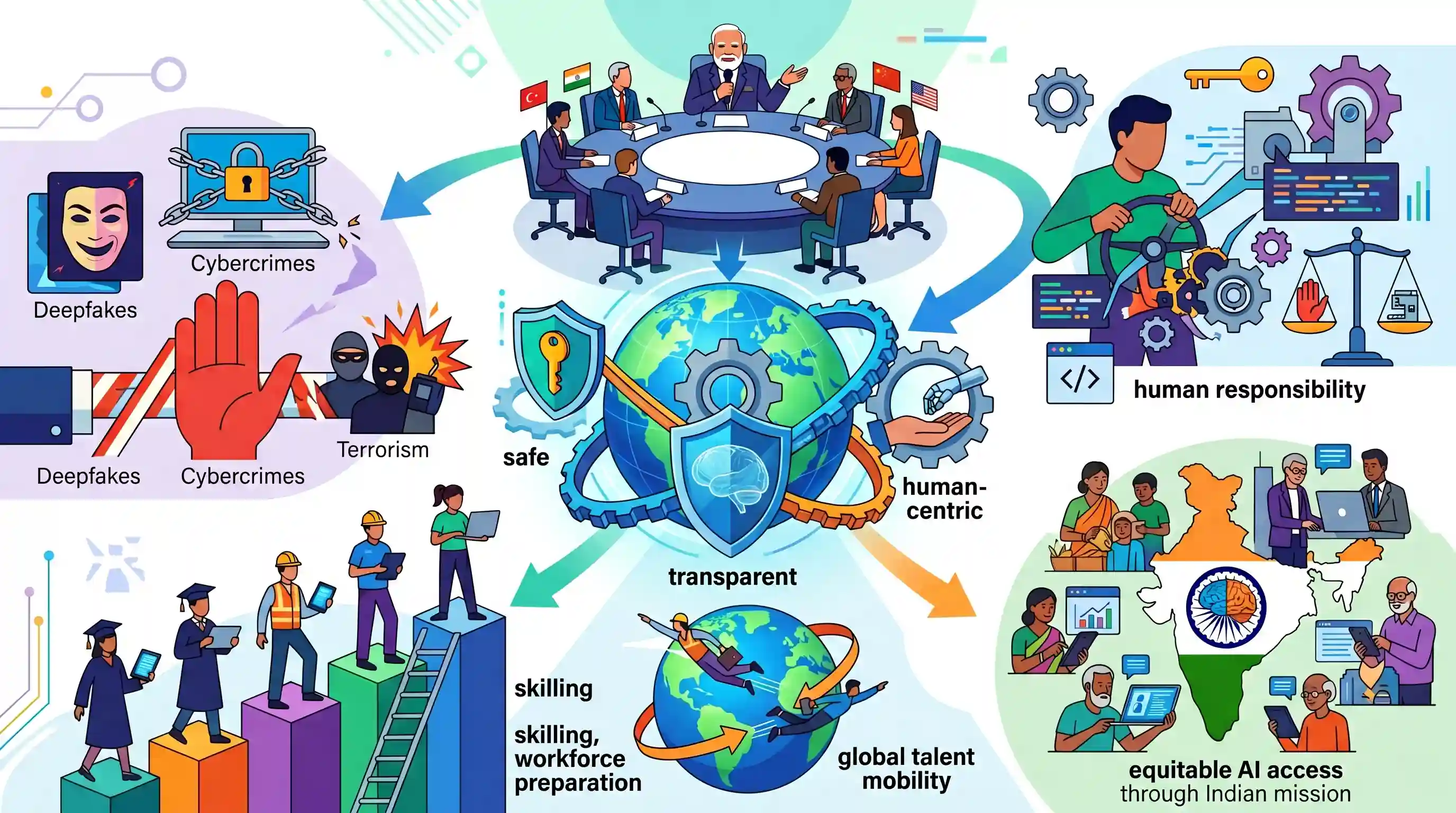
At the G20 Summit in Johannesburg, Prime Minister Narendra Modi called for the creation of a 'global compact on AI' to ensure the technology remains safe, transparent, and human-centric. Highlighting the risks associated with frontier technologies, he advocated for strict restrictions on the misuse of AI for deepfakes, cybercrimes, and terrorism. Modi emphasized that AI applications should be open-source and that the ultimate responsibility for AI outcomes must rest with humans. Additionally, he proposed a G20 framework for global talent mobility to prepare the workforce for future capabilities and showcased India's commitment to equitable AI access through the India-AI Mission.
Key Points
- PM Modi proposed a 'global compact on AI' at the G20 Summit in Johannesburg to establish international norms for artificial intelligence.
- The proposed compact emphasizes safety-by-design, effective human oversight, transparency, and strict restrictions on AI misuse such as deepfakes, cybercrime, and terrorism.
- Modi advocated for 'open-source' and 'global' AI applications rather than exclusive models, asserting that AI must be human-centric and auditable.
- He called for a G20-led global framework for 'talent mobility' to align workforce skills with the capabilities required for the future.
- Highlighted India's approach of equitable access and population-level skilling through the India-AI Mission, and announced India will host the AI Impact Summit in 2026.
Important Terms
Global Compact on AI

A proposed international agreement to establish ethical standards and safety regulations for Artificial Intelligence, emphasizing human oversight, transparency, and strict restrictions on misuse like deepfakes.
UPSC context
GS Paper 2 (International Relations) and GS Paper 3 (S&T); tests understanding of global technology governance and India's diplomatic leadership.
India-AI Mission
India's flagship initiative (₹10,371 crore outlay) aimed at building indigenous AI compute capacity (38,000+ GPUs), datasets (AIKosh), and foundational models to democratize AI access.
UPSC context
GS Paper 3 (Science & Technology); focuses on digital infrastructure, self-reliance (Atmanirbharta), and socio-economic transformation through emerging technologies.
G20 (Group of Twenty)
An intergovernmental forum of 19 countries, the EU, and the AU that coordinates global policy on financial stability, climate change, and sustainable development.
UPSC context
GS Paper 2 (Global Groupings); core topic for international institutional frameworks and India's role in multilateral diplomacy.
Deepfakes
Synthetic media—videos, audio, or images—manipulated using deep learning (AI) to hyper-realistically falsify a person's likeness, often used for misinformation or fraud.
UPSC context
GS Paper 3 (Cyber Security/Internal Security); tests awareness of new-age security threats and the ethical challenges of generative AI.
Global Talent Mobility
A proposed international framework to facilitate the movement of skilled professionals across borders, aligning global workforce skills with the 'capabilities of tomorrow'.
UPSC context
GS Paper 3 (Economy/Human Resources); relevant to global labor markets, skilling, and the 'Brain Gain' strategy for India.
Human-centric AI
A technology governance philosophy prioritizing human well-being, rights, and ultimate human responsibility in decision-making over purely financial or automated interests.
UPSC context
GS Paper 4 (Ethics) and GS Paper 3 (S&T); tests the ability to analyze the ethical dimensions and societal impact of technology.
Prelims Trap
The 'Global Compact on AI' is a legally binding treaty finalized by the United Nations.
Aspirants may confuse India's G20 proposal for establishing international norms with an existing UN treaty. It is a proposed framework, not a binding pact.
Static Concepts Connected
How do Generative Adversarial Networks (GANs) create deepfakes?
- Dual Networks: GANs pit a 'generator' creating fake data against a 'discriminator' evaluating it, iteratively improving realism to bypass human detection.
- Broad Applications: While notorious for deepfakes, GANs are also utilized legitimately in drug discovery, medical imaging, and video game design.
What are the core pillars of the IndiaAI Mission?
- Nodal Agency: Spearheaded by MeitY under the Digital India Corporation with a ₹10,300+ crore outlay to democratize AI access.
- AI Compute Capacity: Aims to establish a national computing grid of 10,000+ GPUs through public-private partnerships to support startups.
- AIKosh Platform: An Open Dataset Platform designed to provide high-quality, non-personal datasets for training indigenous, linguistically diverse AI models.
Cross-Topic Patterns
AI as a Public Good vs Safety-First
India contrasts the Western 'Safety-First' regulatory model (like the EU AI Act) with a DPI-inspired 'Impact-First' model, advocating for open-source AI over exclusive corporate monopolies.
Technology Governance & Labor Economics
The push for a G20 'talent mobility' framework ties directly into GS3 concerns about AI-induced job displacement and India's need to leverage its demographic dividend.

Expect a 2026 GS3 Mains question contrasting India's 'Impact-First' open-source AI governance model with the EU's 'Safety-First' AI Act.
Linked PYQs · 4
Linked PYQs · 4
- 2023MainsGS3
Introduce the concept of Artificial Intelligence (AI). How does Al help clinical diagnosis? Do you perceive any threat to privacy of the individual in the use of Al in healthcare?
- 2024MainsGS4
The application of Artificial Intelligence as a dependable source of input for administrative rational decision-making is a debatable issue. Critically examine the statement from the ethical point of view.
- 2021MainsGS3
Keeping in view India's internal security, analyse the impact of cross-border cyber attacks. Also discuss defensive measures against these sophisticated attacks.
- 2024MainsGS4
ABC Incorporated is a technological company named which is the second largest worldwide, situated in the Third World. You are the Chief Executive Officer and the majority shareholder of this company. The fast technological improvements have raised worries among environmental activists, regulatory authorities, and the general public over the sustainability of this scenario. You confront substantial issues about the business's environmental footprint. In 2023, your organization had a significant increase of 48% in greenhouse gas emissions compared to the levels recorded in 2019. The significant rise in energy consumption is mainly due to the surging energy requirements of your data centers, fuelled by the exponential expansion of Artificial Intelligence (AI). AI-powered services need much more computational resources and electrical energy compared to conventional online activities, notwithstanding their notable gains. The technology's proliferation has led to a growing concern over the environmental repercussions, resulting in an increase in warnings. Al models, especially those used in extensive machine learning and data processing, exhibit much greater energy consumption than conventional computer tasks, with an exponential increase. Although there is already a commitment and goal to achieve net zero emissions by 2030, the challenge of lowering emissions seems overwhelming as the integration of Al continues to increase. To achieve this goal, substantial investments in renewable energy use would be necessary. The difficulty is exacerbated by the competitive environment of the technology sector, where rapid innovation is essential for preserving market standing and shareholders' worth. To achieve a balance between innovation, profitability and sustainability, a strategic move is necessary that is in line with both, business objectives and ethical obligations. (a) What is your immediate response to the challenges posed in the above case? (b) Discuss the ethical issues involved in the above case. (c) Your company has been identified to be penalized by technological giants. What logical and ethical arguments will you put forth to convince about its necessity? (d) Being a conscience being, what measures would you adopt to maintain balance between AI innovation and environmental footprint?
