G20 Summit in South Africa Adopts Declaration Amid US Boycott
Source:Indian Express ↗
Why It Matters
The US boycott of a major multilateral forum like the G20 signals a significant rift in global governance, highlighting the challenges of achieving consensus on critical global issues such as climate change and developing country debt without the participation of the world's largest economy.
Summary
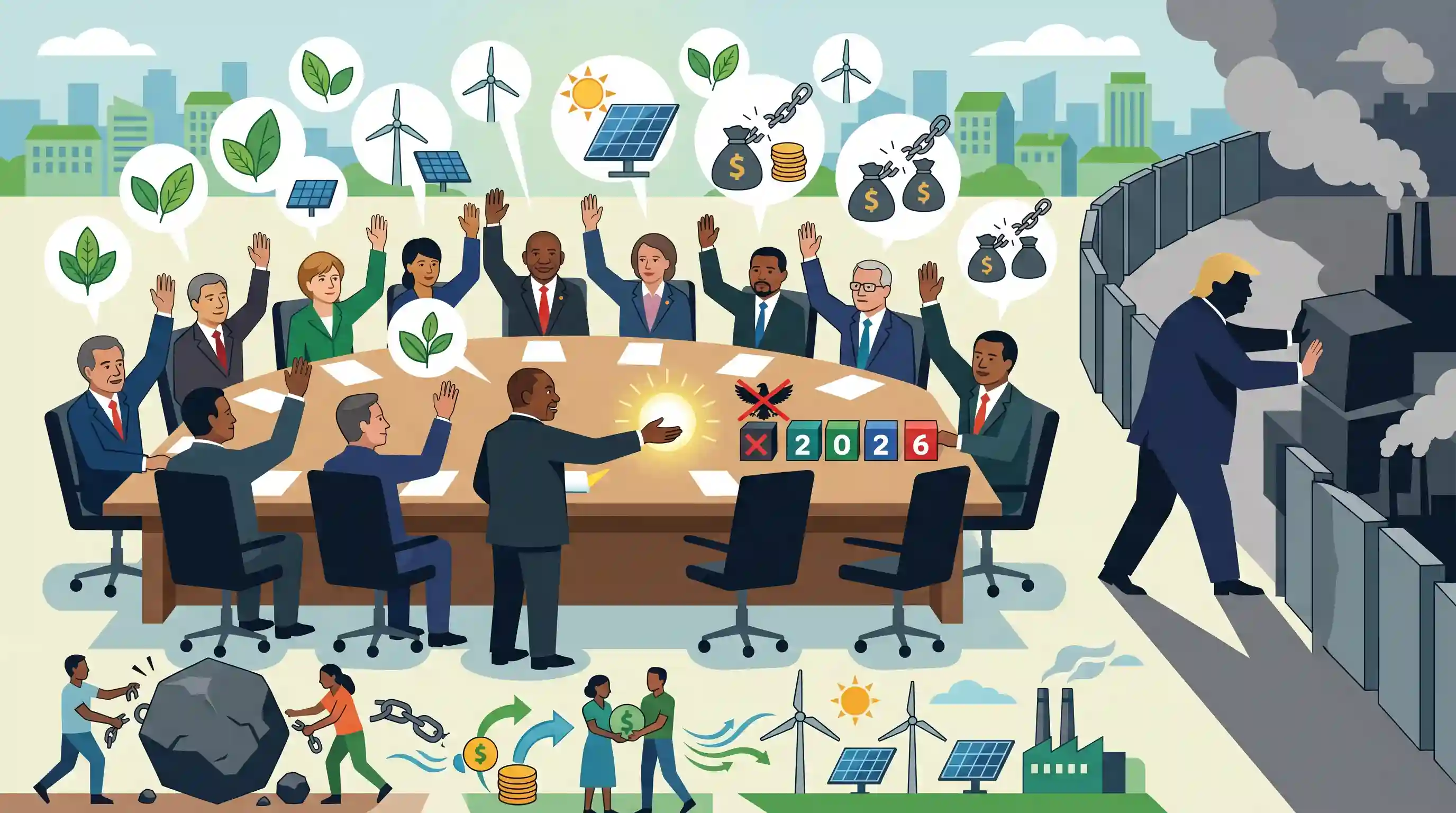
The G20 Summit in Johannesburg, South Africa, concluded with the adoption of a joint declaration focused on climate change, renewable energy, and debt relief for developing nations, notably without the participation of the United States. US President Donald Trump boycotted the event over unfounded claims regarding the South African government, and his administration strongly opposed the declaration's language on global warming. South African President Cyril Ramaphosa praised the overwhelming consensus among the remaining G20 members, underscoring the summit's focus on the Global South. The event culminated in a highly unusual handover of the 2026 rotating G20 presidency to an 'empty chair', symbolizing the US absence.
Key Points
- The G20 Summit in South Africa adopted a joint declaration emphasizing climate change action, renewable energy, and debt relief for developing nations, despite a US boycott.
- US President Donald Trump boycotted the summit citing unfounded allegations regarding South Africa's government, while US officials criticized the declaration's explicit language on global warming.
- South African President Cyril Ramaphosa highlighted the summit's success in achieving consensus and focusing on the challenges faced by the Global South, such as climate vulnerability and heavy debt.
- The summit concluded with an unprecedented symbolic handover of the 2026 G20 rotating presidency to the United States via an 'empty chair'.
Important Terms
G20 (Group of Twenty)

An international forum of 19 countries, the EU, and the AU, representing the world's major economies and focusing on global financial stability and sustainable development.
UPSC context
GS Paper II (International Relations); tests knowledge of global economic governance and India’s strategic role in multilateral forums.
Global South
Developing nations in Africa, Asia, and Latin America often seeking structural reforms in global finance and more equitable representation in international decision-making.
UPSC context
GS Paper II; critical for understanding India's leadership aspirations and North-South diplomacy in current affairs.
Leaders' Declaration
A consensus-based document issued by G20 heads of state, summarizing commitments on global challenges such as climate change, health, and economic policy.
UPSC context
GS Paper II; requires analysis of diplomatic negotiations and the impact of bilateral tensions on multilateral outcomes.
Multilateralism
Organized cooperation between three or more nations to achieve common goals, currently facing challenges from isolationism and a shift toward bilateralism.
UPSC context
GS Paper II; explores the evolving nature of the rules-based international order and institutional effectiveness.
Debt Relief
The process of reorganizing or forgiving the debt of developing countries to allow for fiscal space in education, healthcare, and climate resilience.
UPSC context
GS Paper III (Economy); concerns global financial architecture and the economic stability of the developing world.
Rotating Presidency
The annual leadership position of the G20, responsible for hosting the summit and directing the group's agenda for one calendar year.
UPSC context
GS Paper II; tests understanding of the G20’s "Troika" system and the influence of host nations on global policy.
Prelims Trap
"G20 declarations are legally binding treaties enforced by its permanent secretariat."
The G20 is an informal forum. Its declarations are political statements, not legally binding treaties, and it relies entirely on the rotating 'Troika' rather than a permanent secretariat.
Static Concepts Connected
What is the G20 'Troika' and why is it significant?
- Structure: It comprises the past, present, and future G20 presidencies, working together to ensure agenda continuity since the forum lacks a permanent secretariat.
- Recent milestone: The 2022-2025 cycle (Indonesia, India, Brazil, South Africa) marked the first time the Troika was entirely composed of developing nations from the Global South.
How do 'debt-for-climate swaps' work for developing nations?
- Mechanism: A creditor forgives or discounts a portion of a developing nation's foreign debt in exchange for commitments to fund domestic climate adaptation and mitigation initiatives.
- Significance: It relieves severe fiscal pressure on low-income countries, ensuring that heavy external debt-servicing costs do not derail their Sustainable Development Goals (SDGs).
Cross-Topic Patterns
MDB Reforms + Global South
The unbroken four-year chain of developing-nation G20 presidencies successfully pushed structural reform of Multilateral Development Banks (MDBs) and debt restructuring to the forefront of global finance.
Climate isolationism + Leadership vacuum
US withdrawal from multilateral climate consensus creates a geopolitical vacuum in standard-setting, which is historically leveraged by powers like China to expand influence across the Global South.

The historic 4-year Global South G20 presidency cycle (2022-25) and 'Troika' mechanics will likely feature in a 2026 Prelims statement.
Linked PYQs · 2
Linked PYQs · 2
- 2019MainsGS2
‘The long-sustained image of India as a leader of the oppressed and marginalised nations has disappeared on account of its new found role in the emerging global order.’ Elaborate.
- 2022MainsGS3
Discuss global warming and mention its effects on the global climate. Explain the control measures to bring down the level of greenhouse gases which cause global warming, in the light of the Kyoto Protocol, 1997.
