ISRO Climate Satellite Plans and Deep Ocean Missions
Source:The Hindu ↗
Why It Matters
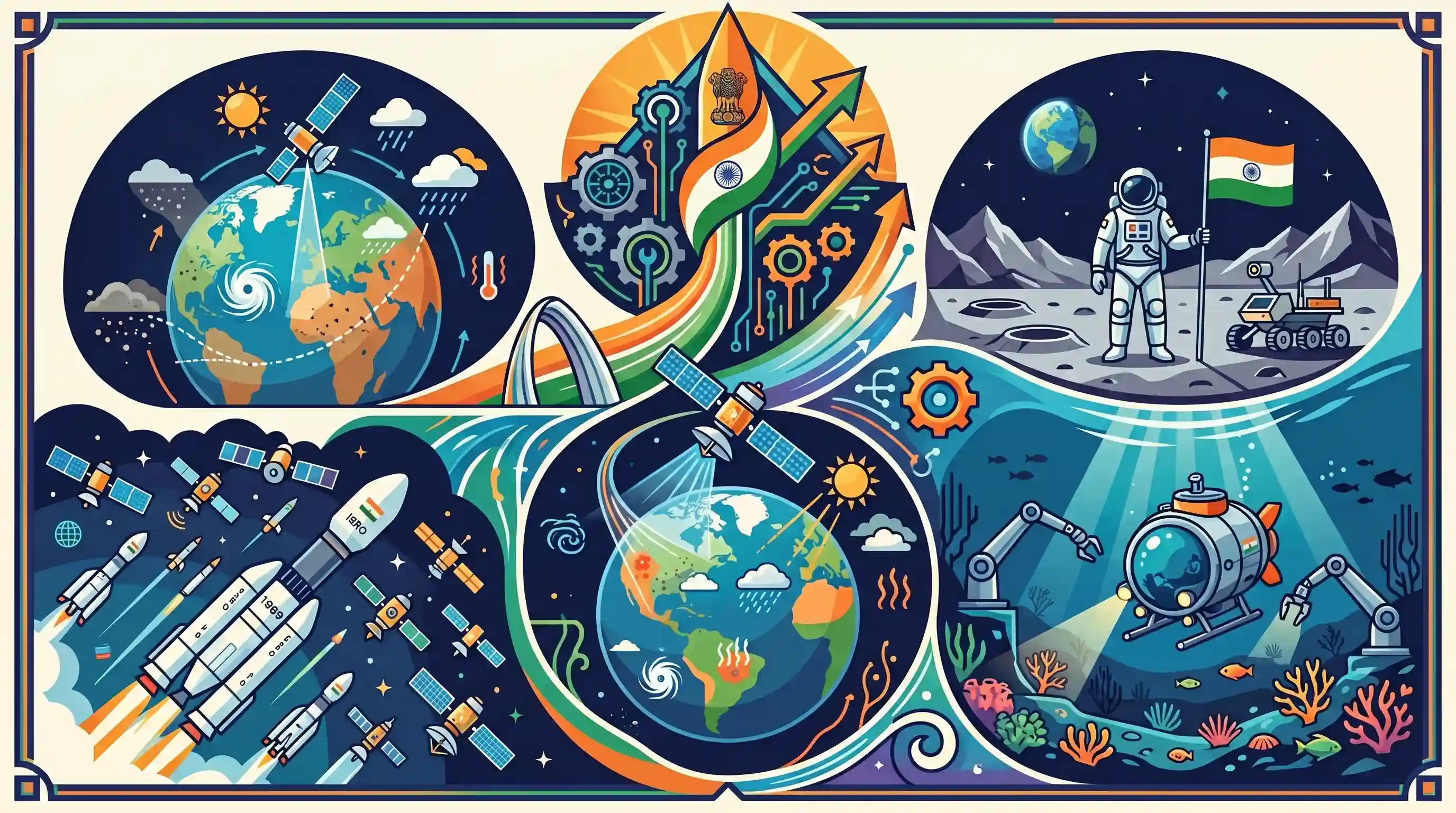
The article details vital scientific and technological milestones for India, bridging both outer space and deep ocean domains. The G20 satellite represents India's space diplomacy and commitment to climate tracking, while the Moon mission and Samudrayaan highlight ongoing efforts toward self-reliance (Viksit Bharat) and advanced technological applications.
Summary
ISRO Chairman V. Narayanan has announced that the "G20 satellite," proposed by India during its G20 presidency for studying climate, air pollution, and weather monitoring, is targeted for launch in 2027. He also highlighted ISRO's commercial achievements, including launching 433 satellites from 34 countries and successfully placing 104 satellites using a single rocket. Furthermore, he outlined future national goals, such as landing an Indian astronaut on the Moon by 2040 and developing a 2.2-meter titanium vessel for the Samudrayaan mission, part of India's Deep Ocean Mission, aiming for technological parity with global space-faring nations under the "Viksit Bharat" vision.
Key Points
- The G20 satellite, aimed at monitoring climate change, air pollution, and weather patterns, is scheduled for launch by ISRO in 2027.
- ISRO's commercial operations have significantly expanded, successfully launching 433 satellites for 34 different countries.
- The agency holds the distinct record of placing 104 satellites into orbit using a single launch vehicle without collisions.
- India's future space roadmap includes a long-term goal of landing an Indian astronaut on the Moon by 2040.
- As part of the Deep Ocean Mission's Samudrayaan project, ISRO is contributing to the development of a 2.2-metre diameter titanium vessel designed to withstand deep-sea pressure.
Important Terms
G20 Satellite

An environmental satellite proposed by India for G20 nations to monitor climate change, air pollution, and weather patterns, expected to launch in 2027.
UPSC context
GS Paper 2 & 3: International Relations and Space; reflects India's leadership in the Global South and scientific diplomacy.
Samudrayaan
India's first manned deep-ocean mission aimed at sending a three-person crew to a depth of 6,000 meters for scientific exploration and resource assessment.
UPSC context
GS Paper 3: Science and Technology; tests knowledge of indigenous high-pressure technology and maritime exploration capabilities.
Matsya-6000
An indigenously developed, self-propelled manned submersible designed to carry three humans to the deep ocean floor (6,000m) under the Samudrayaan project.
UPSC context
GS Paper 3: Science and Tech; identifies specific Indian advancements in extreme-environment engineering and deep-sea research.
Deep Ocean Mission (DOM)
A flagship initiative by the Ministry of Earth Sciences to explore deep-sea resources like polymetallic nodules and strengthen India's Blue Economy.
UPSC context
GS Paper 3: Economy and Environment; essential for understanding resource security (critical minerals) and sustainable ocean governance.
Viksit Bharat 2047
The Government of India's long-term vision to transform the country into a fully developed and self-reliant nation by 2047, its centenary of independence.
UPSC context
GS Paper 3: Indian Economy and Governance; central theme for long-term growth targets and socio-economic transformation.
Blue Economy
An economic model focused on the sustainable use of ocean resources for economic growth, improved livelihoods, and jobs while preserving ecosystem health.
UPSC context
GS Paper 3: Economy and Geography; vital for questions on marine resource potential and coastal development.
Prelims Trap
"ISRO is the nodal agency responsible for executing India's Deep Ocean Mission."
The Deep Ocean Mission is governed and funded by the Ministry of Earth Sciences (MoES). ISRO is only collaborating to build the titanium pressure sphere.
Static Concepts Connected
What are the primary objectives of India's Deep Ocean Mission?
- Manned Exploration: Developing Matsya 6000, a manned submersible designed to carry three humans to a depth of 6,000 meters for deep-sea exploration.
- Deep-Sea Mining: Exploration and extraction of polymetallic nodules (rich in copper, nickel, cobalt) from the Central Indian Ocean Basin (CIOB).
- Ocean Climate Services: Creating ocean climate change advisory services and conducting bio-prospecting of deep-sea flora and fauna.
How do Earth Observation satellites differ operationally from Communication satellites?
- Orbit Placement: Earth observation (like the G20 satellite) usually utilizes Low Earth Orbit (LEO) for high-resolution imaging, whereas communication satellites sit in Geostationary Orbit (GEO).
- Applications: LEO platforms monitor climate, agriculture, and disasters using remote sensing; GEO platforms provide continuous, stationary telecommunication and DTH broadcasting.
Cross-Topic Patterns
Space Diplomacy and Soft Power
Like the 2017 South Asia Satellite, the G20 satellite acts as a diplomatic tool, providing free climate and weather data to member nations, thereby bolstering India's soft power and "Vishwa Mitra" image.
Inter-agency Tech Transfer: Space to Sea
ISRO's metallurgical expertise in building the titanium pressure sphere for Samudrayaan highlights how space-grade technology is repurposed for extreme-pressure marine environments under the Ministry of Earth Sciences.

ISRO's inter-agency tech transfers (Matsya 6000) combined with space diplomacy (G20 satellite) is highly probable for a 2026 Prelims MCQ.
Linked PYQs · 2
Linked PYQs · 2
- 2016MainsGS3
Discuss India's achievements in the field of Space Science and Technology. How the application of this technology has helped India in its socio-economic development?
- 2018PrelimsGS1
With reference to India's satellite launch vehicles, consider the following statements: 1. PSLVs launch the satellites useful for Earth resources monitoring whereas GSLVs are designed mainly to launch communication satellites. 2. Satellites launched by PSLV appear to remain permanently fixed in the same position in the sky, as viewed from a particular location on Earth. 3. GSLV Mk III is a four-staged launch vehicle with the first and third stages using solid rocket motors; and the second and fourth stages using liquid rocket engines. Which of the statements given above is/are correct?
