Public Sector Banks Record Surge in FY25 Dividend Transfers
Source:Indian Express ↗
Why It Matters
The transformation of PSBs from loss-making entities burdened by NPAs into profitable, dividend-paying institutions demonstrates the tangible impact of structural economic reforms. The significant boost to non-tax revenue is crucial for managing the fiscal deficit and ensuring macroeconomic stability.
Summary
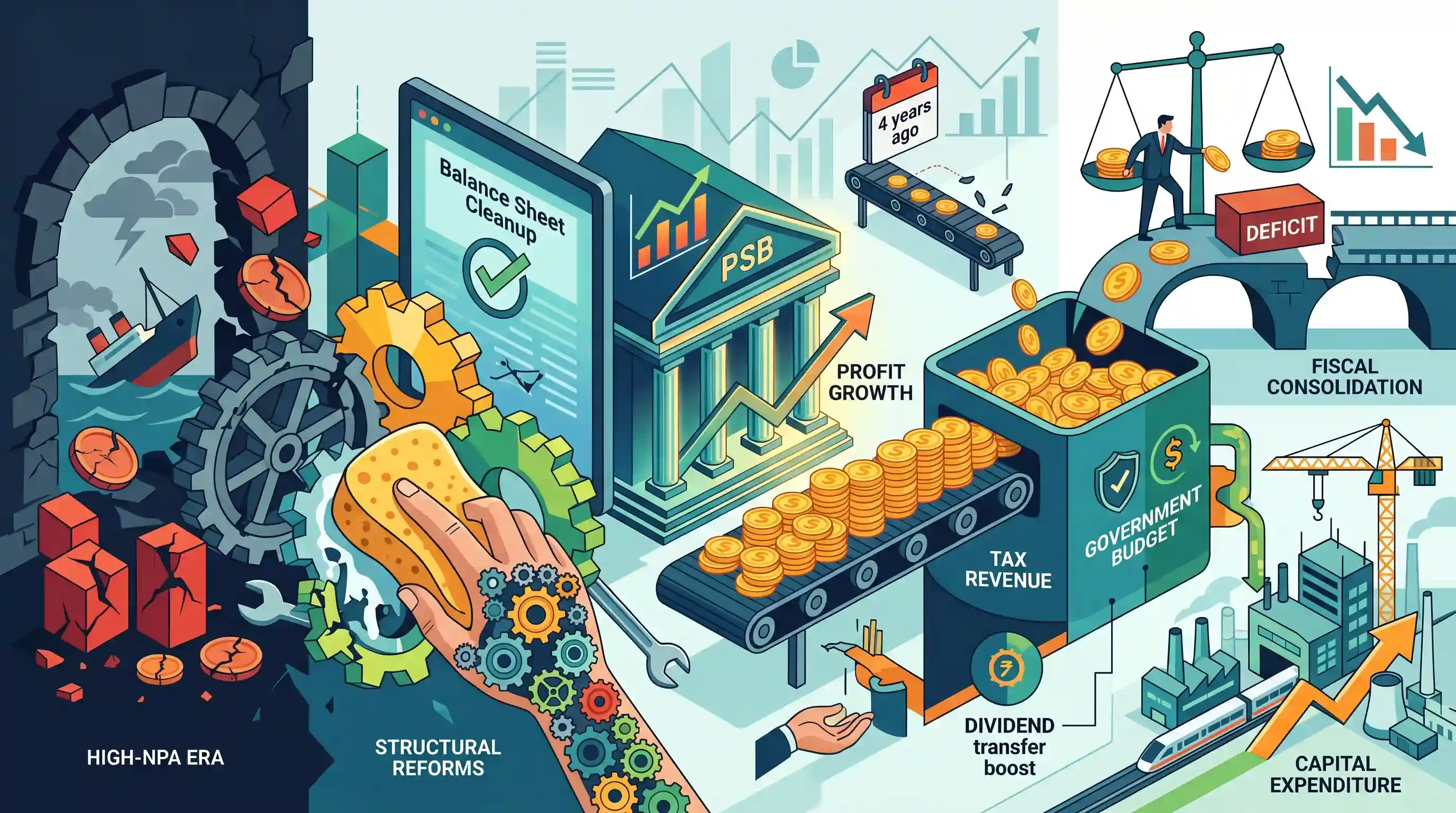
Public Sector Banks (PSBs) are projected to transfer dividends for FY25 that are 166% higher than they were four years ago, driven by robust profit growth. This turnaround from the high-NPA era highlights the success of structural banking reforms and balance sheet cleanups. The increased dividend payouts provide a substantial boost to the government's non-tax revenue, offering a critical financial buffer to support fiscal consolidation without compromising on capital expenditure.
Key Points
- Dividend transfers from Public Sector Banks (PSBs) to the government for FY25 are expected to surge by 166% compared to levels four years ago.
- The surge is driven by a strong turnaround in PSB profitability, reflecting a recovery from the high-NPA (Non-Performing Assets) crisis of the past decade.
- Higher dividend payouts from PSBs and the RBI significantly boost the government's non-tax revenue receipts.
- This additional revenue buffer aids the government in meeting its fiscal deficit consolidation targets while continuing to fund capital and infrastructure expenditures.
- The trend validates the success of multi-year banking sector interventions, including capital infusion, mega-mergers, and resolution of bad loans through the IBC.
Important Terms
Public Sector Banks (PSBs)

Banks where the Government of India or state governments hold a majority stake (at least 51%). They are key instruments for financial inclusion and credit delivery to priority sectors.
UPSC context
GS Paper III (Banking); tests knowledge of structural reforms, financial stability, and the role of state-owned banks in the economy.
Insolvency and Bankruptcy Code (IBC)
The 2016 framework for the time-bound resolution of insolvency and bankruptcy. It aims to maximize asset value and has significantly improved recovery rates for banks' stressed assets.
UPSC context
GS Paper III (Economy); crucial for questions on resolving non-performing assets and improving India's credit culture and ease of doing business.
Non-Tax Revenue
Government income earned from sources other than taxes, such as dividends from Public Sector Undertakings (PSUs), interest receipts, and fees for providing administrative services.
UPSC context
GS Paper III (Budgeting); tests understanding of revenue receipts and the government's ability to manage fiscal deficits via diverse income streams.
Fiscal Consolidation
A policy aimed at reducing the government’s fiscal deficit and public debt-to-GDP ratio. It involves enhancing revenue and rationalizing expenditure to ensure long-term macroeconomic stability.
UPSC context
GS Paper III (Fiscal Policy); essential for analyzing the FRBM Act and the government's path toward financial discipline.
Non-Performing Assets (NPA)
A loan or advance where interest or principal payments remain overdue for 90 days or more. It serves as a primary indicator of a bank's asset quality and financial health.
UPSC context
GS Paper III (Banking); fundamental for discussing financial sector health and the "Twin Balance Sheet" problem in India.
Prelims Trap
"Dividends and profits from PSBs/RBI are classified as Capital Receipts."
Dividends do not reduce the government's asset base or create a liability. They are routine income, making them strictly Non-Tax Revenue Receipts.
Static Concepts Connected
What are the primary components of Non-Tax Revenue for the Union Government?
- Dividends & Profits: Surplus transfers from the RBI, nationalized banks (PSBs), and Central Public Sector Enterprises (CPSEs).
- Interest Receipts: Interest earned on loans given by the Central government to States, UTs, and public enterprises.
- External Grants: Grants-in-aid received from foreign governments and international organizations.
- Fees & Services: Income from telecom spectrum auctions, royalties, passport fees, and judicial fines.
What was the "4R Strategy" to resolve the Twin Balance Sheet crisis?
- Recognition: Transparently identifying bad loans via Asset Quality Reviews instead of "evergreening" them.
- Resolution: Using the Insolvency and Bankruptcy Code (IBC) to recover value from defaulting corporate assets.
- Recapitalization: Injecting government equity into stressed PSBs to help them meet Basel III capital adequacy norms.
- Reforms: Enhancing board-level governance, risk management, and the mega-merger of PSBs for scale.
Cross-Topic Patterns
Non-tax revenue fueling Capex
Higher dividend streams provide a crucial revenue buffer, allowing the government to maintain its fiscal glide path (deficit reduction) while keeping infrastructure capital expenditure (capex) elevated.
IBC and the Credit Cycle Turnaround
The shift from debtor-in-possession to a creditor-in-control regime under IBC fundamentally improved credit discipline, reversing the NPA drag and restarting the private credit cycle.

Expect a multi-statement Prelims question testing the exact components of Non-Tax Revenue Receipts paired with PSB profitability trends.
Linked PYQs · 3
Linked PYQs · 3
- 2018PrelimsGS1
With reference to the governance of public sector banking in India, consider the following statements: 1. Capital infusion into public sector banks by the Government of India has steadily increased in the last decade. 2. To put the public sector banks in order, the merger of associate banks with the parent State Bank of India has been affected. Which of the statements given above is/are correct?
- 2021MainsGS3
Distinguish between Capital Budget and Revenue Budget. Explain the components of both these Budgets.
- 2025PrelimsGS1
Suppose the revenue expenditure is ₹ 80,000 crores and the revenue receipts of the Government are ₹60,000 crores. The Government budget also shows borrowings of ₹ 10,000 crores and interest payments of ₹ 6,000 crores. Which of the following statements are correct? I. Revenue deficit is ₹ 20,000 crores. II. Fiscal deficit is ₹ 10,000 crores. III. Primary deficit is ₹ 4,000 crores. Select the correct answer using the code given below.
