Public Education Reforms and Skill Initiatives in Telangana
Source:The Hindu ↗
Why It Matters
The article provides a robust case study of state-level interventions aimed at revamping public education and human capital formation. It highlights modern policy solutions integrating AI education, digital mentorship, skill development, and NGO partnerships for welfare schemes, which are highly relevant for GS-2 (Education & Social Justice) and GS-3 (Employment & Skill Development).
Summary
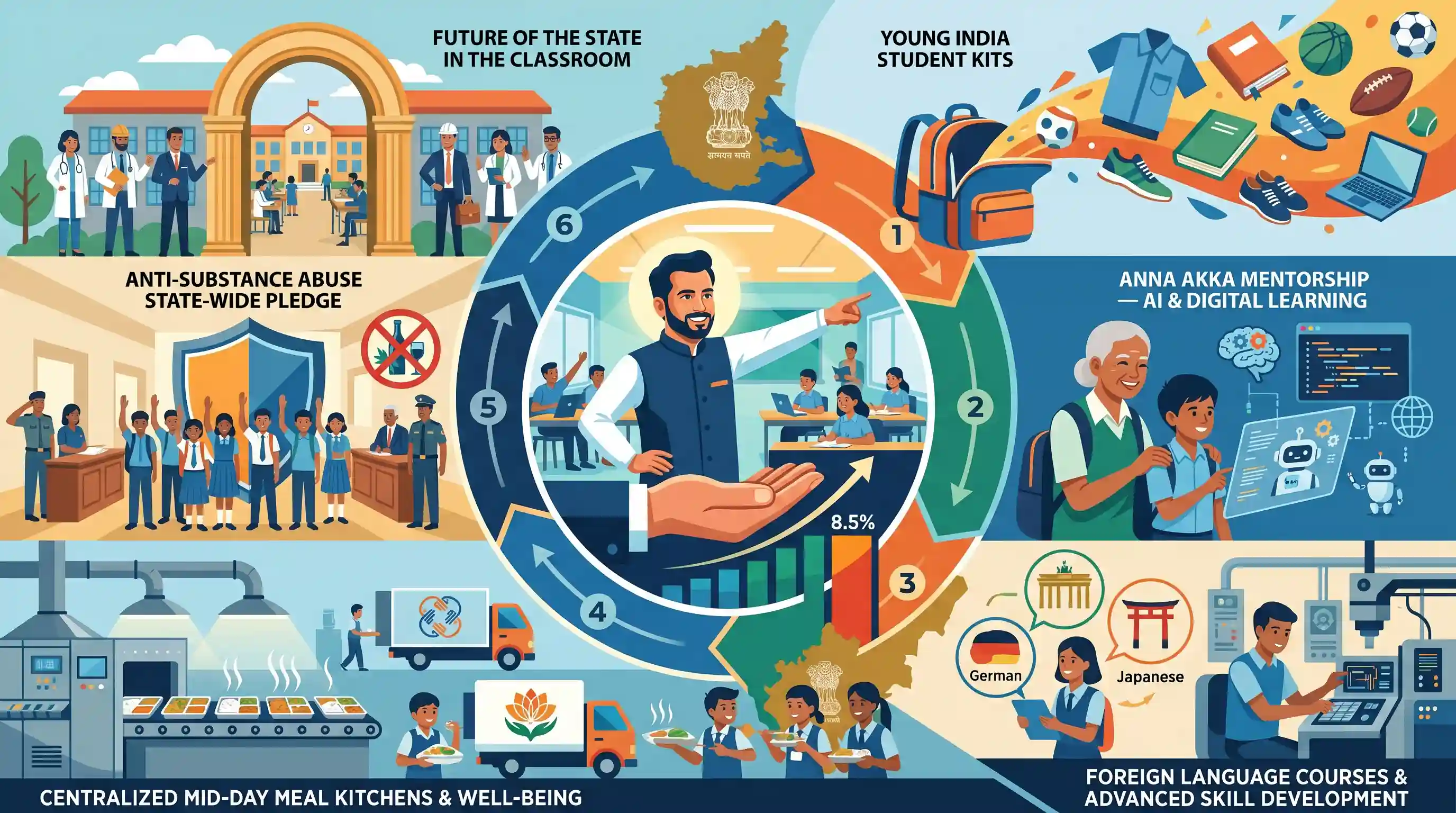
Telangana Chief Minister Revanth Reddy has outlined a transformative vision for the state's public education system, emphasizing that the "Future of Telangana is in the classrooms." The state government has allocated 8.5% of its budget to education, introducing comprehensive reforms and welfare measures for marginalized students. Key initiatives include the distribution of 'Young India Student Kits', the launch of the 'Anna Akka mentorship — AI & digital learning programme' to bolster digital literacy, and the introduction of foreign language courses (such as German and Japanese) for advanced skill development. Furthermore, holistic student well-being is being addressed through centralized mid-day meal kitchens managed in partnership with NGOs like Hare Krishna Charities, and active efforts to combat youth substance abuse through state-wide anti-drug pledges.
Key Points
- The Telangana government has increased its focus on public education, allocating 8.5% of the State budget to the sector to modernize schools and introduce pre-primary education.
- The State launched the 'Young India Student Kits' initiative, providing comprehensive educational materials to public school students, particularly targeting marginalized sections.
- The 'Anna Akka mentorship — AI & digital learning programme' was introduced to enhance digital literacy, bridge the digital divide, and prepare students for technological advancements like Artificial Intelligence.
- Skill development is being prioritized by introducing foreign language courses (like German and Japanese) in schools to improve global employability and turn the state into an education hub.
- Holistic student welfare measures include centralized kitchens for the mid-day meal scheme in partnership with NGOs and the administration of anti-drug pledges to combat substance abuse.
Important Terms
Anna Akka mentorship programme

A flagship peer-mentorship initiative where senior college students (fifth-semester degree/polytechnic) train government school students in Classes 6-10 on AI, digital literacy, and computational thinking.
UPSC context
GS Paper II: Social Justice; tests understanding of digital literacy interventions and innovative educational mentorship models.
Young India Student Kits
A welfare initiative providing essential educational materials; residential students receive kits with 22-24 items (uniforms, bedding, stationery), while day scholars receive basic items like shoes and bags.
UPSC context
GS Paper II: Welfare Schemes; relevant for topics on education access and reducing out-of-pocket expenditure for marginalized sections.
Hare Krishna Charities
A non-profit organization (part of HKM Charitable Foundation) partnering with the Telangana government to provide nutritious, subsidized meals and free breakfast (Swasthya Ahara) through centralized high-tech kitchens.
UPSC context
GS Paper II: Governance; illustrates the role of NGOs and Public-Private Partnerships (PPP) in social service delivery.
Mid-day meal scheme (Telangana)
A nutritional support program in Telangana, recently reformed to include centralized kitchen services and enhanced diet/cosmetic charges to improve food quality for over 7.6 lakh hostel students.
UPSC context
GS Paper II: Issues relating to Hunger and Nutrition; tests knowledge of state-specific improvements in national flagship schemes.
Young India Integrated Residential Schools
A landmark infrastructure project to build high-quality, integrated campuses in every assembly constituency, providing digital classrooms and sports facilities for SC, ST, BC, and minority students.
UPSC context
GS Paper II: Education/Vulnerable Sections; relevant for studying state interventions in social equity through specialized education infrastructure.
Prelims Trap
NEP 2020 mandates states to allocate a minimum of 6% of their State Budget to education.
NEP 2020 recommends allocating 6% of the GDP (combined Centre and State) to education, not 6% of a specific State's or Union's budget.
Static Concepts Connected
How is 'Education' structured under the 7th Schedule of the Constitution?
- Concurrent List: Education was shifted from the State List to the Concurrent List by the 42nd Amendment Act (1976), enabling joint responsibility.
- Union Overrides: Entries 65 and 66 give the Centre power over research institutions and the coordination/determination of standards in higher education.
- State Execution: States handle primary execution, school infrastructure, and state-board curriculum within the broader national framework.
What are the key structural provisions of PM POSHAN (Mid-Day Meal Scheme)?
- Target Beneficiaries: It provides one hot cooked meal to children in classes I-VIII in government and government-aided schools.
- Nutritional Norms: 450 calories/12g protein for Primary, and 700 calories/20g protein for Upper Primary students.
- Decentralized Implementation: The scheme explicitly encourages partnerships with FPOs, Women SHGs, and NGOs for managing centralized kitchens in urban clusters.
Cross-Topic Patterns
AI Skilling and the Demographic Dividend
State programs like 'Anna Akka' AI mentorship complement national SWAYAM initiatives, transitioning India’s demographic bulge from low-skill labor to tech-ready global human capital.
NGOs in Public Service Delivery
Telangana’s centralized kitchen model using NGOs highlights the growing trend of leveraging civil society for scaling targeted welfare schemes like PM-POSHAN.

Mains 2026 may test state-level tech interventions (like AI mentorship or language skilling) in realizing India's demographic dividend.
Linked PYQs · 3
Linked PYQs · 3
- 2023MainsGS2
Skill development programmes have succeeded in increasing human resources supply to various sectors. In the context of the statement analyse the linkages between education, skill and employment.
- 2024MainsGS2
Public charitable trusts have the potential to make India's development more inclusive as they relate to certain vital public issues. Comment.
- 2023MainsGS3
Introduce the concept of Artificial Intelligence (AI). How does Al help clinical diagnosis? Do you perceive any threat to privacy of the individual in the use of Al in healthcare?
