Defence Minister Emphasizes Integration for Future Military Power
Source:The Hindu ↗
Why It Matters
The article outlines India's top-level defense doctrine and reform imperatives—focusing on jointness, theatre commands, and technology integration—which form crucial components of the GS3 Security syllabus.
Summary
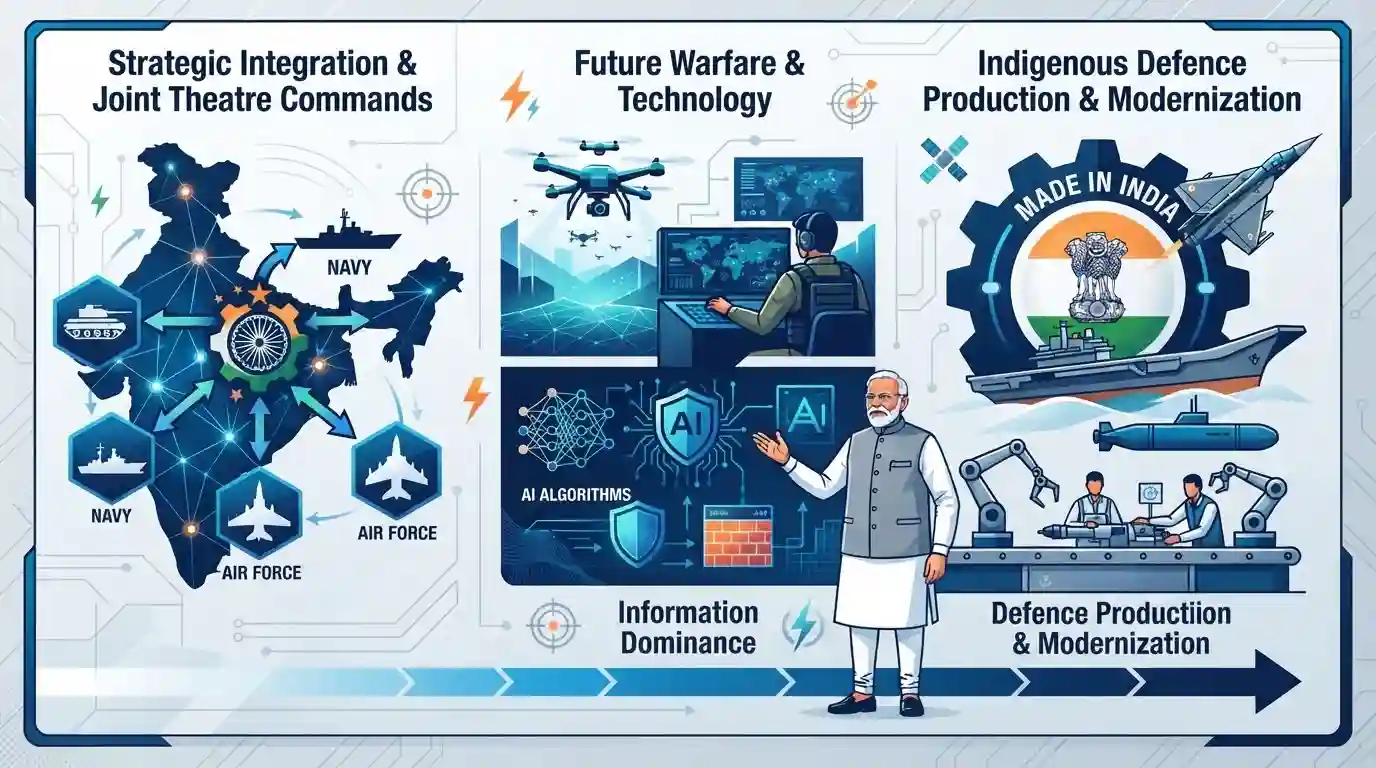
Defence Minister Rajnath Singh emphasized that future military power relies on speed, precision, information dominance, and strategic integration. Highlighting changing global security dynamics and emerging warfare technologies (such as AI, cyber, and drones), he underscored the imperative for India's armed forces to build joint theatre commands, modernize capabilities, and achieve self-reliance in defence manufacturing.
Key Points
- Defence Minister Rajnath Singh stated that future military power will depend on speed, precision, information, and integration.
- Stressed the necessity of military integration, jointness, and theatre commands to face modern hybrid warfare challenges.
- Highlighted that technological advancements like artificial intelligence, cyber capabilities, and autonomous systems are reshaping traditional warfare doctrines.
- Emphasized India's push towards indigenous defence manufacturing (Atmanirbhar Bharat) to ensure strategic autonomy.
Important Terms
Integrated Theatre Commands

A military organization structure where resources of the Army, Navy, and Air Force are unified under a single commander for specific geographical operational zones to ensure synergy and jointness.
UPSC context
UPSC GS Paper III (Security): Essential military reform to enhance tri-service jointness and address modern multi-domain threats.
Defence Indigenisation
India's policy drive toward self-reliance in the defence sector through indigenous manufacturing, positive indigenisation lists, and reduced import dependency.
UPSC context
UPSC GS Paper III (Security & Economy): Evaluates India's pursuit of strategic autonomy, export potential, and domestic manufacturing capacity.
Emerging Warfare Technologies
The integration of artificial intelligence, cyber capabilities, robotics, and advanced drone technology into modern warfare doctrines and force structures.
UPSC context
UPSC GS Paper III (Internal Security / Technology): Tests understanding of disruptive tech transforming traditional combat paradigms and information dominance.
Information Dominance
The capability of armed forces to maintain continuous real-time situational awareness and secure data networks while denying the same to adversaries.
UPSC context
UPSC GS Paper III (Security): Highlights the changing nature of warfare where information superiority is vital for strategic decision-making and precision strikes.
Prelims Trap
The establishment of Integrated Theatre Commands marks the creation of the Department of Military Affairs to manage military discipline.
Aspirants often confuse Integrated Theatre Commands with the Department of Military Affairs; ITCs are operational field commands, whereas the DMA is a policy-making department within the Ministry of Defence headed by the CDS.
Static Concepts Connected
What are the key institutional reforms and mechanisms driving India's defence modernization and jointness?
- CDS & DMA: Created in 2019, the DMA functions under the Ministry of Defence and is headed by the Chief of Defence Staff (CDS).
- iDEX Scheme: Initiatives like iDEX (Innovations for Defence Excellence) foster co-development and co-production by engaging startups and MSMEs in high-tech military applications.
- Indigenisation Lists: Positive Indigenisation Lists impose phased import embargoes on designated military equipment, compelling domestic procurement under DAP guidelines.
Cross-Topic Patterns
Defence Indigenization + International Export Control Regimes
The push for Atmanirbhar Bharat in defence production directly intersects with export controls, dual-use technology regulations, and international technology transfer regimes like the MTCR and Wassenaar Arrangement.
Military Modernization + Critical Information Infrastructure Security
Modern military integration and joint theater commands require robust domestic cryptographic, quantum, and cyber-defense frameworks, linking military modernization with internal security and critical information infrastructure protection.

Expect a multi-statement prelims/mains question on the structural reforms of India's defence (CDS, DMA, ITCs) alongside indigenization tools.
Linked PYQs · 2
Linked PYQs · 2
- 2022MainsGS3
What are the maritime security challenges in India ? Discuss the organisational, technical and procedural initiatives taken to improve the maritime security.
- 2021MainsGS3
Keeping in view India's internal security, analyse the impact of cross-border cyber attacks. Also discuss defensive measures against these sophisticated attacks.
