US President Warns Iran Following Airstrikes on Nuclear Infrastructure
Source:Indian Express ↗
Why It Matters
The direct US military action against Iran's nuclear sites fundamentally alters the security landscape of West Asia. For India, this escalation poses significant challenges regarding energy security, the safety of its diaspora in the region, and its strategic balancing act between the US, Israel, and Iran (including projects like Chabahar Port).
Summary
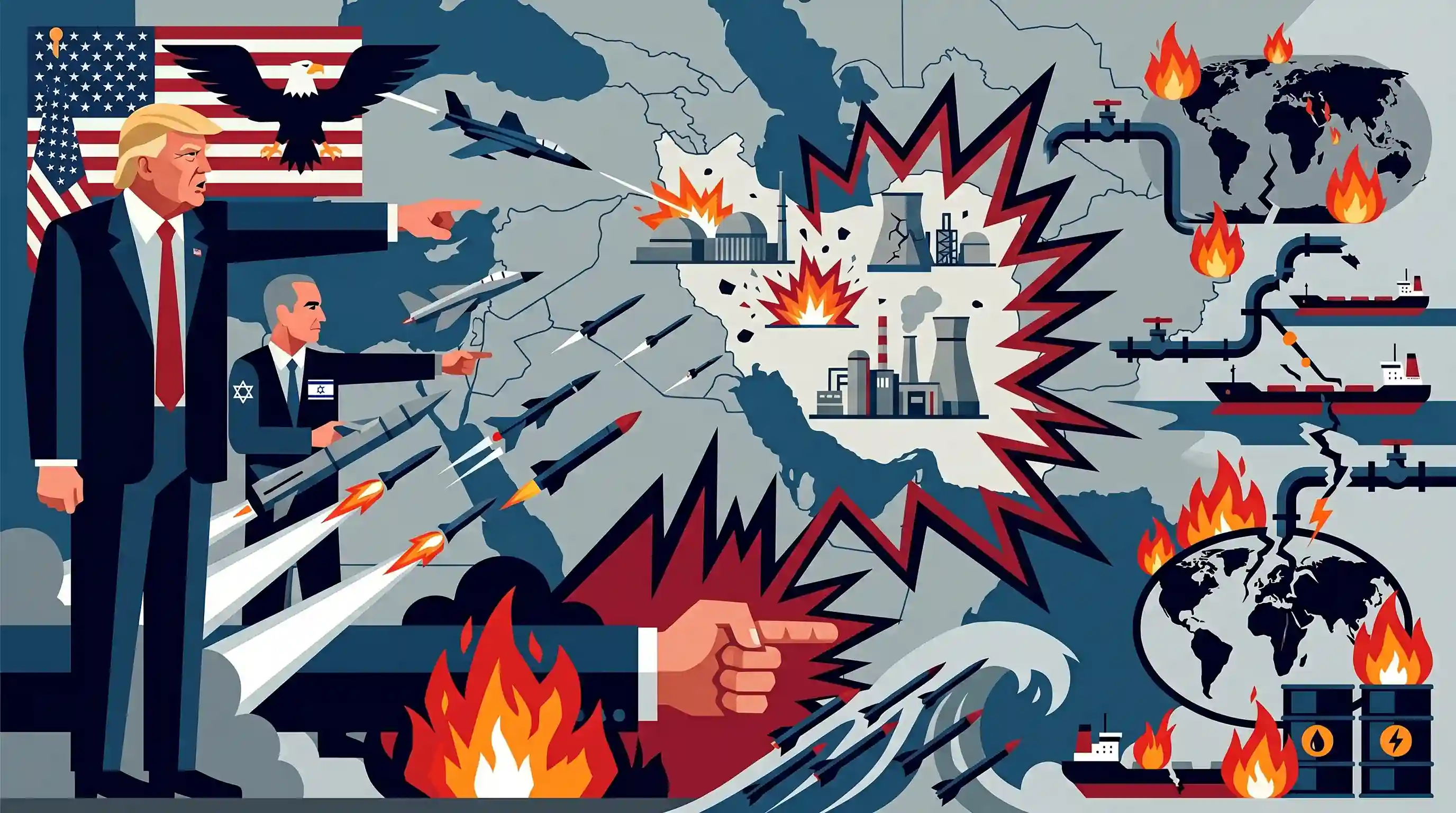
The US carried out extensive military strikes targeting Iran's nuclear facilities, including sites at Fordow, Natanz, and Esfahan, in a major escalation of Middle East tensions. Ordered by President Donald Trump and coordinated with Israel, the operation was designed to severely degrade Iran's nuclear enrichment capacity. Following the strikes, Trump issued a stark warning that any retaliation by Tehran would result in catastrophic further attacks. The development marks a dramatic shift in US-Iran relations, threatening broader regional conflict and posing immediate risks to global energy security.
Key Points
- The US military conducted massive airstrikes on key Iranian nuclear facilities, including Fordow, Natanz, and Esfahan.
- President Donald Trump stated the strikes aimed to dismantle Iran's nuclear enrichment capabilities and declared the operation a major success.
- The operation involved close intelligence and strategic coordination with Israel.
- Trump issued a stern warning that any retaliatory measures by Iran would trigger even greater destruction of its military and government infrastructure.
- The unprecedented escalation significantly alters Middle East geopolitics, raising global concerns over regional conflict and energy security.
Important Terms
Natanz and Fordow

Iran’s primary nuclear facilities. Natanz is the largest uranium enrichment site; Fordow is a smaller, highly fortified facility built deep underground near Qom to protect it from aerial strikes.
UPSC context
GS-II/III. Vital for understanding Middle East security, nuclear proliferation, and international monitoring of dual-use technologies.
Uranium Enrichment
The technical process of increasing the concentration of the fissile isotope Uranium-235. Low enrichment (3-5%) fuels power plants; highly enriched uranium (~90%) is required for nuclear weapons.
UPSC context
GS-III (Science & Tech). Essential for distinguishing between peaceful civilian energy and military weaponization risks.
Joint Comprehensive Plan of Action (JCPOA)
The 2015 landmark agreement between Iran and the P5+1 nations. It restricted Iran's nuclear capabilities and enrichment levels in exchange for relief from international economic sanctions.
UPSC context
GS-II. A crucial case study in diplomacy, multilateralism, and the impacts of unilateral withdrawal (US-2018).
International Atomic Energy Agency (IAEA)
A Vienna-based UN body known as the world’s 'Atoms for Peace' watchdog. It monitors and verifies that nuclear programs remain peaceful through safeguards and inspections.
UPSC context
GS-II. Central to global nuclear governance and India’s civil nuclear cooperation agreements.
Nuclear Non-Proliferation Treaty (NPT)
An international treaty aiming to prevent the spread of nuclear weapons. It recognizes five 'Nuclear-Weapon States' (P5) while other signatories agree to remain non-nuclear and accept inspections.
UPSC context
GS-II. Frequently tested regarding India’s non-signatory status and the treaty's perceived discriminatory nature.
West Asia Geopolitics
The strategic interactions and power dynamics in the Middle East, characterized by energy security concerns, regional rivalries (Iran-Israel), and the intervention of global superpowers.
UPSC context
GS-II. Fundamental for analyzing India’s 'Look West' policy, maritime trade, and energy security.
Prelims Trap
"Chabahar Port is located in the Persian Gulf and would be blocked if the Strait of Hormuz closes."
Chabahar is actually located on the Gulf of Oman, outside the Strait of Hormuz. This specific geography is precisely why India invested in it as a secure bypass route.
Static Concepts Connected
What are the key maritime chokepoints defining West Asian geopolitics?
- Strait of Hormuz: Connects the Persian Gulf to the Gulf of Oman. A highly vulnerable maritime transit route that handles roughly 20% of global oil consumption.
- Bab-el-Mandeb: Connects the Red Sea to the Gulf of Aden. Critical for all maritime shipping accessing the Mediterranean Sea via the Suez Canal.
How does uranium enrichment differentiate civilian power from weapons capability?
- Low-Enriched Uranium (LEU): Typically enriched to 3-5% U-235, sufficient for commercial nuclear power plants. The now-defunct JCPOA capped Iran's enrichment at 3.67%.
- Weapons-Grade Uranium: Requires enrichment to 90% or above. Crucially, the technical leap from 60% enrichment to 90% is much faster than going from natural uranium to 20%.
Cross-Topic Patterns
Oil shocks & RBI monetary policy
A disruption in the Strait of Hormuz spikes crude prices, creating imported inflation. This restricts the RBI's ability to lower repo rates, demonstrating the direct link between West Asian geopolitics and domestic macroeconomic stability.
Strait blockades + INSTC logistics disruption
With the Red Sea already threatened by Houthis, conflict near Iran jeopardizes Chabahar and the INSTC, severely choking India's primary alternative strategic trade corridors to Central Asia and Europe.

Map-based Prelims questions pairing Iranian nuclear sites (Natanz, Fordow) or regional ports (Chabahar) with water bodies are highly likely.
Linked PYQs · 2
Linked PYQs · 2
- 2018MainsGS2
In what ways would the ongoing US-Iran Nuclear Pact Controversy affect the national interest of India? How should India respond to this situation?
- 2025MainsGS2
"Energy security constitutes the dominant kingpin of India's foreign policy, and is linked with India's overarching influence in Middle Eastern countries.” How would you integrate energy security with India's foreign policy trajectories in the coming years?
