Urban Spider Adaptation to Noise Pollution and Biomimicry Potential
Source:The Hindu ↗
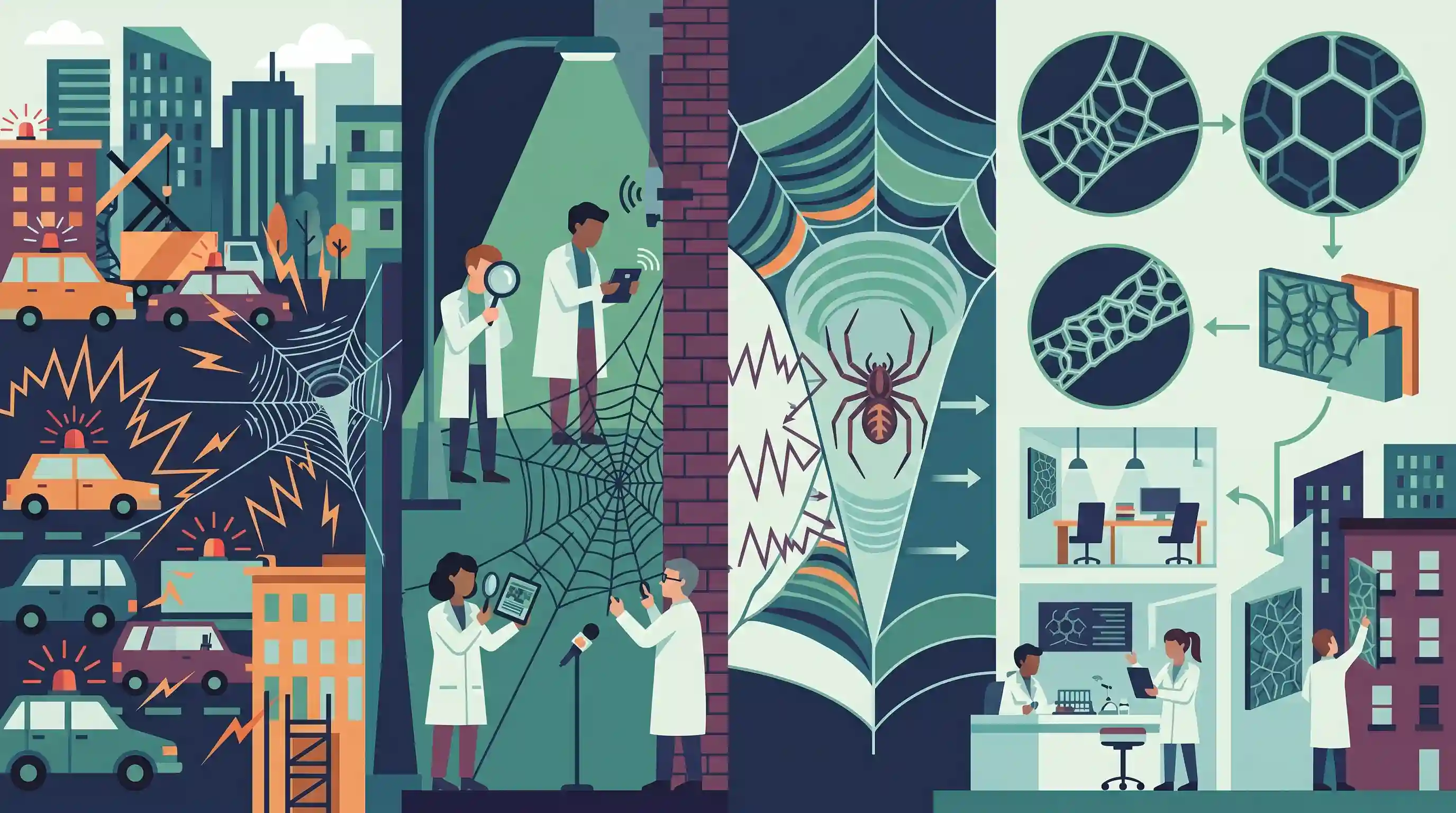
Why It Matters
It provides a compelling example of evolutionary adaptation to urban pollution and highlights the potential of biomimicry in material science for developing noise-cancellation technologies.
Summary
Researchers have discovered that certain urban funnel-weaving spiders have adapted to city noise pollution by constructing soundproof webs. These webs function as natural acoustic filters, mitigating disruptive ambient sounds so the spiders can successfully hunt and communicate. This phenomenon not only underscores the remarkable evolutionary adaptations of species to urban ecologies but also holds significant potential for biomimicry, wherein the unique properties of spider silk could inspire the development of novel acoustic and soundproofing materials.
Key Points
- A newly discovered adaptation among urban funnel-weaving spiders allows them to build soundproof webs.
- The web structure acts as a natural acoustic filter, helping the spiders block out ambient city noise to effectively detect prey and communicate.
- This highlights the evolutionary resilience of wildlife in responding to anthropogenic stressors like urban noise pollution.
- The acoustic properties of these spider webs offer promising avenues in material science and biomimicry for developing advanced soundproofing technologies.
Prelims Trap
Spiders adapted to noise by synthesizing a new type of sound-blocking protein fiber.
The adaptation lies in the structural design and weaving of the web (behavioral adaptation), not a genetic change creating a newly synthesized protein fiber.
Static Concepts Connected
What is Biomimicry and how is it applied in technology?
- Definition: The design and production of materials, structures, and systems modeled on biological entities and processes.
- Key Examples: Velcro (from plant burrs), bullet trains (from kingfisher beaks), and synthetic spider silk (for Kevlar-like strength and now acoustic panels).
How does anthropogenic noise pollution biologically impact wildlife?
- Acoustic Masking: Low-frequency city noise masks bird songs and amphibian mating calls, forcing them to alter pitch or timing.
- Hunting Disruption: Interferes with auditory cues used by predators (like owls) to find prey, or prey using sounds to evade predators.
- Physiological Stress: Chronic noise exposure increases cortisol levels in animals, leading to lowered immunity and reproductive failure.
Cross-Topic Patterns
Biomimicry in Material Science
Spider silk is frequently discussed for its tensile strength; its newly discovered acoustic damping connects biological adaptation directly to the development of advanced metamaterials and urban soundproofing.
Urban micro-evolution & anthropogenic stress
Connects to how species rapidly adapt to city stressors, mirroring phenomena like industrial melanism or urban birds altering their song pitch to overcome low-frequency traffic noise.

Expect a multi-statement question combining biomimicry (spider silk acoustic properties) with anthropogenic noise impacts on urban wildlife.
Linked PYQs · 3
Linked PYQs · 3
- 2022PrelimsGS1
"Biorock technology" is talked about in which one of the following situations?
- 2022PrelimsGS1
Consider the following statements: 1. Biofilms can form on medical implants within human tissues. 2. Biofilms can form on food and food processing surfaces. 3. Biofilms can exhibit antibiotic resistance. Which of the statements given above are correct?
- 2023PrelimsGS1
'Microsatellite DNA' is used in the case of which one of the following?
