Riverside rituals near Sutlej dams spark downstream safety warnings
Source:tribuneindia ↗
Why It Matters
Demonstrates the critical intersection of physical geography (hydrology of Himalayan rivers), infrastructure management, and public safety. It is relevant for questions on disaster mitigation, early warning systems for dam-induced floods, and the socio-environmental impacts of hydroelectric projects in hilly terrain.
Summary
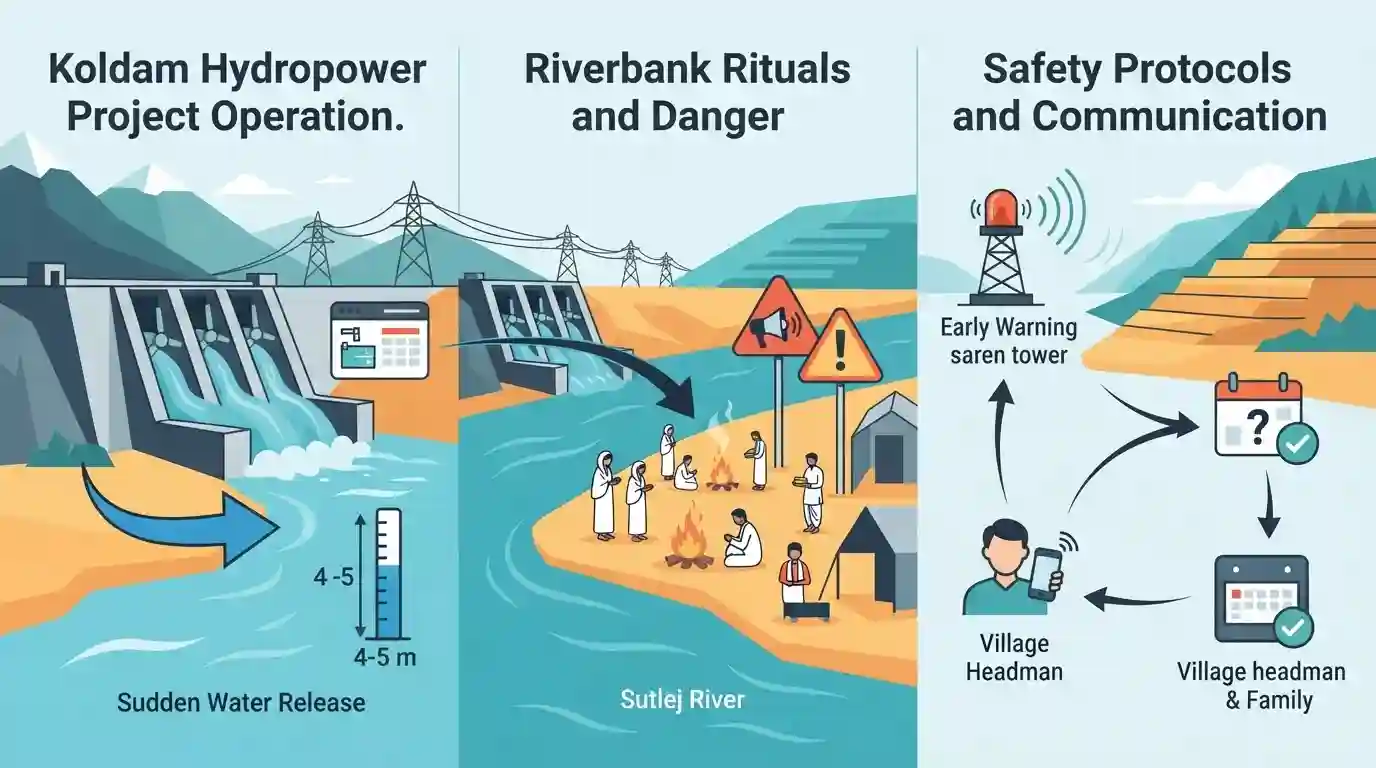
Safety concerns are mounting in Himachal Pradesh's Mandi and Bilaspur districts due to funerals being conducted on the banks of the Sutlej River, downstream of the Koldam Hydropower Project. The sudden release of water from the dam can cause river levels to rise rapidly by up to 4-5 meters, endangering people near the active channel. Authorities have established early warning systems but are urging locals to provide prior notice before holding rituals, allowing for the adjustment of water release schedules and ensuring public safety.
Key Points
- Funerals conducted on the banks of the Sutlej river downstream of the Koldam Hydropower Project in Himachal Pradesh are causing severe public safety concerns.
- Water released from the Koldam dam can cause the river level to surge abruptly by 4-5 meters, converting riverbanks into hazardous zones within minutes.
- Despite early warning mechanisms like alarms and vehicle patrols, incidents of people being exposed to sudden water rises persist due to lack of coordination.
- Authorities urge residents to provide prior notification before conducting riverside rituals, enabling the project management to adjust water release timings and prevent life-threatening accidents.
- The situation underscores the ongoing challenge of balancing essential socio-religious practices with public safety requirements near major riverine infrastructure.
Important Terms
Koldam Hydropower Project

An 800 MW run-of-the-river embankment dam and hydroelectric power station on the Sutlej River in Himachal Pradesh, constructed and managed by NTPC.
UPSC context
Important for GS-1 (Geography) and GS-3 (Infrastructure/Energy) regarding Himalayan run-of-the-river projects and their environmental and safety impacts.
Sutlej River
An antecedent Himalayan river originating in Tibet near Mansarovar. It flows through Himachal Pradesh and Punjab, serving as a critical water resource and hosting major dams.
UPSC context
Crucial for Prelims (Geography: Indian river systems, origins, tributaries) and GS-1 (Water Resources).
Dam Early Warning System (EWS)
A public safety mechanism comprising sensors, sirens, and communication protocols used to detect and alert downstream communities about sudden water releases or potential floods.
UPSC context
Highly relevant for GS-3 (Disaster Management) and tests awareness of the Dam Safety Act 2021 and hazard mitigation strategies.
Prelims Trap
"Sutlej originates in the Indian Himalayas and follows a consequent drainage pattern."
Sutlej actually originates in Tibet (Lake Rakshastal) and is a classic antecedent river, meaning it existed prior to the Himalayan uplift and cut through it.
Static Concepts Connected
What characterizes an antecedent drainage system?
- Pre-existing course: These rivers existed before the upliftment of the Himalayas, maintaining their path by continuously eroding the rising landmass.
- Deep gorges: They form deep V-shaped valleys and gorges, such as the Shipki La gorge carved by the Sutlej river.
- Key examples: The Indus, Sutlej, and Brahmaputra are classic antecedent rivers that originate beyond the Greater Himalayas.
What are the key obligations under the Dam Safety Act, 2021?
- Institutional setup: Establishes the National Dam Safety Authority (NDSA) at the center and State Dam Safety Organisations (SDSO) to regulate safety protocols.
- Mandatory inspections: Requires comprehensive safety inspections of specified dams at least twice a year, specifically pre- and post-monsoon.
- Emergency plans: Mandates the setup of early warning systems, sirens, and Emergency Action Plans to protect downstream populations from sudden discharges.
Cross-Topic Patterns
Himalayan Hydro-risks & GLOFs
Routine dam releases compound the broader vulnerabilities of Himalayan states to Glacial Lake Outburst Floods (GLOFs), heavily testing state disaster early-warning frameworks.
Cultural Practices vs. Infrastructure Safety
The friction between traditional riparian funeral rites and dam operations highlights the administrative hurdle of integrating socio-cultural habits into modern infrastructure safety plans.

Expect a multi-statement Prelims question mapping Himalayan rivers to their transboundary origins, gorges (Shipki La), and major dams.
Linked PYQs · 2
Linked PYQs · 2
- 2020HPAS_PRELIMSGS1
Which of the following pair is not correctly matched?
- 2023HPAS_PRELIMSGS1
Given below are two statements : Statement I : Chandra Tal lake in Lahaul and Spiti district of Himachal Pradesh is about 6000 m above sea level. Statement II : Suraj Tal lake is the source of Spiti river in Himachal Pradesh. In the light of the above statements, choose the most appropriate answer from the options given below :
