India retail inflation trends and producer price index
Source:The Hindu ↗
Why It Matters
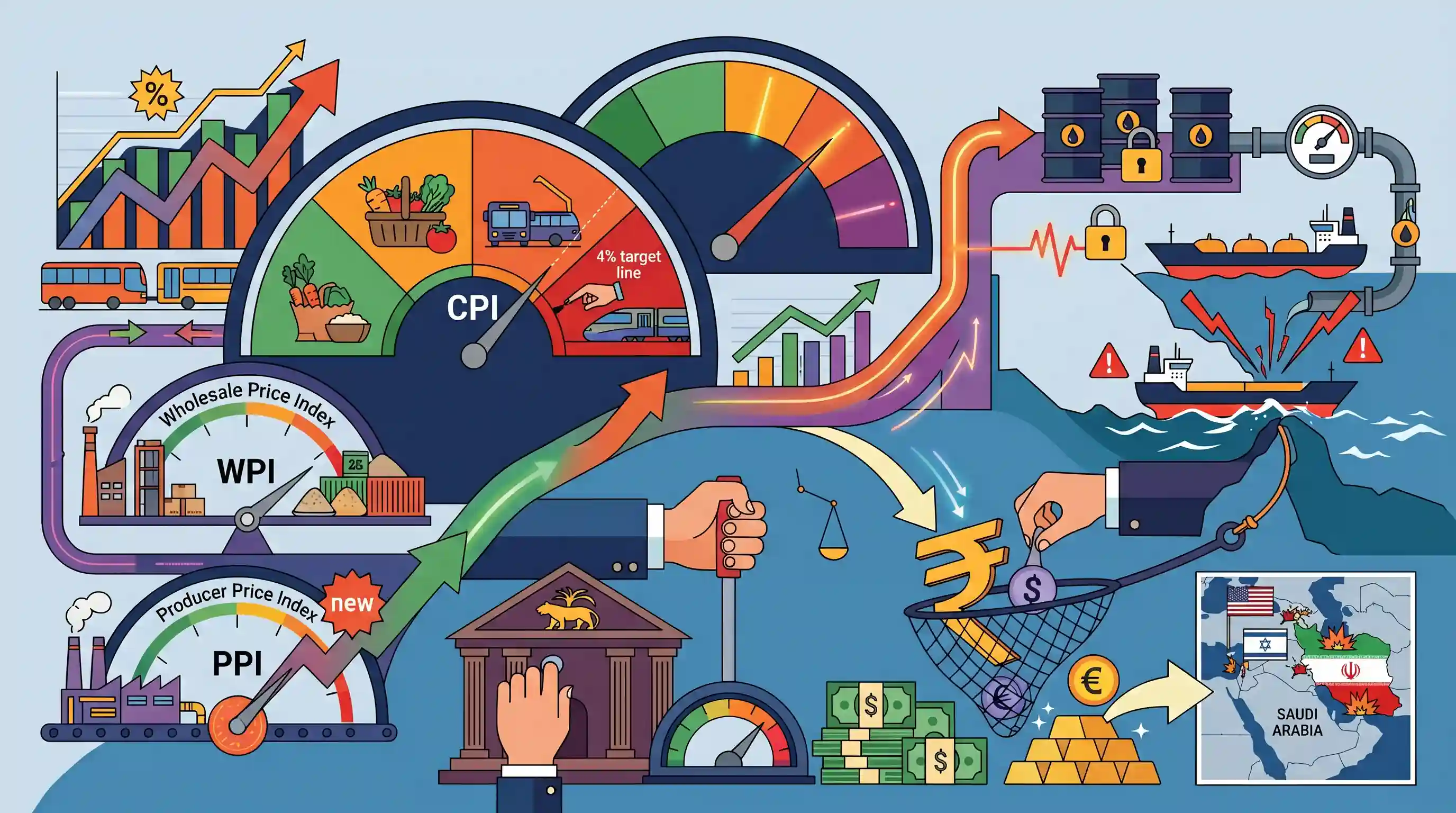
Provides a holistic view of how domestic factors (food prices, fuel hikes) and international geopolitical developments (Middle East conflict, Strait of Hormuz) interconnect to impact India's macroeconomic stability, inflation, and currency valuation. It also highlights the upcoming introduction of a new major economic indicator, the Producer Price Index (PPI).
Summary
The article analyzes India's rising retail inflation in May, which hit 3.93% primarily due to surging food and transport costs. Although overall inflation remains below the RBI's 4% target and core inflation is contained, the RBI has retained a neutral policy stance while intervening in forex markets to stabilize the depreciating rupee amidst the US-Israel-Iran conflict. The forthcoming introduction of India's first Producer Price Index (PPI) and a revised WPI will provide deeper insights into wholesale price pressures. Meanwhile, geopolitical risks regarding transit through the Strait of Hormuz and sticky retail fuel prices suggest that a rapid decline in inflation is unlikely.
Key Points
- India's May retail inflation reached a 15-month high of 3.93%, driven by surging food (4.78%) and fuel costs, despite core inflation remaining contained at 3.8%-3.9%.
- The RBI retained a neutral monetary policy stance as headline inflation remains within its 2-6% tolerance band, but it actively intervened via dollar sales to stabilize the depreciating rupee amid Middle East tensions.
- The impending release of India's first Producer Price Index (PPI) alongside a new WPI series will help reveal the extent to which producers are absorbing price shocks.
- Geopolitical uncertainties surrounding the Strait of Hormuz and sticky retail fuel prices indicate that imported inflation pressures may persist for energy-dependent nations like India.
Important Terms
Producer Price Index (PPI)

Measures price changes from the producer's perspective, tracking what they receive for output before it reaches consumers; unlike WPI, it typically excludes taxes and transport margins.
UPSC context
GS-III: Indian Economy. Relevant for understanding shifts in inflation measurement and its role as a leading indicator for retail inflation.
Consumer Price Index (CPI)
An index tracking retail price changes of a representative basket of goods and services. It serves as the primary inflation targeting anchor (4% +/- 2%) for the RBI.
UPSC context
GS-III: Monetary Policy. Vital for topics on price stability and the RBI’s mandate to control retail inflation.
Strait of Hormuz
A critical maritime chokepoint between Oman and Iran connecting the Persian Gulf to the Gulf of Oman; a primary transit route for nearly 20% of global oil.
UPSC context
GS-II & GS-III: International Relations and Energy Security. Important for analyzing India's energy vulnerability and geopolitical risks in West Asia.
Oil Marketing Companies (OMCs)
Entities (primarily state-owned like IOCL, BPCL, HPCL) responsible for refining and selling petroleum. They often buffer domestic consumers by absorbing global crude price volatility.
UPSC context
GS-III: Infrastructure/Energy. Tests understanding of 'sticky' inflation and the fiscal/economic role of state-run energy enterprises.
Forex Intervention
RBI's active engagement in the currency market—buying or selling USD—to manage the Rupee’s volatility and stabilize its exchange rate against global headwinds.
UPSC context
GS-III: External Sector. Covers central bank tools for managing currency depreciation and ensuring macroeconomic stability.
Wholesale Price Index (WPI)
Measures changes in the price of goods sold and traded in bulk by wholesale businesses. It focuses on manufactured goods and excludes the services sector.
UPSC context
GS-III: Indian Economy. Key for comparing different levels of price pressure (wholesale vs. retail) in the economy.
Prelims Trap
"The RBI officially targets Core CPI to formulate its monetary policy, as it excludes volatile food and fuel prices."
False. Under the amended RBI Act, the Monetary Policy Committee legally targets Headline CPI (4% ± 2%), not Core CPI, even though headline includes volatile food and fuel.
Static Concepts Connected
What are the core differences between WPI, CPI, and PPI?
- Taxes and Margins: PPI measures prices at the factory-gate level before indirect taxes and transport margins are added, unlike WPI.
- Services Inclusion: WPI exclusively covers goods, whereas modern PPI frameworks and CPI include both goods and services.
- Consumer Level: CPI measures retail prices paid by the end consumer, reflecting final inflation impacts including all markups.
How does the RBI's forex intervention affect domestic liquidity?
- Dollar Sales: To defend a depreciating Rupee, the RBI sells US dollars from its reserves, absorbing excess Rupee liquidity from the domestic banking system.
- Sterilization: If domestic liquidity becomes too tight from dollar sales, the RBI may conduct Open Market Operations (buying bonds) to inject Rupees back into the system.
Cross-Topic Patterns
Maritime chokepoints and imported inflation
Disruptions in the Strait of Hormuz directly translate to higher crude prices, highlighting how geopolitical maritime chokepoints dictate India's vulnerability to imported inflation despite domestic macro-stability.
Impossible Trinity constraints in practice
The RBI's simultaneous attempt to manage the exchange rate via dollar sales while maintaining domestic inflation targets reflects classic macroeconomic trilemma management in emerging markets.

Expect a Prelims question comparing the components, services inclusion, and tax treatments of WPI, CPI, and the new Producer Price Index.
Linked PYQs · 2
Linked PYQs · 2
- 2020PrelimsGS1
Consider the following statements: 1. The weightage of food in Consumer Price Index (CPI) is higher than that in Wholesale Price Index (WPI). 2. The WPI does not capture changes in the prices of services, which CPI does. 3. Reserve Bank of India has now adopted WPI as its key measure of inflation and to decide on changing the key policy rates. Which of the statements given above is/are correct?
- 2024MainsGS3
What are the causes of persistent high food inflation in India? Comment on the effectiveness of the monetary policy of the RBI to control this type of inflation.
