Retail inflation dip and wholesale price index divergence in India
Source:The Hindu ↗
Why It Matters
This article is crucial for UPSC aspirants as it bridges core macroeconomic concepts (CPI, WPI, PPI, monetary policy, exchange rate management) with contemporary geopolitical events (Middle East conflicts impacting energy security). It provides a holistic view of how domestic inflation targeting and currency stability are intertwined with global supply chain vulnerabilities, highly relevant for GS Paper 3 (Economy) and GS Paper 2 (International Relations).
Summary
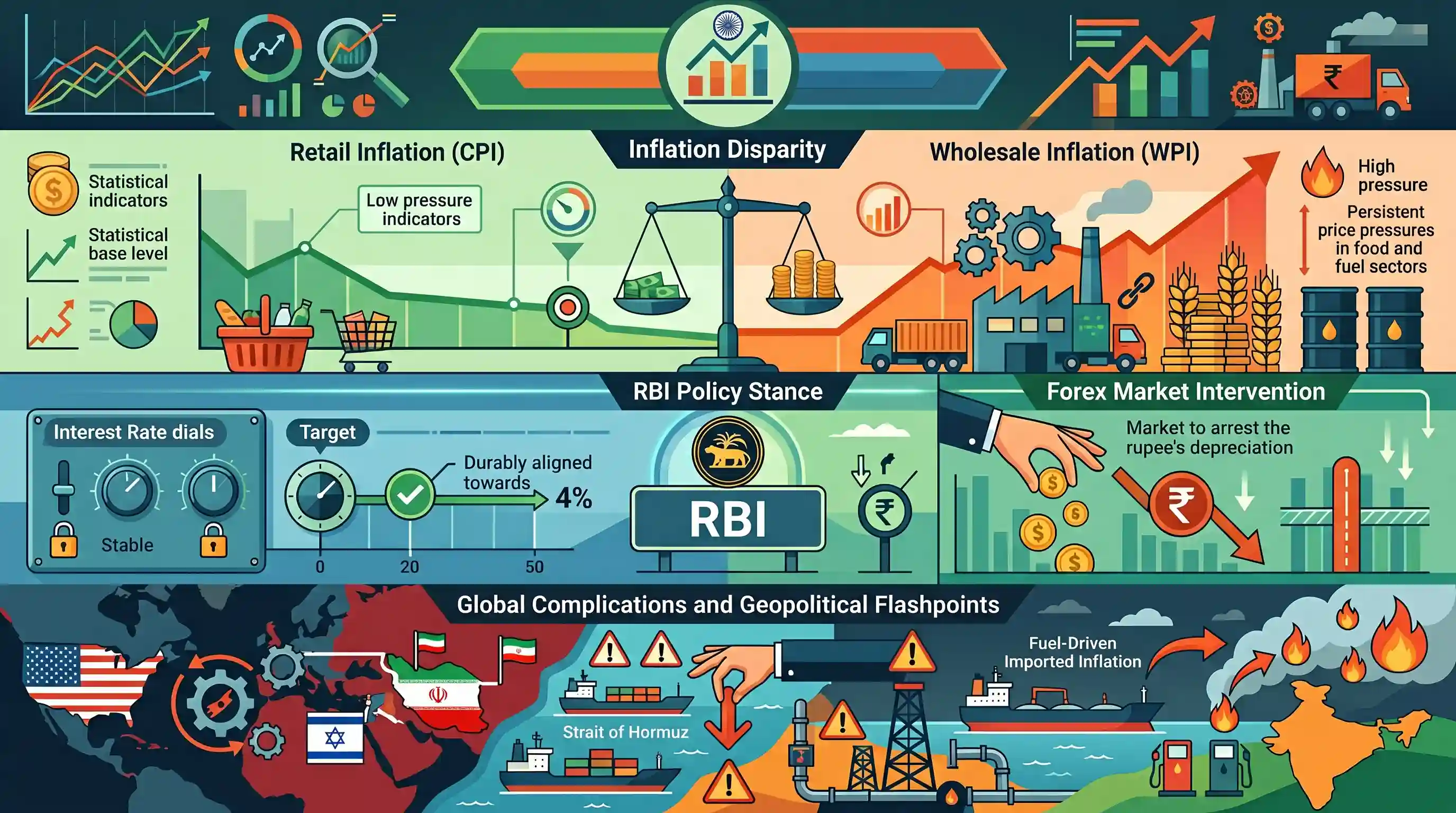
India's macroeconomic landscape presents a mixed picture as retail inflation in May dipped to a series-low of 3.93%, primarily due to statistical base effects, while wholesale inflation (WPI) climbed to a 22-month high of 5.56%. The disparity highlights persistent price pressures, notably in food and fuel segments, alongside the government's push for a new WPI series and a Producer Price Index (PPI) for better tracking. The Reserve Bank of India (RBI) has opted to retain its neutral stance, keeping interest rates steady to ensure inflation aligns durably with its 4% target. Simultaneously, the RBI has actively intervened in the forex market by selling dollars to arrest the rupee's depreciation past ₹95 against the dollar. The situation is further complicated by geopolitical flashpoints involving the US, Israel, and Iran, which heighten the risk of energy supply disruptions through the Strait of Hormuz and threaten to reignite fuel-driven imported inflation.
Key Points
- Retail inflation in May moderated to 3.93%, the lowest in the current Consumer Price Index (CPI) series, largely aided by a high base effect.
- In contrast, the Wholesale Price Index (WPI) surged to a 22-month high of 5.56%, prompting the government to consider a new WPI series and India's first Producer Price Index (PPI).
- Food inflation accelerated to 7.63%, and fuel-driven transport inflation rose sharply, with LPG prices soaring by 17.6%. Core inflation remained stable around 3.8-3.9%.
- The RBI maintained a neutral monetary policy stance and kept the repo rate unchanged, prioritizing the 4% inflation target amidst upside risks.
- The Indian Rupee faced significant depreciation pressure, dropping below ₹95 to the US dollar, leading to RBI interventions via dollar sales to stabilize the currency.
- Geopolitical tensions involving the US, Israel, and Iran threaten to disrupt energy supplies through the Strait of Hormuz, posing a risk of imported inflation via higher global fuel prices.
Important Terms
Consumer Price Index (CPI)

Measures price changes from the consumer's perspective for a basket of goods and services. It is the primary index used by the RBI for inflation targeting in India.
UPSC context
GS-3 Economy; core concept for inflation targeting (4% +/- 2%) and monetary policy transmission.
Wholesale Price Index (WPI)
Measures price changes at the wholesale level before goods reach consumers. Compiled by DPIIT, it currently tracks only goods and is being phased out in favor of the PPI.
UPSC context
GS-3 Economy; useful for supply-side analysis and tracking factory-gate price pressures.
Producer Price Index (PPI)
Measures price changes from the producer’s perspective, covering goods and services. It excludes taxes and transport margins, providing a more accurate gauge for GDP deflation than WPI.
UPSC context
GS-3 Economy; structural overhaul of inflation statistics and international alignment of national accounts.
Base Effect
A mathematical distortion in current inflation figures caused by unusually high or low levels in the previous year’s reference period, which can mislead the interpretation of trends.
UPSC context
GS-3 Economy; fundamental for data interpretation in Prelims and evaluating macroeconomic performance in Mains.
Imported Inflation
Price rises driven by the increased cost of imported commodities (like oil) or domestic currency depreciation, which makes foreign goods more expensive for local industries and consumers.
UPSC context
GS-3 Economy; highlights external sector vulnerabilities, exchange rate management, and cost-push inflation drivers.
Strait of Hormuz
A strategic maritime chokepoint between Iran and Oman connecting the Persian Gulf to the Gulf of Oman. It handles roughly 20% of global oil consumption.
UPSC context
GS-1/2 Geography & IR; critical for India's energy security (40% crude imports) and West Asian stability.
Reserve Bank of India (RBI)
India’s central bank responsible for monetary stability, managing foreign exchange reserves, and regulating the banking system. It uses interest rates to control inflation.
UPSC context
GS-3 Economy; anchor of monetary policy and macroeconomic management.
Prelims Trap
Producer Price Index (PPI) captures the prices of goods inclusive of indirect taxes like GST.
False. PPI measures the basic price received by the producer. It explicitly excludes indirect taxes (which consumers pay) and includes subsidies, unlike WPI or CPI.
Static Concepts Connected
How do CPI, WPI, and the proposed PPI differ fundamentally?
- Consumer Price Index: Measures retail prices paid by consumers, including indirect taxes. It includes services and gives the highest weightage to food articles.
- Wholesale Price Index: Measures bulk wholesale transactions. It entirely excludes services and gives the highest weightage to manufactured products.
- Producer Price Index: Measures average prices received by domestic producers for their output. It covers both goods and services but strictly excludes indirect taxes.
How does the RBI intervene to arrest steep Rupee depreciation?
- Spot Market Sales: The RBI sells US dollars from its forex reserves, which increases dollar supply and absorbs excess Rupee liquidity, thereby stabilizing the exchange rate.
- Forward Interventions: RBI enters forward contracts to buy/sell dollars at a future date, managing market expectations without immediately depleting spot reserves.
- Interest Rate Anchor: By holding or raising the repo rate, the RBI prevents capital flight by maintaining an attractive interest rate differential with developed economies.
Cross-Topic Patterns
Chokepoints & Imported Inflation
Disruptions in the Strait of Hormuz directly trigger 'imported inflation' via soaring energy prices, simultaneously widening India's Current Account Deficit and stressing forex reserves.
Trilemma in Macroeconomic Management
RBI’s dual battle—keeping rates neutral for domestic inflation while selling dollars to defend the Rupee—is a classic real-world test of the Mundell-Fleming 'Impossible Trinity'.

Expect a 2026 paired-statement question contrasting the proposed Producer Price Index (PPI) methodology against CPI/WPI compositions.
Linked PYQs · 5
Linked PYQs · 5
- 2020PrelimsGS1
Consider the following statements: 1. The weightage of food in Consumer Price Index (CPI) is higher than that in Wholesale Price Index (WPI). 2. The WPI does not capture changes in the prices of services, which CPI does. 3. Reserve Bank of India has now adopted WPI as its key measure of inflation and to decide on changing the key policy rates. Which of the statements given above is/are correct?
- 2010PrelimsGS1
With reference to India, consider the following statements : 1. The Wholesale Price Index (WPI) in India is available on a monthly basis only. 2. As compared to Consumer Price Index for Industrial Workers (CPI(IW)), the WPI gives less weight to food articles. Which of the statements given above is/are correct ?
- 2022PrelimsGS1
With reference to the Indian economy, consider the following statements: 1. If the inflation is too high, Reserve Bank of India (RBI) is likely to buy government securities. 2. If the rupee is rapidly depreciating, RBI is likely to sell dollars in the market. 3. If interest rates in the USA or European Union were to fall, that is likely to induce RBI to buy dollars. Which of the statements given above are correct?
- 2019PrelimsGS1
Which one of the following is not the most likely measure the Government/RBI takes to stop the slide of Indian rupee?
- 2025MainsGS3
Why is maritime security vital to protect India's sea trade? Discuss maritime and coastal security challenges and the way forward.
