Stands At Rudraprayag Gurdwara Ends Peacefully After Official Talks
Source:babushahi ↗
Why It Matters
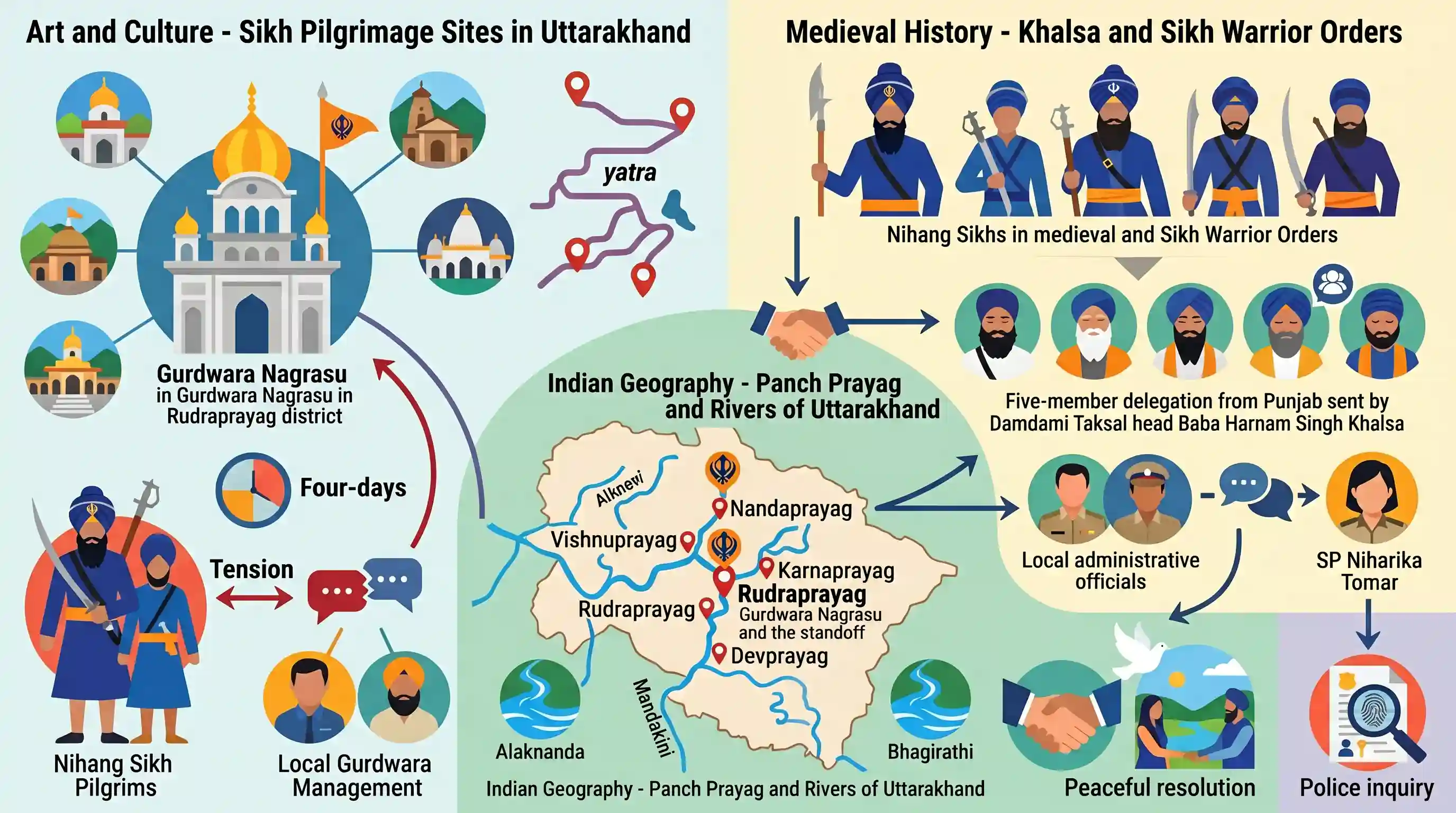
The event brings together multiple high-yield UKPSC Prelims themes, including the geographical significance of Rudraprayag (one of the Panch Prayag), religious tourism corridors (such as Hemkund Sahib), and historical questions regarding Sikh warrior institutions like the Nihangs and the Khalsa.
Summary
A tense four-day standoff at Gurdwara Nagrasu in Rudraprayag district, Uttarakhand, ended peacefully on June 23, 2026, after successful mediation between visiting Nihang Sikh pilgrims, local gurdwara management, and administrative officials. The breakthrough was achieved with the help of a five-member delegation from Punjab sent by Damdami Taksal head Baba Harnam Singh Khalsa. Local authorities, led by Rudraprayag SP Niharika Tomar, facilitated continuous dialogue to prevent escalation, and a detailed police inquiry has been initiated to investigate the underlying dispute.
Key Points
- A four-day-long standoff at Gurdwara Nagrasu in Rudraprayag district, Uttarakhand, ended peacefully on June 23, 2026, after multiple rounds of talks.
- The dispute began on June 20, 2026, involving visiting Nihang Sikh pilgrims and the local gurdwara management committee, with some pilgrims occupying the upper floors and rooftop.
- A five-member mediating delegation sent from Punjab by Baba Harnam Singh Khalsa (head of the Damdami Taksal) successfully brokered peace, allowing the pilgrims to return to Punjab without any arrests or confrontation.
- The Rudraprayag administration and police, led by Superintendent of Police Niharika Tomar, maintained security and facilitated the dialogue. A formal inquiry has been initiated to ascertain the cause of the dispute.
- Gurdwara Nagrasu is a key transit and religious hub in Rudraprayag district on the route towards the highly revered Sri Hemkund Sahib in Chamoli.
- Nihang Sikhs are a traditional warrior order within Sikhism tracing their origins to the founding of the Khalsa by Guru Gobind Singh in 1699.
- Rudraprayag is highly significant in Uttarakhand's geography as one of the Panch Prayag, marking the confluence of the Alaknanda and Mandakini rivers.
Important Terms
Damdami Taksal

An orthodox Sikh seminary and educational institution founded in 1706 by Guru Gobind Singh. It is dedicated to teaching the correct recitation, pronunciation, and interpretation of the Sri Guru Granth Sahib and other scriptures.
UPSC context
GS Paper I (History/Culture) and GS Paper III (Security); tests major historical and contemporary religious organizations in India.
Nihang Sikhs
A traditional, armed Sikh warrior order characterized by cobalt-blue robes, high turbans with steel quoits, and weapons. They follow a strict Khalsa code and historically defended the Sikh community from invaders.
UPSC context
GS Paper I (Art and Culture/History); tests knowledge of medieval military sects, Sikh history, and regional cultural traditions.
Gurdwara Nagrasu Management Committee
The local administrative body responsible for the daily operations, shelter, and community kitchen (langar) of Gurdwara Nagrasu, a vital transit shrine in Rudraprayag, Uttarakhand, on the Hemkund Sahib pilgrimage route.
UPSC context
GS Paper I (Art and Culture/Geography); tests awareness of pilgrimage administration and local cultural infrastructure.
Panch Prayag
The five sacred river confluences in Uttarakhand’s Garhwal region—Vishnuprayag, Nandaprayag, Karnaprayag, Rudraprayag, and Devprayag—where tributaries join the Alaknanda River, highly revered in Indian physical and cultural geography.
UPSC context
GS Paper I (Indian Geography); tests understanding of Himalayan river systems, drainage networks, and regional topography.
Prelims Trap
Gurudwara Hemkund Sahib is located at one of the five sacred Prayags and is dedicated to the travels of Guru Nanak.
Hemkund Sahib is situated next to a high-altitude glacial lake in Chamoli (not at a river confluence) and is associated with Guru Gobind Singh's meditation, not Guru Nanak.
Static Concepts Connected
What are the five river confluences of the Panch Prayag in sequential downstream order?
- Vishnuprayag: Alaknanda meets the Dhauliganga River at Vishnuprayag, the first of the five confluences.
- Nandaprayag: Alaknanda meets the Nandakini River at Nandaprayag.
- Karnaprayag: Alaknanda meets the Pindar River (originating from Pindari Glacier) at Karnaprayag.
- Rudraprayag & Devprayag: Alaknanda meets the Mandakini River (originating near Kedarnath) at Rudraprayag, and finally meets the Bhagirathi at Devprayag to form the Ganga.
What are the historical origins and characteristics of the Nihang Sikh order?
- Origin: An elite warrior order traced back to the creation of the Khalsa Panth by Guru Gobind Singh in 1699.
- Distinctive Attire: Known for wearing electric blue robes (chola) and high conical turbans (dumalla) decorated with steel quoits (chakrams).
- Military Role: Historically functioned as the armed vanguard (Akalis) to defend the Sikh community during religious conflicts in the 18th century.
Cross-Topic Patterns
Himalayan Ecology vs. Sacred Tourism
The carrying capacity of fragile high-altitude pilgrimage sites like Hemkund Sahib intersects with physical geography hazards and disaster-resilient infrastructure planning in Uttarakhand.
Sikh Liturgical Texts and Geography
Texts like the Bachitra Natak link physical landforms to spiritual lineages, establishing historical Sikh heritage corridors far outside the traditional geography of Punjab.

Panch Prayag river confluences matched with high-altitude Himalayan shrines likely to appear as a physical-geography matching question.
Linked PYQs · 2
Linked PYQs · 2
- 2007UKPSC_PRELIMSGS1
Name the river which flows between Kedarnath | Rudra Prayag?
- 2016UKPSC_PRELIMSGS1
Under which Sikh Guru the Sikhs were transformed into the 'Khalsa'?
