Fujiyama Power Sets Up 2 GW Power Electronics Plant in Ratlam
Source:energetica-india ↗
Why It Matters
The commissioning of this large-scale solar electronics facility highlights Madhya Pradesh's growing role in India's renewable energy supply chain. It is directly relevant for MPPSC Prelims questions focusing on industrial locations, renewable energy projects (like Rewa and Omkareshwar), and state-level economic development.
Summary
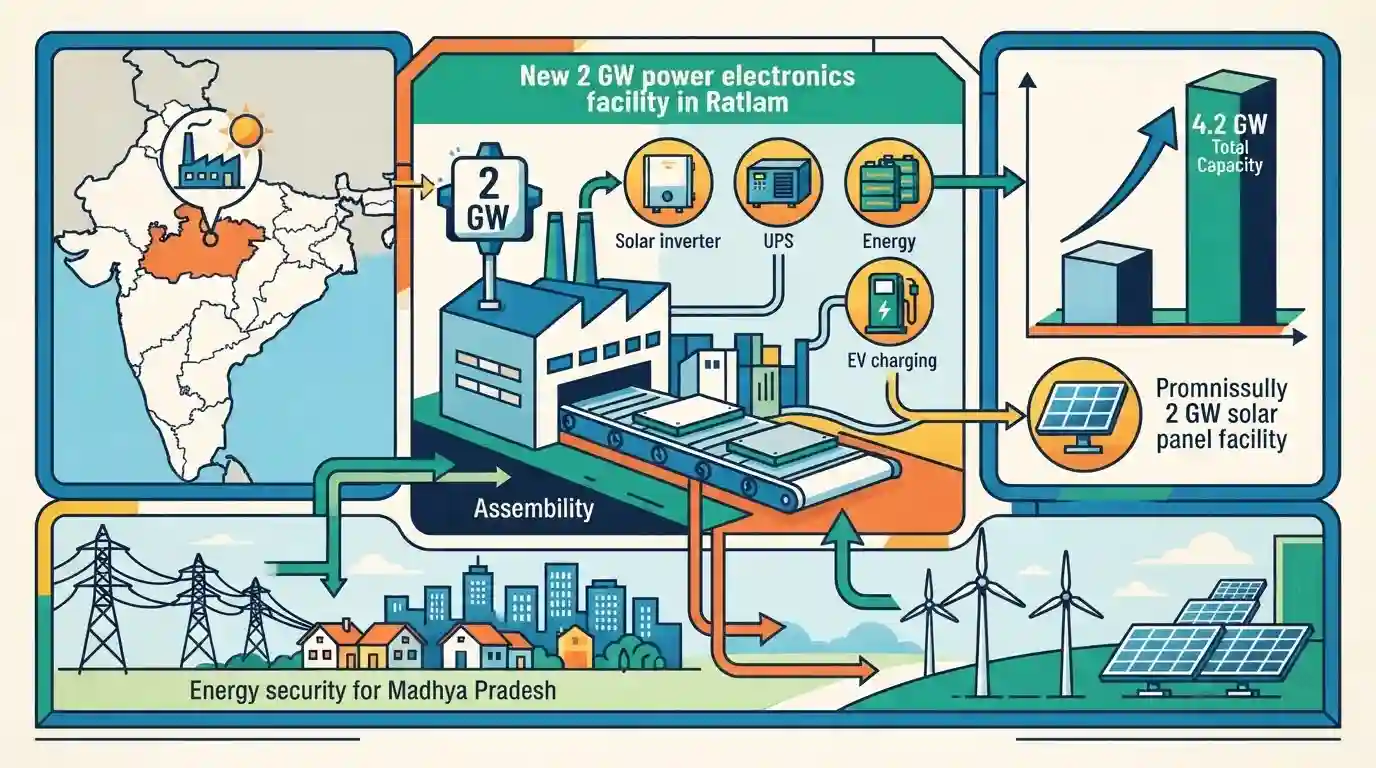
Fujiyama Power Systems has commissioned a 2 GW power electronics manufacturing facility in Ratlam, Madhya Pradesh, increasing its total power electronics manufacturing capacity to 4.2 GW. Following a 2 GW solar panel manufacturing facility commissioned earlier, the new plant will produce solar inverters, UPS systems, energy storage solutions, and EV chargers, supporting India's renewable energy sector and contributing to the industrial growth of Madhya Pradesh.
Key Points
- Fujiyama Power Systems has commissioned a 2 GW power electronics manufacturing facility in Ratlam, Madhya Pradesh.
- The facility increases the company's total power electronics manufacturing capacity to 4.2 GW.
- The plant will manufacture solar inverters, UPS systems, energy storage solutions, EV chargers, and solar pump controllers.
- The development aligns with India's push for self-reliance in renewable energy and boosts industrial development in Madhya Pradesh.
Important Terms
Atmanirbhar Bharat

A national initiative to make India a self-reliant global manufacturing hub. In the renewable sector, it focuses on reducing import dependency for solar components and boosting domestic production to ensure energy security.
UPSC context
GS Paper 3 (Indian Economy). Tests understanding of domestic manufacturing policies, supply chain resilience, and energy security.
Energy Storage Solutions
Technologies like lithium-ion batteries or pumped hydro that store excess renewable electricity during high generation and release it during peak demand, converting intermittent green energy into reliable power.
UPSC context
GS Paper 3 (Energy). Critical for grid stability and integrating intermittent renewables to meet India's climate targets.
Power Electronics
An interdisciplinary engineering field using solid-state semiconductor devices to convert, control, and condition electric power. It is foundational for manufacturing solar inverters, battery storage converters, and EV chargers.
UPSC context
GS Paper 3 (Science & Technology). Highlights technological self-reliance required for grid modernization and the renewable energy transition.
Fujiyama Power Systems
An Indian domestic renewable energy company that manufactures solar panels, inverters, and battery storage. Its recent multi-gigawatt facilities in Madhya Pradesh strengthen India's integrated rooftop solar value chain.
UPSC context
GS Paper 3 (Infrastructure/Industrial Growth). A case study of private sector expansion advancing domestic content requirements in renewables.
Prelims Trap
PM-KUSUM restricts standalone solar pumps strictly to irrigation, prohibiting the use of excess power for other activities.
False. Universal Solar Pump Controllers (USPCs) under PM-KUSUM allow farmers to utilize excess solar power to run secondary agricultural equipment like cold storage.
Static Concepts Connected
What are the three core components of the PM-KUSUM scheme?
- Component A: Setting up 10,000 MW of decentralized ground-mounted, grid-connected renewable power plants by farmers or cooperatives.
- Component B: Installation of standalone solar-powered agriculture pumps, reducing reliance on diesel generators for off-grid farmers.
- Component C: Solarization of existing grid-connected agriculture pumps, allowing farmers to sell surplus solar power back to DISCOMs.
Why are Battery Energy Storage Systems (BESS) critical for national grid integration?
- Tackling Intermittency: Solves solar and wind variability by storing excess daytime energy for dispatch during peak evening demand hours.
- Grid Stability: Provides crucial frequency regulation and active voltage support to prevent national grid collapses.
- Reducing Curtailment: Reduces the forced curtailment (shutting down) of renewable energy generation when grid demand is unexpectedly low.
Cross-Topic Patterns
DMIC nodes driving green manufacturing
Ratlam's position on the Delhi-Mumbai Industrial Corridor (DMIC) highlights a trend where traditional transport and logistics nodes are intentionally being developed into localized green energy and power electronics manufacturing hubs.
PM-KUSUM & secondary agri-processing
Domestic manufacturing of solar pump controllers directly enables PM-KUSUM's provision to use standalone solar power for non-irrigation tasks (like cold storage), bridging renewable energy with agricultural value addition.

Expect a multi-statement question in 2026 linking PM-KUSUM's Universal Solar Pump Controllers with India's Battery Energy Storage mandates.
Linked PYQs · 2
Linked PYQs · 2
- 2020MPPSC_PRELIMSGS1
750 Megawatt (MW) Solar Power Plant is situated in which district of Madhya Pradesh?
- 2021MPPSC_PRELIMSGS1
In which region of Madhya Pradesh Solar Floating Project of 600 MW capacity is proposed?
